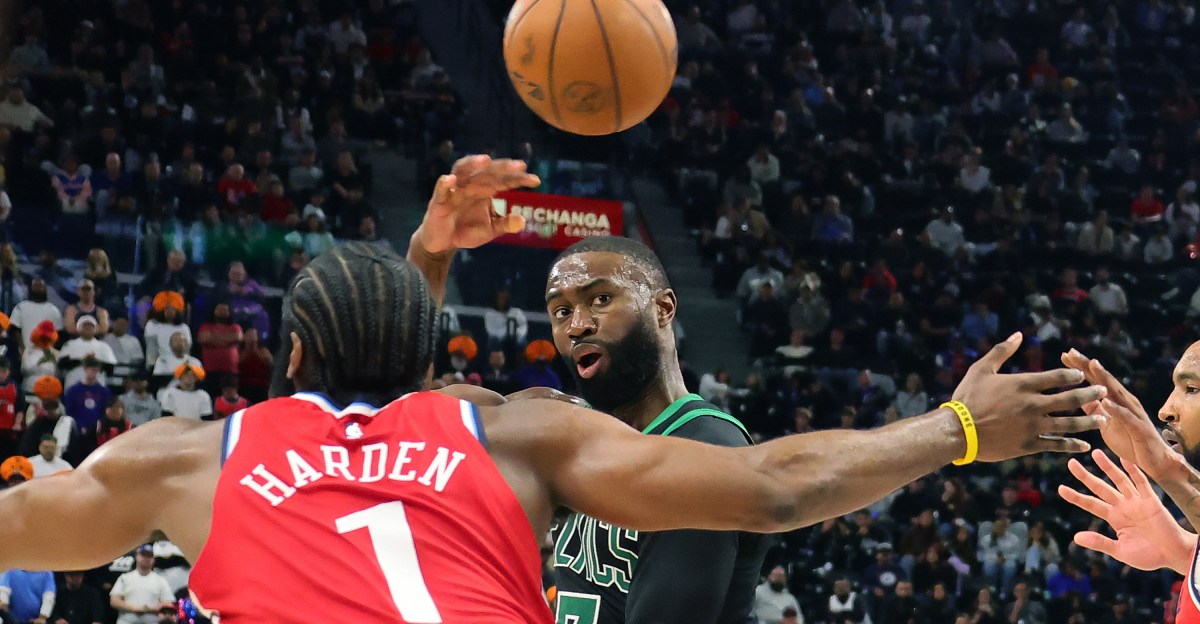
#1 – Boston took over the isolation battle
A few nights ago, we had a battle between the Jazz’s ball movement and the Celtics’ more stagnant approach — which was won by Joe Mazzulla’s team, taking revenge after a last-second loss in Boston earlier this season. But last night was different — it was a battle between two teams that rely heavily on isolation, and Boston took over.
Boston was able to create far better isolation opportunities thanks to their spacing and matchup hunting. Defensively, they made sure not to give up the matchup or the space that Kawhi wanted, while generating the most optimized opportunities on the other end.
Isolation goes beyond one-on-one. In the modern NBA, even isolation isn’t about individual matchups or old-school duels. It’s about generating the best shot possible for your most prolific scorer through spacing and matchup advantages. How did the Celtics do it on both ends? Let’s find out.
Joe Mazzulla went to one of his favorite tricks last night and mixed the matchups again. As often with this approach, the goal is to use teams’ offensive weaknesses to protect the paint as much as possible.
To start the game, the Celtics had Derrick White matched up with Brook Lopez. As the former Buck isn’t much of a post-up threat anymore, White could comfortably defend him on the perimeter. Plus, with Lopez often acting as the screener for Kawhi Leonard, this alignment gives the Celtics the option to switch or double using White.
Meanwhile, Neemias Queta roamed near the rim. The Celtics treated John Collins as a non-shooting threat — a classic move from Joe Mazzulla’s coaching staff.

On the first play of the game, Lopez, as expected, set a screen for Kawhi. Both White and Brown applied pressure on the ball, briefly leaving Lopez open. Pritchard switched onto him and left Kris Dunn open, as he is another non-shooting threat. That gave White enough time to recover, and the defense was set again.

While it initially looked like a defensive mind game designed to take away the paint, this game plan had another objective: putting an end to Kawhi’s MVP-level stretch.
#3 – Limiting Kawhi’s usage
During the Los Angeles Clippers’ winning streak, Leonard’s scoring impact was the foundation of their offense. Over the six games they won, he scored at least 30 points in five of them. The Celtics knew they had to reduce his scoring and did so collectively, helping Jaylen Brown fulfill his desire to lock him down.
By sending multiple defenders at him instead of respecting every shooting threat, Joe Mazzulla’s staff forced the Clippers’ supporting cast to take more shots than usual. By pushing the Clippers into an offensive style they didn’t want to play, the Celtics succeeded in taking away Kawhi’s recent MVP-level impact.
Per Cleaning the Glass, Kawhi’s usage rate was up to 36.5% during the winning streak. It dropped to 31% last night against the Celtics with a great collective effort, led by JB and put in place by the coaching staff.
#4 – Empty-side choreography
The Celtics’ first play calls to start games are always a joy to dissect — they often give you a hint of what they’ll be trying to accomplish all night. They opened the game in LA with an empty-side action, another classic from Joe Mazzulla’s playbook. But before the how, let’s focus on the why.
The goal of this play is to involve James Harden on defense — more specifically, his off-ball defense. Like other offensive stars, Harden can lose focus on that end. Here, after the switch onto Jaylen Brown, a miscommunication with John Collins leaves White wide open.
A few possessions later, the Celtics ran the same play, but this time Harden was hiding on the weak side. Even then, White drove the ball and Harden was hunted again. Sam Hauser, now defended by the former MVP, used Queta’s screen to relocate to the corner and lose his matchup. White anticipated it, swung the ball, and six points were generated purely from Harden’s off-ball defense.
While isolation might grab the headlines when talking about Jaylen Brown’s night, this play showed how well the Celtics’ coaching staff knows how to get him going early.
White handled the ball while the Celtics set two screens: one by Queta to involve Lopez and his drop coverage, and one by Pritchard to add confusion.
Because of the pressure on the ball, Kawhi helped from the weak side, leaving JB open for three. It was a trap — and the Clippers fell right into it.
#6 – Spain to beat the drop
Against drop coverage from Lopez or Ivica Zubac, there was little doubt the Celtics would lean into Spain pick-and-roll actions. These are designed to punish big men who stay low by placing a shooter behind them.
On this play, notice how Hauser subtly nudges Lopez to force a switch onto Jaylen Brown. That small screen completely breaks the Clippers’ defensive structure, leaving no one to tag the roll man, Neemias Queta, who finishes at the rim with space.
With multiple screens, the Celtics forced the Clippers’ centers to commit and vacate the paint. On the next action, they reversed the order. After staggered screens freed White, Pritchard — instead of Queta — set the on-ball screen, then ran off Queta’s screen himself.
Pritchard received the ball with a step on Kris Dunn, forcing Zubac to help — and the deal was sealed. The center was pulled out of the paint, and Queta finished at the rim.
Hard not to be romantic about Celtics basketball.
#7 – Points off turnovers differential
The turnover economy is a major factor in the NBA. Last year’s playoffs showed how teams that protect the ball — like the Pacers — or generate transition from live-ball turnovers — like the Thunder — gain a significant edge. Owen Phillips highlighted this during last postseason:
“One of the dominant themes in this year’s playoffs from my perspective has been the impact of turnovers on the outcomes of games. In this year’s postseason, teams are 46-20 when they have fewer turnovers than their opponent. That’s a 70 percent win rate — up from 58 percent in the regular season and 56 percent in last year’s postseason.”
Last night, the Celtics dominated both sides of that equation. They committed fewer turnovers than LA (six vs. nine), but more importantly, they capitalized on them. Per NBA.com, Boston scored 20 points off the Clippers’ nine turnovers — 16 more than LA generated from Boston’s mistakes.
That 16-point differential kept Boston in control all night, as the Clippers never took the lead.
#8 – Offensive rebounding
Rebounding is another critical part of the game — and one that hurt the Celtics early in the season. But last night, it flipped the script, giving Boston 11 more true shot attempts than the Clippers.
That might sound minor in a blowout, but the game remained close until late in the second half. By dominating the possession battle throughout, the Celtics kept LA at arm’s length before Jaylen Brown closed the door.
#9 – The best offensive performance of the season
Let’s step back and look at the numbers:
158 points per 100 possessions (100th percentile among all NBA games this season)
68.2% eFG% (97th percentile)
7.0% TOV% (98th percentile)
42.5% OREB% (95th percentile)
Against the hottest team in the NBA entering the night, the Celtics came to LA and delivered their best offensive game of the season. A strong statement to close a West Coast road trip.
#10 – JB had a message to share
You know who else had his best game of the season? Jaylen Marselles Brown.
It was his most efficient performance of the year, scoring 1.61 points per shot while posting one of his highest usage rates of the season at 40%.

As shown earlier, he wasn’t just scoring in isolation — he was also used as an off-ball weapon to punish the Clippers’ aggressive approach. He was assisted on 33% of his field goals, higher than his season average, showing real adaptability to the game plan.
There will be countless tweets and articles about his historic night in LA — and no single takeaway can capture it all — but this was a hell of a response to the Player of the Month noise.
I’m not usually a fan of off-court narratives and viral debates, but answering with the best performance of the year against the league’s hottest team? Sheesh, JB — you keep surprising me.
