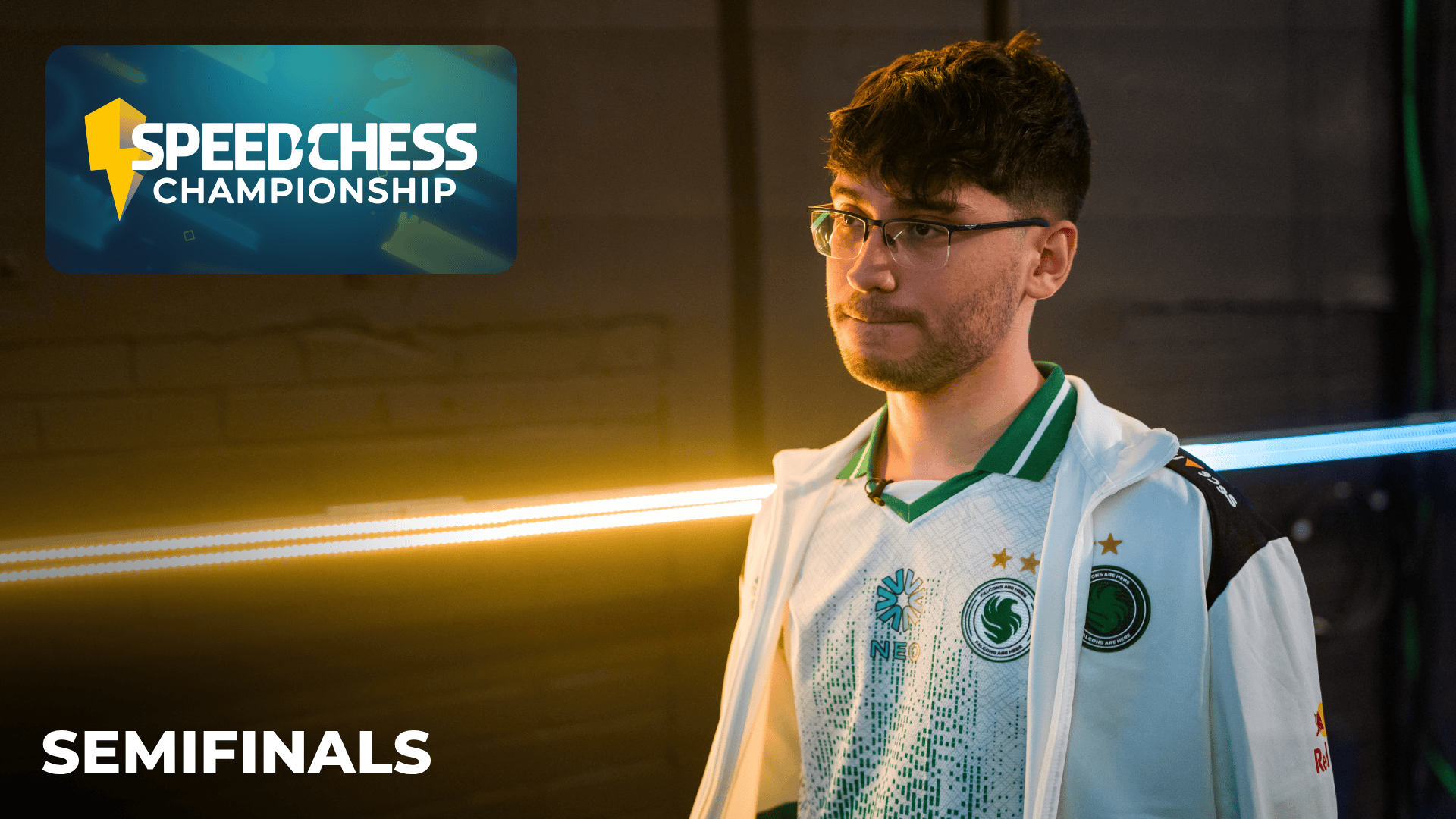
GMs Magnus Carlsen and Alireza Firouzja are the two finalists in the 2025 Speed Chess Championship. Carlsen prevailed in a one-sided match against GM Denis Lazavik 17-9, while Firouzja pulled off one of the greatest comebacks in SCC history to reach overtime against GM Hikaru Nakamura, and then won with a two-point margin.
The Final and 3rd Place Match take place on Sunday, February 8, starting at 8 a.m. ET / 14:00 CET / 6:30 p.m. IST. On top of the $65,000 offered in prizes, the top three will qualify for the 2026 Esports World Cup.
2025 Speed Chess Championship Bracket
The in-person Finals of the Speed Chess Championship take place at 180 Studios in London, England on February 7 and 8. Picking up where we left off with the Quarterfinals in November, the event begins with the final four. Over the next two days they’ll face off in Chess.com’s traditional format of 90 minutes for 5+1, 60 minutes for 3+1, and 30 minutes for 1+1. The player to accrue the most points in the allotted time wins the match.
The broadcast, featuring two semifinal matches, showcased 11 hours of high-speed tactical skirmishes and split-second decision-making. But the day began with a moment of silence in honor of GM Daniel Naroditsky, who held a special passion for the Speed Chess Championship.
In memory and honor of Daniel Naroditsky, we’ve worked with Secretlab to create a special edition chair for the Speed Chess Championship Finals. This chair will be prominently displayed during the SCC, remaining empty as a reminder of Daniel’s contribution to the SCC and chess as… pic.twitter.com/DvnWDr9bEh
— Chess.com (@chesscom) February 7, 2026
Carlsen 17-9 Lazavik: Carlsen Dominates
Surprisingly, Carlsen and Lazavik had never played each other in the Speed Chess Championship before. Chess.com predicted a 14-10 final score for Carlsen, but the 20-time world champion’s actual performance was significantly better than that.
Carlsen left no room for doubt as he gained a six-point lead in the first two segments and then consolidated in the bullet. “It’s been a while since I played any serious event, so I wasn’t quite sure about my form,” he said after the match. It turned out to be quite good.

5+1: Carlsen 6-3 Lazavik
Carlsen lost the first game, but then scored four wins to take a three-point lead.
The Norwegian grandmaster, in avoiding a repetition of moves in game one, dropped a pawn in the endgame and lost with the white pieces. But after evening the score in game two, Carlsen took the lead in game three.

42.Bxd4 led to an easy win when Lazavik failed to find the only playable recapture, and instead dropped a clean pawn. “I felt after that I got my footing back,” said Carlsen about winning that game.
After a draw in game four, Lazavik was down by just one point and told John Sargent, “So far, so good, not so bad actually.” But Carlsen would return to immediately win the most impressive game of the segment.
In a complex middlegame, the Belarusian GM struck with the slick exchange sacrifice 32…Re4!, and both players handled the complications flawlessly until move 37. But given a chance, Carlsen found the two only moves to win: 38.R2f3! followed by the harder 39.b3!, and transitioned into a winning rook endgame.
In the remaining four games, Carlsen scored just one more win in yet another rook endgame—one that should be a theoretical draw, but not necessarily against the blitz world champion.
“We should be headed towards a draw” turns into “and Magnus wins that game” in under a minute!https://t.co/9HPKdFcuwY#SpeedChess pic.twitter.com/ufTJjIqsq4
— chess24 (@chess24com) February 7, 2026
With a three-point lead ahead of the 3+1 segment, Carlsen told Sargent, “He’s really good, he plays well, he doesn’t make it easy for me at all. It’s been a grind so far.”
He’s really good, he plays well, he doesn’t make it easy for me at all.
—Magnus Carlsen
3+1: Carlsen 6-3 Lazavik
The second segment began razor-sharp as Carlsen sacrificed a pawn on the black side of a Catalan Opening. Lazavik handled the complications and had an advantage, but when clocks got low Carlsen’s attack broke through, and he won in the resulting endgame. GM Rafael Leitao analyzes the Game of the Day below.

Carlsen won two games out of the next three, and looked to be winning a third when Lazavik found an out-of-the-blue combination to turn the game around. 28.Rxe5!! was especially a stunner that left even Carlsen smiling as he resigned what, seconds ago, was a better position for him.
Denis finds the incredible 28.Rxe5!! to turn the game around, and Magnus smiles before resigning!https://t.co/k7Yl4uKy1D#SpeedChess pic.twitter.com/e0ZKC4OLkJ
— chess24 (@chess24com) February 7, 2026
The exchange sacrifice may have very well been the move of the day, though Lazavik told Sargent that he heard the crowd through his headphones before finding the move. He said, “Unfortunately, even with headphones, I can hear the crowd… I can say that when they started to scream, I understood that there was something.”
Carlsen nevertheless had a five-point lead and was playing risky openings by now. In the last four games, he won two, lost one, and drew the last to lead 12-6 ahead of the bullet.
1+1: Carlsen 5-3 Lazavik
The bullet segment started in the worst possible way for Lazavik. After just two games, a third of the match clock (10 minutes out of 30) had disappeared as the players made two very long draws. Of all three segments, the bullet shockingly featured the fewest number of games.
Carlsen won in the third with beautiful endgame technique, finally sacrificing his queen to cap it off.
“This is excellent bullet chess,” says Eric Hansen, seconds before Magnus sacrifices his queen to put it away bullet game #3.https://t.co/YtWUGS6Sc5#SpeedChess pic.twitter.com/5MEaJKlRLu
— chess24 (@chess24com) February 7, 2026
But Lazavik won with an attack the following game, brilliantly sacrificing two minor pieces to seal the black king’s fate.
Carlsen responded with a fine win of his own, alternating between threatening checkmate and trapping the opponent’s bishop.
Of the last three games, Carlsen won two and lost one to finally end with an eight-point lead.

Carlsen tipped his hat to Firouzja as a favorite in the following match and said,
I don’t have a preference since they’re both incredibly exciting in their own way and the match is going to be very very open. I would say I think Alireza’s a very slight favorite, but there’s every chance that this next match is going to be a lot closer [than mine].
But nobody could have predicted exactly how it would play out.
Nakamura 13-15 Firouzja: Firouzja Comes Back In The Final 5 Minutes
Firouzja won their last meeting in Paris last year 12-6, but this match looked almost sure to be Nakamura’s in the last five minutes. Chess.com’s pre-match prediction set Nakamura as the 65% favorite, but Firouzja pulled off a nearly unbelievable comeback in the final minutes of the approximately five-hour match.

5+1: Nakamura 4.5-3.5 Firouzja
The match had a rocky beginning as technical issues in the first two games caused Nakamura’s clock to lag; by the time the issue was resolved, we were an hour into the match. IA Judit Sztaray told Chess.com that the problem stemmed from the internet connection at the venue, not the computers themselves or Chess.com’s servers.
Despite challenges on and off the board, however, Nakamura finished the first segment with a one-point lead.

Firouzja converted an extra pawn in game one, though Nakamura had great chances to defend, but after a draw Nakamura evened the score in game three. Somehow, the American alchemized a pawn-down position into a winning rook endgame in the blink of an eye.
Hikaru turns it around and evens the score in game three!https://t.co/HGWBPhs5u0#SpeedChess pic.twitter.com/liY7phU5Sr
— chess24 (@chess24com) February 7, 2026
After a dramatic draw in game four, we saw three decisive games that left Nakamura in the lead. Firouzja won the first of these three games, but after that, in a time scramble he dropped a mate in one (though his position was losing anyway).
“That was the best game Hikaru’s played so far, without a doubt, in this match,” says David Howell as White lands a mate-in-one!https://t.co/YWfmVVobSN#SpeedChess pic.twitter.com/xSn6iOVsHB
— chess24 (@chess24com) February 7, 2026
The next game, Firouzja was in the driver’s seat, but the American GM slipped out of a lost position and even went on to win again, to take the lead.
With a draw in the final game, Nakamura was in the lead but didn’t look too happy. He said, “Alireza’s played a lot better than I have, but he’s mismanaged his time. That’s why I’m in the match.”
3+1: Nakamura 3.5-4.5 Firouzja
Firouzja spun the match around when he won four games in a row in this segment, but Nakamura added one last twist by evening the score in the final two games. Firouzja later explained: “It seemed like no one could keep the lead. When he was up two points, I was bouncing back immediately. When I was up two points, I couldn’t keep the balance. It was insane.”
It seemed like no one could keep the lead.
—Alireza Firouzja

Nakamura won the first 3+1 game to extend his lead to two points, but after a draw Firouzja won three games in a row before the halftime break. The first of those featured a nice positional pawn sacrifice, clearing the d5-square for a powerful minor piece, first the knight and then the bishop.
When they returned from the break, Firouzja won yet again to extend his lead to two. But Nakamura struck back, twice, and evened the score. First, taking advantage of his opponent’s severe time trouble, Nakamura won by trapping the white rook.
He then won a clutch final game. Nakamura traded from a rook endgame into a pawn endgame that, after promotions, became a queen endgame, before finally taking the full point.
Hikaru wins the last game of the 3+1 segment and evens the score!https://t.co/WNCyisNFm3#SpeedChess pic.twitter.com/jynRNfDFyr
— chess24 (@chess24com) February 7, 2026
1+1: Nakamura 4.5-4.5 Firouzja
“Hikaru played one of the best bullets I ever saw in my life,” said Firouzja after escaping what looked like almost certain defeat.
Nakamura won the first two games of the segment, making it the second time in the match that a player won four games in a row. In both cases, he was just much faster than Firouzja, who collapsed with seconds left.
Firouzja won a game, but after two draws Nakamura struck right back to regain a two-point lead. With four minutes and 55 seconds left on the match clock, Firouzja needed to win two games just to even the score. (Of course, if a player wins even with one second left on the match clock, the second game begins and the player will get the second chance.)
With under five minutes on the match clock, Alireza must win two games to even the score!#SpeedChess pic.twitter.com/bpsujKMkPO
— chess24 (@chess24com) February 7, 2026
And Firouzja delivered. The second win was a heartbreaker for Nakamura, as he came terribly close to equalizing. It was a case of finding the right idea, but the wrong order of moves.
Overtime: Nakamura 0.5-2 Firouzja
After an even score in the regular games, the players were to play four 1+1 games with no match clock. If the score were to remain equal, they would then play an armageddon tiebreaker.
Game one of Overtime was, in hindsight, the decider. Nakamura outplayed his opponent and had a rook and three pawns against a rook and one pawn. When Nakamura lost this one, it was a clear sign of the psychological trend the match had taken.
Game two was drawn, but Firouzja took the match with a game to spare after finding a one-move fork in game three.
Alireza wins game three of overtime with a fork and takes the match!#SpeedChess pic.twitter.com/VCxaFFlqUK
— chess24 (@chess24com) February 7, 2026
“It was a tale of lost opportunities for Hikaru,” summarized GM David Howell. Firouzja, alluding to moments in the match where Nakamura strategically drained the match clock, told Sargent, “Somehow when he was wasting time, you know these kinds of things have karma… I have no other explanation.”
You can listen to his full interview with FM Mike Klein as well, included below.
Full interview with Alireza following his amazing match with Hikaru! #SCCFinals pic.twitter.com/AvXirMX2xW
— Chess.com (@chesscom) February 7, 2026
You can also watch Nakamura’s recap of the day below.
It’s Firouzja against Carlsen in the final match, and no matter what happens next, both players will have already qualified for the 2026 Esports World Cup. If he wins, Firouzja will be the first person other than Carlsen and Nakamura to win the SCC. At the same time, he acknowledged that he had a more exhausting day than his opponent, saying, “He has more energy of course. I’ll try to recover, we’ll see.”
The Speed Chess Championship, which starts on October 12 and culminates with Live Finals on February 7-8, 2026 in London, is Chess.com’s most important speed chess event. Some of the biggest names in chess compete to determine the best speed chess player in the world. The games are played with time controls of 5+1, 3+1, and 1+1. The prize fund is $250,000.
Previous Reports:
