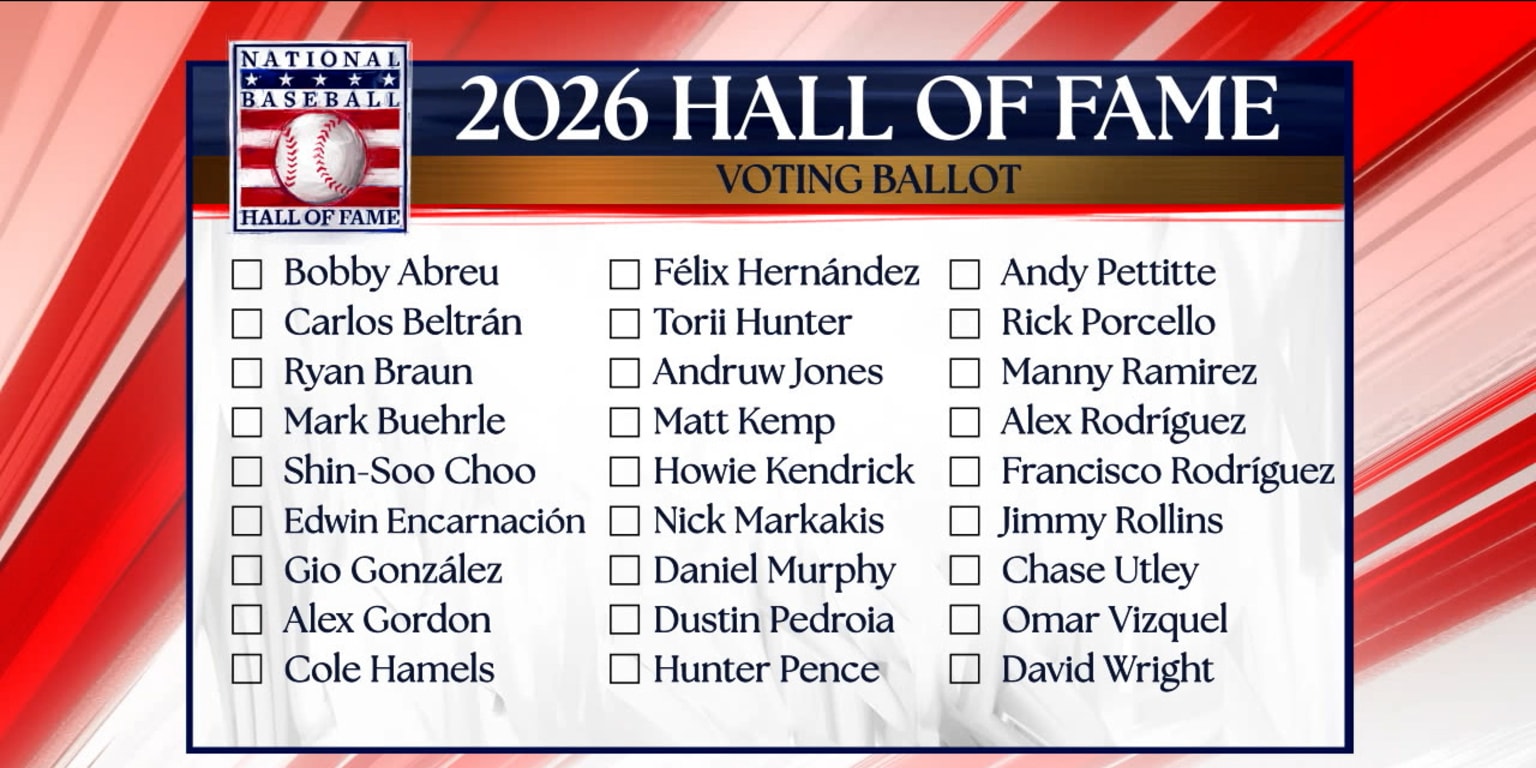
We won’t find out for sure until Jan. 20, when the voting results from the Baseball Writers’ Association of America ballot are announced live on MLB Network at 6 p.m. ET. But we don’t have to wait until then to gain some insight into the voting.
Thanks to Ryan Thibodaux’s Hall of Fame ballot tracker, we can keep up with how the vote is trending. And Jason Sardell, who has run simulations to project Hall of Fame vote totals for the past several years, has been providing periodic updates on projections for this year’s candidates.
Using these two valuable tools, here’s what we can glean about the BBWAA voting so far.
Note: Thibodaux’s ballot tracker has counted 158 ballots as of Sunday at 5:20 p.m. ET. All vote percentages are current as of that time. All projections provided by Sardell are through 148 ballots input into Thibodaux’s tracker as of Thursday.
1. Beltrán looks like a lock to get the Hall call
Maybe Carlos Beltrán will hold off on celebrating until it becomes official, but the 20-year big leaguer can probably start making flight plans for Cooperstown this summer.
Beltrán has received a vote on 89.2% of the ballots counted by Thiboadaux’s tracker. Like all players on the BBWAA ballot, he just needs to be above 75% of the vote when the final results are unveiled. According to Sardell’s latest simulations, Beltrán ends up north of that magic number 99.7% of the time. So the chances look pretty good that the Hall of Fame Class of 2026 will contain two members of the 2004 Astros.
One of the best power-speed threats of his generation, Beltrán is among five players in AL/NL history who have racked 500 doubles, 400 homers and 300 steals, joining Alex Rodríguez, Barry Bonds, Andre Dawson and Willie Mays.
Here is where the real drama lies. Now in his ninth year on the BBWAA ballot, Andruw Jones‘s vote percentage has just about doubled — from 33.9% to 66.2% — over the past five cycles. He’s sitting at 82.9% in the tracker, but that isn’t quite as safe as it seems.
A player’s vote percentage in the tracker is often less than the actual final tally. For instance, Beltrán’s final percentage in the tracker last year was 73.6%. He ended up at 70.3%. Jones’ final percentage in the 2025 tracker was 70.3%. Once every ballot was counted, he was at 66.2%. If he experiences the same decline this year, Jones would still be elected to the Hall with a little room to spare, at 78.8%. He clears the 75% threshold in about three-quarters of Sardell’s latest simulations.
The owner of 10 Gold Gloves and 434 home runs, Jones ranked third in Baseball-Reference WAR (57.6) during his 10-year peak from 1998 through 2007. The two players in front of him? Rodriguez (80.0) and Bonds (71.0).
3. Utley is doing well in Year 3
Chase Utley has the third-highest vote percentage of the 27 players on this year’s ballot. He’s currently at 66.5% in the tracker, which would be a massive leap from his 2025 total of 39.8%. It’s likely that Utley’s vote percentage will settle somewhere in the low-to-mid-60s — last year’s final total was about 5 percentage points less than his tracker support — but the longtime Phillies second baseman has time on his side; he will be eligible for the next seven BBWAA ballots.
Utley’s career bWAR of 64.6 ranks 15th all-time among second basemen, ahead of many who have already been inducted into the Hall — and one who will be in Kent (55.4).
4. Who have been the biggest risers?
While Utley’s jump is impressive, there are two starting pitchers who have made an even bigger surge.
Félix Hernández, who was at 20.6% as a ballot newcomer last year, has a 57.0% vote percentage in the tracker. That improvement is backed by 30 votes from returning BBWAA members who didn’t vote for King Félix in ’25. Only one other player has received even 15 such new votes this year, and that’s Andy Pettitte.
The five-time World Series champion has gained the support of 22 returning voters who didn’t mark him on their 2025 ballot. He’s at 57.6% in the tracker after finishing last year at 27.9%.
But there are obviously different levels of urgency with these two hurlers. Hernández is in just his second year on the ballot while Pettitte is in his eighth. The lefty has a lot of ground to cover before he gets to 75%, but after gaining 14.4 percentage points of support from 2024 to ’25 — the biggest increase among any ballot veteran — Pettitte has a chance to complete a late climb to Cooperstown a la Larry Walker, who was at 34.1% after his eighth year on the ballot but was elected to the Hall in Year 10.
5. Which first-time candidates will stay on the ballot?
There won’t be a first-timer in this year’s class. The better question is: Which ballot newcomer will clear the 5% threshold to remain on the ballot in 2027? Right now, there is only one player over that line in the tracker: Cole Hamels. The four-time All-Star is at 32.3%, which would be a pretty strong showing compared to where the aforementioned Hernández (20.6%) and Pettitte (9.9%) were after their first years on the ballot.
Hamels has been marked on 51 of the 158 ballots in the tracker. The other 11 first-timers on the ballot have received a combined total of eight votes. Those have been spread between Ryan Braun (four), Edwin Encarnación (two), Shin-Soo Choo (one) and Hunter Pence (one).
6. Who else is in danger of falling off the ballot?
Manny Ramirez is in his 10th year on the ballot, so this is the last time his Hall case will be assessed by the BBWAA. Although he has the numbers of a Cooperstown shoo-in — 555 home runs, .312 career average, .996 OPS — multiple violations of MLB’s performance-enhancing drug policy late in his career have seemingly put a hard cap on Ramirez’s Hall support. His vote percentage has been between 25% and 35% every year since 2020, and he is currently at 41.8% in the tracker.
Torii Hunter is at 4.4% in the tracker and clinging to his candidacy in his sixth year on the ballot. But the nine-time Gold Glover has been here before. His final percentage in the tracker last year was 4.8%, but Hunter gained a little more support on ballots that weren’t made public and barely cleared the cut line, finishing at 5.1%.
