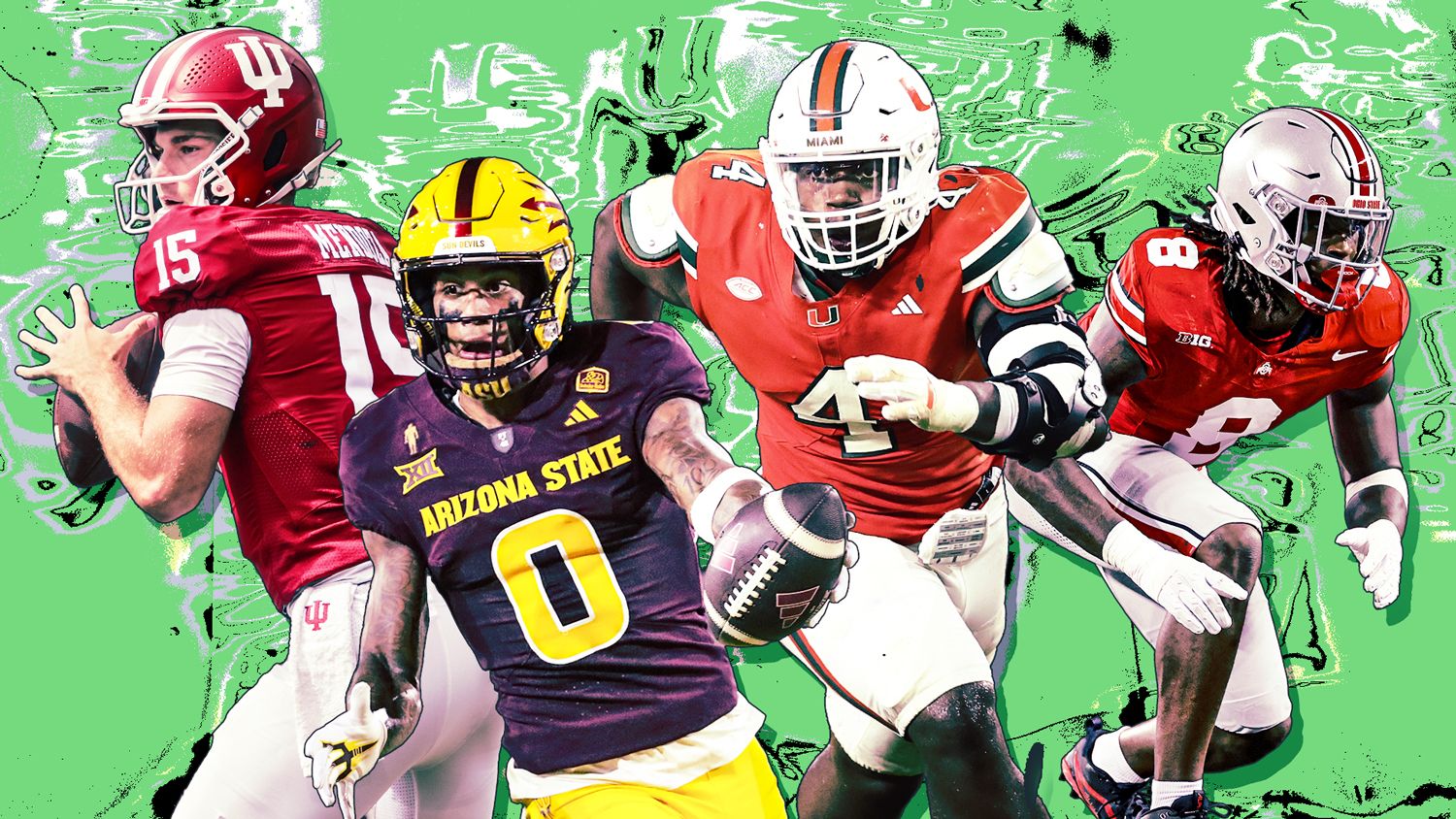
There’s no official start to NFL draft season. But there’s no better time than the present to kick it off, as the calendar turns to December. The 2025 college football regular season just concluded, with conference championship weekend, the 12-team College Football Playoff and bowl games up next. Plus, the 2025 NFL season has only five weeks left until the playoffs begin. So let’s start looking ahead and answer questions about prospects for the 2026 NFL draft.
Remarkably, we’re less than five months from Day 1 of the draft, which starts April 23 in Pittsburgh. But plenty can change between now and then. The draft order won’t be fully set until mid-February, and the No. 1 pick is up for grabs. The final stretch of the 2025 season, along with all-star events, the combine, pro day workouts and a ton of predraft interviews, will ultimately determine how draft boards will be constructed. But things are starting to take shape.
We brought in our NFL draft experts — Mel Kiper Jr., Matt Miller, Jordan Reid and Field Yates — along with several NFL Nation reporters to answer 30 big questions about the class at this point in the process. Who is the No. 1 quarterback on the board, and how does this class of signal-callers look after having its share of surprises? Who is in the running for the No. 1 player in the class? Which positions are the strongest, and who are the top defensive players to know? And with four teams holding multiple first-round picks, could we see some wheeling and dealing come April? Let’s dive in and discuss this intriguing draft class.
Jump to a section:
Top prospect | QBs | RBs | WRs and TEs
Defensive front seven | Defensive backs
Risers | Toughest evaluation | Our guys
Who would you rank as the No. 1 prospect in the class right now?

Kiper: Dante Moore, QB, Oregon. He’s poised and accurate, sitting third in the FBS in completion percentage (72.5%). I really like his deep-ball touch, and he’s good enough with his legs when he needs to scramble. And Moore hasn’t really had a perfect situation — he has played multiple games in the rain and has missed key players at WR, TE and OL due to injuries. It’s tough to stand out in those conditions, but he has looked great. The biggest question will be Moore’s experience; he is a third-year sophomore with 17 career starts.
Miller: Jeremiyah Love, RB, Notre Dame. He’s the best pure prospect in the class and the closest thing most of us have seen to Reggie Bush since the former USC Heisman winner was terrorizing defenses in the early-mid 2000s. Love has a special blend of burst, deep speed and vision. He is a threat to take it the distance on every touch but has the patience and poise to not press the line of scrimmage. So, without factoring in who will actually go No. 1 due to positional value, Love is the best player in the class.

Reid: Arvell Reese, Edge/LB, Ohio State. Reese has been arguably the most consistent player on a loaded Ohio State defense, which has allowed the fewest points in the FBS (7.8 per game). Reese wasn’t on scouts’ radars entering the season but has seen his stock skyrocket after posting 61 tackles and 6.5 sacks this season. He has a unique combination of bend and power that has prompted questions about where he projects best at the next level. Because of that blend of traits and the flashes that he has shown as a defensive end, I believe Reese fits better as an edge rusher, where he can use his play strength to wreak havoc.

Yates: Fernando Mendoza, QB, Indiana. This answer requires nuance, as Reese is the surest thing among the prospects that I have studied so far and a plausible candidate to go No. 1. However, it’s impossible to ignore positional value, and with that in mind, Mendoza jumps to the top of the heap. He has a starting quarterback grade for me, with elements of his game that remind me of Sam Darnold, and a solid starting quarterback in the NFL is arguably the most valuable position in sports.
Let’s talk through this quarterback group: How many passers have a Round 1 grade?
Reid: Three right now — Moore, Mendoza and Alabama’s Ty Simpson. The interesting thing about this group is that many of the highly touted passers coming into the season haven’t performed as anticipated. Guys such as Arch Manning, LaNorris Sellers and Cade Klubnik have slid, leading to the emergence of others.
Simpson and Moore are both first-year starters who could return to school, so there’s uncertainty on whether they’ll be in the 2026 class. Mendoza has one year of eligibility remaining, but all signs point to him declaring. Scouts had said Mendoza could quickly catapult his way up draft boards if he made the adjustment to Curt Cignetti’s Indiana offense after transferring from Cal. He certainly has, to the tune of 2,758 passing yards, 32 touchdown passes and five interceptions.
0:28
Justice Haynes breaks off for 75-yd rushing TD
Justice Haynes takes it 75 yards to the house to put Michigan back in front vs. Nebraska.
Which QB has the best chance to go No. 1 overall?
Yates: Mendoza. Except for the Titans and Giants, almost every team within striking distance of the first pick needs a quarterback to build around. Of those three QBs in the first-round mix, Mendoza is the one that I feel most confident in declaring for the draft. The QB1 conversation is not open and closed in my book, as much of it will be determined by the team’s offensive system and preferred QB play style.
But wait, the Titans are projected for the No. 1 pick right now and already have a QB. What might they do?

Turron Davenport, Titans reporter: Having taken a quarterback with the No. 1 pick in April (Cam Ward), trading down and collecting a couple of first-round picks is an option for the Titans. Tennessee’s roster lacks top-end talent, so it can’t move back too far. But the Titans would likely be looking to swap with a quarterback-needy team that could be eager to jump to the top of the draft and get its franchise guy. Titans president of football operations Chad Brinker stated last offseason that he’d like to make 12 top-100 picks over the next three drafts. The best way to accumulate the necessary capital is to trade down.
Which middle-round sleeper quarterback will excite scouts the most in the leadup to the draft?

Kiper: Jaden Craig, Harvard. He’s my QB8 right now, and it’d be no surprise if he went in the third or fourth round. Craig has a live arm, a 6-foot-2, 215-pound frame and sound mechanics. I like how he buys time in the pocket with his movement traits and then delivers strikes into tight windows with terrific touch. He has thrown 25 touchdown passes to seven interceptions this season, and although he didn’t have the best game against Villanova in the FCS playoffs, NFL teams are going to be interested.
Are the Jets more likely to target a QB in the draft in 2026 or 2027?

Rich Cimini, Jets reporter: The NFL is an ASAP business, but there are several variables that will determine whether the Jets draft a QB in 2026 or kick the can down the road to 2027. Remember, they have three first-round picks in 2027, and that QB crop is said to be superior to the 2026 group. Ultimately, it will likely come down to their level of conviction in players such as Mendoza, Moore and Simpson. Key question: Can coach Aaron Glenn and GM Darren Mougey — both of whom will be under pressure to win in 2026 — afford to postpone their rebuild another season while they wait for a quarterback? That might be a stretch.
The Browns also have two first-rounders in 2026. Could they go quarterback?
Daniel Oyefusi, Browns reporter: Yes, but the Browns could find themselves picking behind several QB-needy teams if Shedeur Sanders can lead them to a few victories down the stretch (he won his first career start in Week 12). But with the two first-rounders — their own and the Jaguars’ after Jacksonville moved up to pick WR/CB Travis Hunter in April — and 10 total picks, the Browns could also have the draft capital to move up if they covet a particular quarterback prospect.
Should we link the Raiders to the first-round quarterbacks?
Ryan McFadden, Raiders reporter: Yes. Whether Geno Smith is back or not, the Raiders need to create a succession plan for the 35-year-old quarterback. Smith has struggled for the majority of the 2025 campaign. The Raiders already have offensive cornerstones in running back Ashton Jeanty and tight end Brock Bowers, so landing a young quarterback would be beneficial. At the same time, this decision also hinges on how the coaching staff looks in 2026. Las Vegas has already parted ways with offensive coordinator Chip Kelly, and Pete Carroll’s future is in question since the team hasn’t made any progress under his leadership.
Let’s not forget about the Rams. Will they land their QB of the future on Day 1?

Sarah Barshop, Rams reporter: The Rams have a lot of long-term quarterback questions because they don’t know how long Matthew Stafford will want to play. Los Angeles has its eye on its future at the position after Stafford, and with two first-round picks (including one from the Falcons that could be in the top 10), coach Sean McVay and GM Les Snead won’t hesitate to pursue a quarterback they like. Still, even if Stafford, who is playing at an MVP level, retires after this season, I wouldn’t expect a rookie to start for the Rams in 2026.
Name one sleeper team to watch for this QB class.

Yates: The Cardinals. They might not even be a sleeper anymore; I’d be surprised if Arizona isn’t in the quarterback market. Kyler Murray’s contract includes one more year of guaranteed money, but moving on is no longer a nonstarter. I will have my eyes on the veteran QB market this offseason, as recent success stories of second-act signal-callers (or third- and fourth-act) are a reminder that not every quarterback answer involves drafting a new one (see Darnold, Baker Mayfield, Mac Jones et al). That said, Arizona will surely do its quarterback homework in the draft.
Miller: False. I think some of that will be due to Jeanty’s struggles this season (635 yards in 12 games). The NFL runs in cycles, and Jeanty’s failure to spark the Raiders’ offense will likely lead to some trepidation in front offices about drafting another back in the top 10. Given the sheer number of teams that need quarterbacks and the presence of multiple top-tier edge rusher prospects, it’s hard to find a clear fit for Love in the top 10. I don’t see a team taking Love earlier than Jeanty’s slot at No. 6.
That said, Love’s ability to break off big runs, patience and vision behind the line of scrimmage, and overall speed at 6-foot and 214 pounds make him special. A team might go against positional value — and against higher-priority needs — and still take him in the back half of the top 10.
Can teams find starting RBs on Day 2 in this class?
Reid: This isn’t an overly impressive running back class, but there are a few names to know. Love is the obvious top option, and his Notre Dame backfield mate, Jadarian Price, is my RB2. Jonah Coleman (Washington) and Justice Haynes (Michigan) also have starter-level traits and could be drafted inside the top 75 picks. Haynes recently underwent foot surgery, which could have major implications on where he’s selected.
Another name to keep an eye on throughout the predraft process is Emmett Johnson (Nebraska). His 1,451 rushing yards this season currently lead the FBS.
0:30
Kelley Jones picks off Mississippi State Bulldogs
Picked! Kelley Jones hauls in the interception
Is this a good year to need a WR?
Kiper: Oh, yes. It’s the strongest position of an otherwise not-great class. I think three guys could be top-10 picks — Jordyn Tyson (Arizona State), Carnell Tate (Ohio State) and Makai Lemon (USC). Injuries have complicated the WR1 race a bit, as both Tyson and Tate have missed time recently. But Lemon is the top slot receiver and one of my favorite prospects in the class. In all, we could see six receivers in Round 1, with Denzel Boston (Washington), Zachariah Branch (Georgia), Chris Bell (Louisville) and Germie Bernard (Alabama) in the mix.
But even beyond the first round, there are some reliable, sure-handed pass catchers in the class. Ja’Kobi Lane (USC), KC Concepcion (Texas A&M), Malachi Fields (Notre Dame), Chris Brazzell II (Tennessee) and Bryce Lance (North Dakota State) all have the goods to make an NFL impact. And don’t discount the kick-return ability of some of these guys — that matters a lot now.
What is your favorite WR comp in the class?
Miller: Carnell Tate to Justin Jefferson. I know, I know … this sounds wild. But it’s on point when comparing Tate to what Jefferson was at LSU — not what he is doing now in the NFL. Both are 6-foot-3 and around 200 pounds. They each excelled as route runners while also being dominant on 50-50 balls thanks to vertical skills and body-adjustment ability. I’m not predicting Tate will take the NFL by storm and become a top player as quickly as Jefferson did, but their skill sets are very similar when evaluating where they were entering the draft.
There’s a clear TE1, right? What is Kenyon Sadiq‘s best trait?
Yates: Yes, though some will grade Sadiq more as a movable chess piece-type player/H-back than a traditional tight end because of his lack of prototypical size (6-foot-3, 245 pounds). His run-after-catch ability is my favorite trait, as he fires out of a cannon in space and can make defenders miss in the open field. He would be best suited with a playcaller dedicated to crafting touches for him, akin to some of the great ways the Browns have tapped into Harold Fannin Jr.’s run-after-catch skills. I would forecast Sadiq as a late-first-round prospect at this juncture, with notable tight ends behind him including Joe Royer (Cincinnati) and Max Klare (Ohio State).
How many offensive linemen will get drafted in Round 1?
Reid: Right now, I would say four. This offensive tackle class doesn’t have the surefire top-10 picks that Will Campbell and Armand Membou were in 2025. The battle to be the first offensive tackle off the board is probably between the Utah duo of Spencer Fano and Caleb Lomu, but Francis Mauigoa (Miami) is another name to remember. Although he has strictly played right tackle for the Hurricanes, many scouts that I have talked to view him as a guard at the next level.
Kadyn Proctor (Alabama) will be a highly debated prospect, as some evaluators view him as a Round 1 player, whereas others have him graded as a Day 2 prospect because of inconsistency. Guard Olaivavega Ioane (Penn State) and tackle Trevor Goosby (Texas) are also on the rise and could eventually get first-round consideration.
Who’s your favorite under-the-radar offensive player in this class?

Kiper: Bryce Lance, WR, North Dakota State. He keeps producing and just clipped 1,000 yards on the season with his fourth 100-plus-yard game two weeks ago against St. Thomas-Minnesota. The 6-foot-3, 209-pounder is the younger brother of quarterback Trey Lance, and he’s looking like a Day 2 pick. He’s averaging 20.0 yards per catch, sells his routes well and uses his great body control to make tough catches in tight coverage along the sideline.
The Giants need to help Jaxson Dart. What position do you expect them to target in Round 1?

Jordan Raanan, Giants reporter: Wide receiver or offensive line. The Giants still need another offensive threat who strikes fear into opposing defenses. They have some solid players after wide receiver Malik Nabers but no real explosive playmakers. Plus, a decision must be made on fellow receiver Wan’Dale Robinson, who is a free agent after the season.
New York’s offensive line is playing well right now — it’s ranked in the top half of the league in pass block win rate — but there are questions for the future. Right tackle Jermaine Eluemunor is having a strong season and is in line for a payday as an impending free agent. Will he stay in New York? Left guard Greg Van Roten is also a free agent and 35 years old. One could argue that the Giants could greatly benefit from taking a Pro Bowl guard or tackle at the top of the draft.
What is the strongest position in the class on defense?
Reid: A debate for defensive line could be made here, but I’m going with linebacker. I’m extremely high on this class. It not only has strong names at the top but also depth throughout. Arvell Reese (Ohio State) is my No. 1 prospect, but I have him ranked at edge rusher. So, Sonny Styles — Reese’s Ohio State teammate — is my top-ranked player at the position, followed closely by CJ Allen (Georgia). Both project as mid-to-late first-round picks.
Jake Golday (Cincinnati), Anthony Hill Jr. (Texas) and Josiah Trotter (Missouri) are strong candidates to be selected on Day 2 and project as starters early in their careers.
So teams see Reese as an edge rusher in the pros?
Miller: Yes. Reese is a great example of a player who will make the transition from a college stack linebacker to a full-time pass rusher role, a la Micah Parsons or Abdul Carter. At 6-foot-4 and 243 pounds, Reese has impressed this season with his dominant first step off the edge, which he couples with power in his hands to allow him to run through blockers. Reese has the best pass-rush traits of any edge rusher in the class despite never playing the position on a full-time basis.
What are scouts saying about edge rusher Rueben Bain Jr.?

Miller: Bain is seen as a top-five player and one of the most pro-ready players in the class. “He’s Trey Hendrickson,” said an AFC East scout who has seen Bain in person. And a scout from the NFC North said, “He’s the safest bet on defense because he brings a power element to his game and has more than enough quickness. He’s a Day 1 RDE and 10-year starter.”
Bain’s tape doesn’t show the sheer speed of Reese or previous highly drafted defensive ends, but what he lacks in chase skills he makes up for in power and leverage at 6-foot-3 and 275 pounds. In that way he’s very similar to Jared Verse.
Which top-tier edge rushers will be the most interesting evaluations over the next few months?

Kiper: I’ll cheat and say two names because they have similar reasoning. Clemson’s T.J. Parker and Auburn’s Keldric Faulk have all the traits in the world and have shown they can get to the QB. Parker had 11 sacks in 2024 and shows speed-to-power. Faulk had seven sacks in 2024 and wins with inside and outside moves. But neither has produced much in 2025.
Faulk is stuck at two sacks through 12 games, and Parker needed a three-sack performance against South Carolina on Saturday to get to five on the season. Their evaluations are going to remind folks of Shemar Stewart in the leadup to this year’s draft — great skill set, questionable production. Faulk is still in my top 25 right now, but Parker has fallen out.
For teams looking for interior D-line dominance, which player’s tape is a must-watch?
Yates: He might not be first defensive tackle off the board, but Oregon’s A’Mauri Washington has seen his value skyrocket this season, his first as a full-time starter. At 6-foot-3 and 330 pounds, Washington has excellent quickness and overall movement skills for an interior player, providing not just run-stuffing ability but also pocket-collapsing rush skills. Washington has just one career sack but serves as a reminder of the importance of looking past that particular statistic for interior defensive linemen. He’s fun to watch and could be a Day 1 pick.
Why is the race for CB1 a little more complicated than normal?
Kiper: Well, the top CB hasn’t played a snap all season. Jermod McCoy (Tennessee) is No. 16 on my Big Board, but he tore his ACL in January and might miss the whole season. NFL teams will love his ball-hawking traits (four INTs in 2024), but they will obviously be looking closely at those medicals and have to weigh a full year off the football field.
Behind him, things don’t get any clearer. Avieon Terrell (Clemson) is solid but hasn’t picked off any passes this season. Kelley Jones (Mississippi State) shows a veru good feel for coverage, but he’s a third-year sophomore, so teams haven’t done a ton of work on him yet. Mansoor Delane (LSU) makes plays on the ball with six INTs and 17 pass breakups over the past two seasons, but there are questions about his true speed. Brandon Cisse (South Carolina) has had a few hiccups in coverage. Simply put, no one looks elite.
Day 1 might be tough to sort out at the position, but the Day 2 guys have some upside. There’s a bunch of names there, but Colton Hood (Tennessee) and D’Angelo Ponds (Indiana) could be immediate impact players.
0:29
Alabama offensive lineman Kadyn Proctor rumbles his way to a 1st down
Kadyn Proctor takes the direct snap and hurdles his way to an Alabama first down.
Caleb Downs is awesome, but could we really see a safety go in the top five?
Reid: It’s extremely unlikely. You would have to go back to the 2010 draft to see a safety picked in the top five (Eric Berry went to the Chiefs at No. 5). Jamal Adams (2017) is the most recent to be selected in the top 10. Now, if we’re stacking prospects purely on talent, I believe Downs is one of the five best players in this class, and he’s ranked No. 2 overall on my board. He is a consistent tackler with great ball skills (two INTs on the season). But although Downs is exceptional, it would go against the norm to see an NFL team draft Downs inside the top 10, much less the top five.
Which teams are most likely to zero in on defense in Round 1?


Yates: I’m looking at three teams that are projected to pick high and have a quarterback in place: the Giants, Bengals and Commanders. The Giants have underperformed given their talent layout this season but must further address the secondary. Cincinnati needs to address every level and position of its defense. And the Commanders need a youth infusion and some pass-rush juice along with multiple cornerbacks. These teams rank 29th (Giants, 6.0), 31st (Bengals, 6.3) and 32nd (Commanders, 6.3) in yards allowed per play this season.
Could the Cowboys go defense with both of their first-round picks?

Todd Archer, Cowboys reporter: Absolutely. They have four defensive linemen set to be unrestricted free agents (Jadeveon Clowney, Dante Fowler Jr., Sam Williams and Payton Turner). They also have plenty of questions at safety (Donovan Wilson is set to be a free agent) and cornerback; it is possible the Cowboys move on from corner Trevon Diggs after the season. Dallas is 28th in yards allowed per play (5.9) and 31st in points allowed per game (28.5).
In 2005, the Cowboys used their two first-round picks on defense and landed DeMarcus Ware, a Hall of Famer, and Marcus Spears, a multicontract starter. Owner Jerry Jones has said it was a mistake for the Cowboys to have three coordinators in three seasons, so that might buy Matt Eberflus some grace and give him more playmakers to work with in 2026.
Name one player who could shoot up the board as a combine riser.
Kiper: Eli Raridon, TE, Notre Dame. He’s my fourth-ranked tight end now, and a good predraft process could push him into the late-Day 2 mix. He has 32 catches for 482 yards and no touchdowns this season, but he is going to test well. Raridon is what I call an “LTPer” — he looks the part at 6-foot-7 and 251 pounds. And he’s explosive. Get ready to be impressed by his speed and jump results at the combine. (Shoutout to Sonny Styles here, too; he should have a great week at the combine in February.)
Miller: LaNorris Sellers, QB, South Carolina. Sellers has a tough decision coming up regarding where he’ll play in 2026 — be that at South Carolina, transferring to another school or heading to the NFL. If he declares for the draft, Sellers’ combination of arm strength, build (6-foot-3, 240 pounds) and athletic tools will have scouts enamored with his upside and potential. Much like Anthony Richardson Sr., Sellers could build a ton of buzz based on his raw tools if he works out in Indy.

Reid: Chris Johnson, CB, San Diego State. One of my favorite underrated prospects in this class, Johnson has been one of the most consistent cornerbacks on tape this season. At 6-foot and 185 pounds, his technique and movement skills are outstanding. Johnson currently ranks as the No. 46 player on my board, but an invitation to an all-star game could catapult his stock, as he needs to show his skill set against top-tier competition in that type of setting. And if he pops there and then at the combine, it wouldn’t surprise me if he starts to receive late-Round 1 chatter.

Yates: Jaishawn Barham, Edge, Michigan. I am bullish on Barham based off film alone, as he has made a major leap serving as mostly an edge rusher in Michigan’s defense this season. He has exceptional explosiveness and power coming off the edge to terrorize opposing tackles, although he is still learning the nuances of the position as he transitions from his prior role as a standup inside linebacker. Barham might lack prototypical edge bulk (he’s listed at 6-foot-3, 243 pounds), but don’t be surprised if he’s among the best athletes at his position at the combine. He’s likely a second-rounder.
Which prospect is the toughest to evaluate based on what you’re hearing?

Miller: Kadyn Proctor, OT, Alabama. Proctor was tabbed by some scouts as the top player in the class before the season began, but inconsistent play and penalties have led to questions about which player NFL teams will get. Proctor has rare athletic tools at 6-foot-7, 360 pounds with the movement ability of a much smaller tackle prospect. Those traits make him look like a top-10 pick. But his game tape doesn’t show sustained leverage, and he can be run around in the pass game. Scouts can’t yet agree on his stock. (He’s my OT4.)
Kiper: Makai Lemon, WR, USC. This shouldn’t be a shock … I’ve spent a lot of time talking about Lemon this fall. At 5-foot-11 and 195 pounds, Lemon is the best slot receiver in the class, with 79 catches for 1,156 yards and 11 scores this season. He attacks the football in the air. Iowa coach Kirk Ferentz recently said, “No. 6 is as good as I’ve seen. Going back 20-plus years, I don’t know if anybody’s impacted the game more.” That’s real praise. Lemon plays fierce football, and he’s the kind of player I’d want on my roster. Miller: David Bailey, Edge, Texas Tech. Bailey transferred from Stanford to Tech and has been a game wrecker for the Red Raiders’ defensive line all season. He’s quick off the edge at 6-foot-3 and 250 pounds, racks up a ton of pressures and hurries and — most importantly — plays with a relentless pursuit of the quarterback. He’s not my top edge rusher (second on my board), but Bailey is a guy I’ll go to bat for throughout the predraft process. Reid: Francis Mauigoa, OT/G, Miami. My three counterparts choosing the flashy positions, how about showing the offensive line some love? I’d stand on the table for Mauigoa. He has a boringly consistent skill set in that you know exactly what you’re getting on a down-in and down-out basis. He has strictly played right tackle at Miami, but I like him better at guard, where he can use his 6-foot-6, 335-pound frame to dominate. He’s one of the most impressive prospects that I was able to see out on the road this season. I would be fully comfortable drafting him in the top 15 as a plug-and-play starter right away. Yates: Carnell Tate, WR, Ohio State. In what can be described as an annual tradition, Ohio State will have a wide receiver taken in the first round (plus another in 2027 in Jeremiah Smith). Tate has very good size at 6-foot-3 and 195 pounds, but his superpowers are his route running and catch radius. He is a vacuum for nearly every target thrown his way and is also an excellent separator down the field. He has some big slot ability as well, a tool that will allow a playcaller to put him into even more advantageous spots at the NFL level. I won’t be surprised if Tate winds up in the top 10 as the first wideout taken.
Call dibs on a prospect in this class: Who’s your guy?