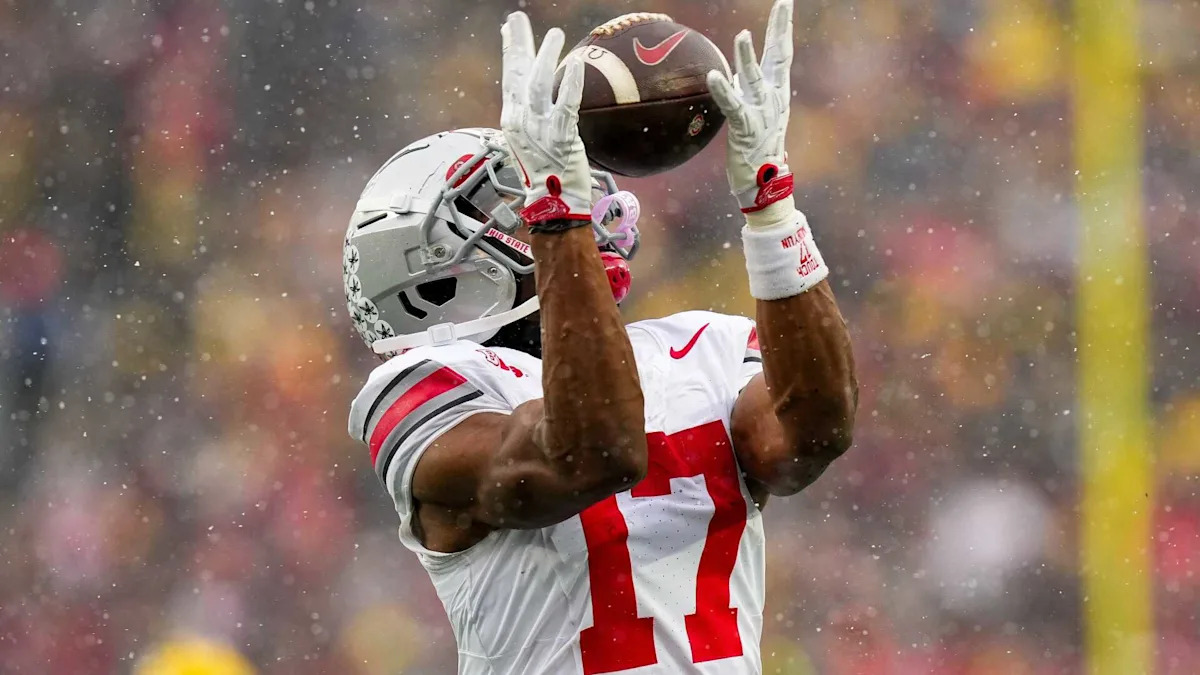
The 2026 NFL Draft WR class is headlined by high-efficiency playmakers and elite size. Who are the best? NBC Sports’ College Football and NFL Draft expert Eric Froton (@CFFroton) has compiled his rankings of the top wideouts in the nation. His breakdown of the talent looking to hear their names called at the NFL Draft is elite.
Yesterday he revealed Wide Receivers 11-20. Today, he offers us his Top 10.
Advertisement
Wide Receiver No. 10 – Germie Bernard, WR, Alabama
Former Washington transfer Germie Bernard (6’1”, 204) is a rugged, versatile weapon whose reliability has been a calling card, posting 80th-percentile-plus drop grades in all four seasons and hauling in 64-of-102 targets for 862 yards and seven touchdowns in 2025 with just one drop. While his per-route efficiency dipped to a middling 1.70 Y/RR (2.24 Y/RR in 2024), Bernard remained effective after the catch (6.2 YAC, 66% first-down rate), lining up primarily outside (62% wide) but also rotating through the slot and backfield to stress defenses horizontally. His 2024 tape showed legitimate downfield juice—27-of-41 on throws of 10+ yards for 617 of his 794 receiving yards—but that vertical efficiency regressed a bit in 2025 (5-of-18 on 20+ yard targets) alongside a drop in contested target success (36% CTC rate). Bernard’s value lies in play strength and processing, as he consistently engages DBs with physicality, waits for leverage to declare, and snaps off sharp in-breakers while bullying defenders who try to reroute him. Not a pure lid-lifter, he compensates with patience, toughness, and advanced YAC instincts on screens, orbit motion, and quick hitters, profiling as a tough, quarterback-friendly chain mover who can win from multiple alignments.
Wide Receiver No. 9 – Ja’Kobi Lane, USC
A player that I’ve watched play in person 9 times at USC, Ja’Kobi Lane (6’4”, 200) profiles as a classic boundary alpha who pairs size with polish, securing 49-of-74 targets for 750 yards (15.3 YPC) and four scores while posting an 81.8 receiving grade. Operating on the perimeter (81% wide rate), Lane averaged 2.42 yards per route with a 12.5 aDOT, flashing after-catch utility (11 MTF, 4.8 YAC) and dominance at the catch point by winning 24-of-49 contested looks (49%) over the last two years. He’s arguably the best wideout in the class at winning at the top of the stem, using late hands, leverage, and body control to box out defenders, convert back-shoulder throws and corner end-zone chances. There’s refinement still needed on vertical efficiency—11-of-24 on deep targets that comprised 18% of his target share over the last two seasons—but his 3.05 Y/RR vs. man (2.28 vs. zone) underscores the difficulty Big Ten DBs experienced when trying to defend him. Lane closed his standout 2024 in knockout fashion, turning seven of his final 10 receptions into touchdowns versus UCLA, Notre Dame, and Texas A&M, a stretch that encapsulated his red-zone inevitability and big-play temperament.
Advertisement
Wide Receiver No. 8 – Zachariah Branch, Georgia
Former five-star uber-prospect Zachariah Branch (5’10”, 180) is an ultra-elusive slot weapon who caught an eye-popping 81-of-93 targets (87%) for 811 yards and six touchdowns, pairing an 82.6 receiving grade with a pristine 90.4 drop grade in 2025. Deployed inside on 79% of his snaps, Branch still generated 2.57 yards per route despite a shallow 3.6 aDOT, a byproduct of his certifiably elite after-catch profile—7.8 YAC and 20 missed tackles forced, both ranking third among 2026 draftees. His fast-twitch explosiveness shows up against coverage, averaging a gaudy 4.23 Y/RR versus man, earning 90th-percentile PFF marks at all four levels, and converting 13-of-21 targets thrown 10+ yards downfield despite only 22.6% of his looks traveling that far. Georgia frequently motioned Branch to manufacture space, where he’s exceptionally difficult to square up, darting through traffic and leveraging blocks with advanced open-field instincts. While he isn’t a natural hands catcher on mid-to-deep balls—occasionally leaving his feet to brace for contact—his reported 4.38s speed and game-breaking YAC ability make him a matchup nightmare built to tilt defenses horizontally and vertically.
Wide Receiver No. 7 – Antonio Williams, Clemson Tigers
Tigers’ WR Antonio Williams (5’11/190) battled through early adversity in 2025, suffering a hamstring injury after just four routes against LSU that effectively cost him three games, yet still finished with 52 catches on 72 targets (75%) for 11.1 YPC and four touchdowns. Building on a strong 2024 breakout (75-of-100 for 908 yards and 11 scores), Williams posted an 80th-percentile receiving grade, 2.27 yards per route, and elite efficiency across all three levels with 90th-percentile PFF marks. His role shifted heavily inside (93% slot rate), reflected by a low 7.7 aDOT, but he remained explosive after the catch (5.8 YAC) and dramatically cleaned up his hands, slashing his drop rate from 9.6% to just 1.8%. Williams is far more than a dink-and-dunk option, securing 17-of-31 deep balls over the last two seasons for 452 yards and nine touchdowns, including a pristine 5-of-9 deep line in 2025 with a 96.7 deep receiving grade. With strong separation versus man (2.64 Y/RR), improving reliability, and underrated vertical production, Williams profiles as a polished slot-plus weapon whose value is rooted in efficiency, toughness, and situational explosiveness.
Advertisement
Wide Receiver No. 6 – Chris Bell, Louisville
Louisville Cardinals WR Chris Bell (6’2”, 220) developed into a reliable, efficient boundary target, posting an 83.3 receiving grade in 2025 while averaging 2.55 yards per route and excelling against both man (3.25 Y/RR) and zone (2.52). Bell’s game blends strength with polish, as he’s converted 56% of his career contested targets (33-of-59) and dropped just three passes on 75 catchable opportunities, underscoring his trustworthiness in traffic. Despite his build, he breaks with surprising sharpness and accelerates like a lighter receiver, allowing him to separate on short and intermediate routes while still finishing through contact. His after-the-catch impact dipped slightly (7.2 YAC in 2024 to 5.2 in 2025), but he remains effective turning routine completions into positive gains. A torn ACL late against SMU will prevent him from testing this cycle, making medicals critical, but Bell’s blend of size, efficiency, and route nuance gives him a clear NFL boundary profile once healthy.
Wide Receiver No. 5 – Kevin Concepcion, Texas A&M
Aggies WR Kevin Concepcion re-established himself as one of the most dynamic space players in college football with an impact 2025 season, catching 61 passes for 919 yards (15.1 YPC) and nine touchdowns while averaging 2.46 yards per route with 7.2 YAC per catch. His versatility has been evident since his true freshman breakout at NC State in 2023, when he piled up 845 receiving yards, 10 touchdowns, and an eye-opening 320 rushing yards on 41 designed touches (7.8 YPC), immediately showcasing his dual-threat value. After an uneven 2024 for a struggling NC State offense, Concepcion’s Aggies tape showed improved efficiency, better play strength, and renewed explosiveness, including consistent production at all depths and strong contested-catch results (66.7% in 2025). He’s most dangerous with the ball in his hands, leveraging quick acceleration, vision, and contact balance to create after the catch, whether on short targets, crossers, or backfield looks. With slot/outside flexibility (65% wide rate in 2025), strong man-coverage efficiency (2.83 Y/RR), and a history of offensive-engine usage, Concepcion profiles as a modern NFL weapon who can stress defenses horizontally and vertically while adding value as a secondary runner.
Advertisement
Wide Receiver No. 4 – Denzel Boston, Washington
Huskies WR Denzel Boston (6’4”, 209) is a smooth, deceptive boundary target with enough speed to stack defenders vertically and the hands to adjust late and finish through contact, evidenced by just two drops and a stellar 10-of-13 contested-target line in 2025. He wins with disguise and timing more than brute force, posting strong efficiency splits (2.66 Y/RR vs. man, 2.15 vs. zone) while occasionally kicking inside or going in motion to stress coverage rules. Boston’s tape is littered with high-end moments—stop-and-go touchdowns, double moves, goal-line fades, and fearless catches over the middle—showcasing body control, concentration, and toughness through the ground. The flip side is inconsistency versus physical corners, as press disruption and early contact have knocked him off routes and led to interceptions when defenders dictate terms, a recurring theme dating back to 2024. When he keeps releases clean and avoids premature tells at the stem, Boston separates and finishes like a true X, but adding play strength and more assertive hand usage will be key to unlocking his ceiling against NFL-caliber press.
Wide Receiver No. 3 – Jordyn Tyson, Arizona State
Jordyn Tyson emerged as a high-volume perimeter target, commanding 100 targets despite playing just seven full games and turning them into 61 catches for 711 yards and 8 touchdowns while splitting reps between the outside (56%) and slot (39%), reflecting formation versatility. He won most consistently in the intermediate and deep quadrants of the field, where 65% of his targets came at 10+ air yards and 11.7 air yards per target, pairing vertical push with good functional downfield tracking and YAC instincts. Tyson’s ball skills showed up with a strong 60.7% first-down rate per reception and minimal ball-security issues (1.0% drop rate, 0 fumbles), helping drive passing efficiency despite a modest 61% catch rate, which reflects a tougher target profile rather than inconsistency. He consistently worked through traffic and contact, logging 263 YAC at 4.3 YAC per reception, indicating adequate play strength and feel after the catch rather than pure make-you-miss dynamism. From a role standpoint, Tyson projects as a timing-based Z/slot hybrid who thrives on intermediate breaks, digs, and posts, evidenced by his Receiving Depth splits (33% medium, 33% short, 18.6% deep targets) and efficient TD conversion (8 scores with 3 deep TDs). Entering the NFL, his profile is that of a reliable separator with translatable route pacing, ball skills, and formation flexibility — a low-error rate receiver with enough vertical juice to punish safeties who squat.
Advertisement
Wide Receiver No. 2 – Makai Lemon, USC
Makai Lemon (5’11/195) emerged as USC’s most reliable chain-moving target in 2025, posting a sterling 79-110-1,156-11 receiving line with a 71.8% catch rate and an elite 53.3% success rate, leading the roster in both yardage and touchdowns. His usage reflected a true all-levels profile — 46% of targets short, 25% intermediate, 30% deep — while still operating primarily from the slot (62% slot vs. 34% wide), where he consistently converted throws into first downs (63.3% 1st Down per rec.). The efficiency held up at depth: he averaged 15.76 Y/RR deep, 17.56 intermediate, and 10.63 short, contributing to a dominant 10.5 yards per target overall and piling up 502 yards after the catch, showing real dynamism with the ball in his hands. His PFF profile was excellent across the board, grading at 90.8 offense / 91.4 receiving, with just a 0.9% drop rate, and a 92.0% route win rate, signaling translatable separation skills and truly clean hands for a high-volume WR1. With 11 TDs, a balanced alignment profile, and strong advanced metrics, Lemon checked the production, efficiency, and technical boxes scouts love — projecting comfortably as a future NFL slot-plus separator with downfield capability.
Wide Receiver No. 1 – Carnell Tate, Ohio State
Carnell Tate (6’3/195) emerged in 2025 as one of college football’s cleanest and most efficient perimeter separators, turning 67 targets into 51 receptions for 875 yards (17.2 YPR) and 9 touchdowns with a 76.1% catch rate. He was particularly lethal downfield converting 11 deep receptions into 6 touchdowns, all while posting a sterling 0% overall drop rate. Tate’s ability to consistently create explosive gains was reflected in his 85.7% contested-catch rate and top-tier 147.7 passer rating when targeted deep, illustrating true three-level value. He also showed strong situational reliability with 35 first-down conversions on 51 receptions, a 68.6% chain-moving rate, and a 3.03 yards-per-route efficiency profile, torching both man coverage (3.12 Y/RR) and zone (2.71) alike. With polished ball skills, pro-ready route pacing, downfield economy, and no glaring usage red flags, Tate projects as a high-floor, high-efficiency NFL X/Z hybrid who can step into a starting role immediately.
Which of these star wideouts fits your team best?
Tomorrow, we’ll publish Froton’s Top Tight Ends.
Enjoy the day and enjoy your continued prep for the 2026 NFL Draft.
