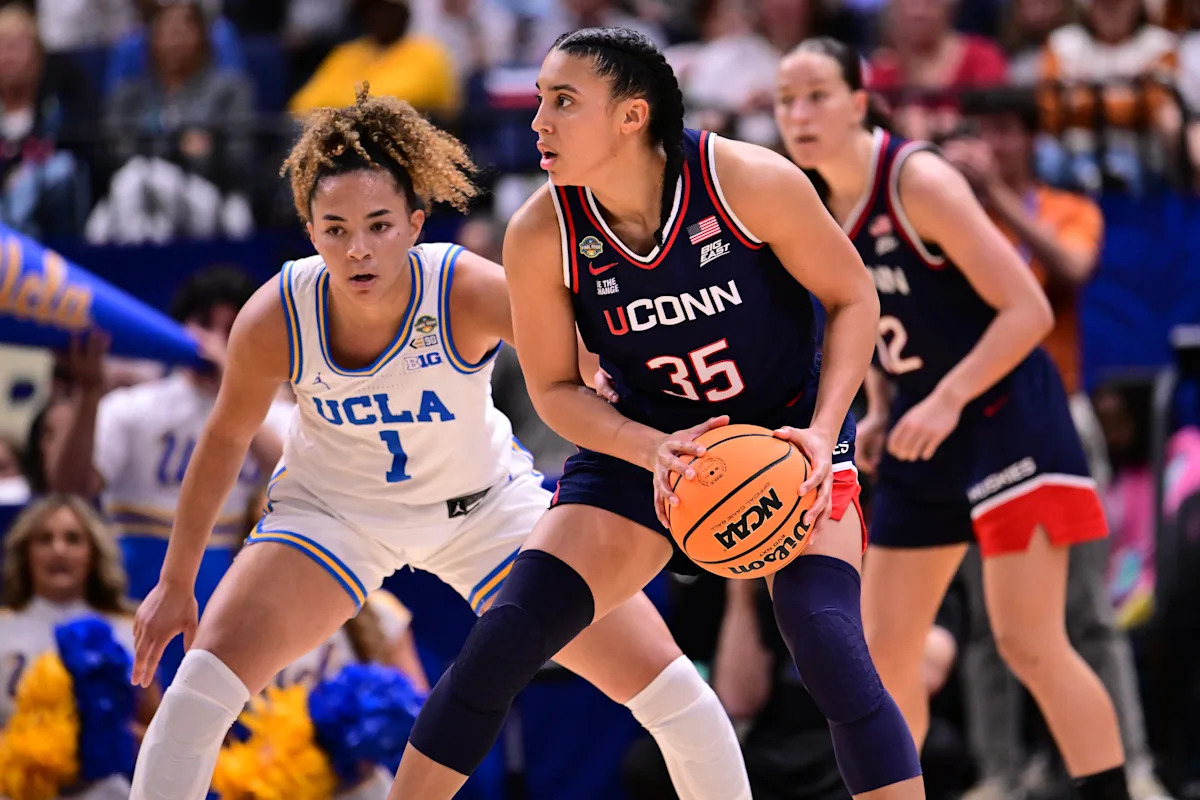
The 2026 WNBA Draft is shaping up to be a difficult one to project—not just because of the talent of the draft class, but also because most teams currently only have a few players under contract.
WNBA players, of course, continue to negotiate a new collective bargaining agreement (CBA) with the league, and in anticipation of this, most of them avoided signing contracts that ran past 2025, with the exceptions being those who are still on their rookie-scale deals. In other words, with such an enormous pool of free agents, it’s virtually impossible to predict how the 2026 WNBA Draft will shake out. The free agency period that usually precedes the draft is on hold, and at the moment, we don’t even know when the draft will be.
Advertisement
Basketball never truly stops, though, and as we wait for a resolution to the ongoing CBA negotiations, there’s an entire class of prospects making their cases to be drafted to the WNBA. As futile as they might be, mock drafts are a fun exercise, so let’s hash out a scenario of what the first round of the 2026 WNBA Draft might look like.
1. Dallas Wings: Awa Fam (Spain)
The world is once again the Wings’ oyster with their second-straight No.1 pick, but unlike last year, there’s no blindingly obvious selection for them to make with it, at least not yet.
That being said, Fam has a strong argument for being one of the first players off the board: She’s exceptionally skilled in the low post, has remarkable touch and vision as a passer and runs the floor better than most at her position. Fam is only 19 years old, so she still has a lot of growing to do, but playing alongside Paige Bueckers would help her development immensely, and drafting her would give the Wings one of the most talented young guard/center tandems in the WNBA. As a bonus, new Wings coach Jose Fernandez has a strong track record of working with international players from his time at South Florida, and he’d love the opportunity to tutor one of the brightest talents in Europe.
Advertisement
2. Minnesota Lynx: Lauren Betts (UCLA)

The rich got richer when the Lynx acquired this pick from the Chicago Sky. Though the news of franchise player Napheesa Collier’s upcoming ankle surgery was a bit startling, they’ll remain firmly in win-now mode for 2026, so they’ll probably want to draft someone who can contribute right away. A massive presence in the post with a strong back-to-the-basket game, Betts wouldn’t be asked to do nearly as much in Minnesota as she does for UCLA, where she’s averaging 16.2 points, 8.1 rebounds and 3.1 assists per game; at 6-foot-7, though, she’d give the Lynx some much-needed size, allowing them to match up better against teams with larger frontcourts.
3. Seattle Storm: Olivia Miles (TCU)

The Storm missed out on drafting Miles last year when she chose to stay in school and transfer to TCU, but they may get another opportunity in 2026. As expected, Miles has been enormously productive for the Horned Frogs, posting averages of 18.4 points, 7.5 rebounds and 7.8 assists per game (all career-highs), and she’s already recorded four triple-doubles. Players who stuff the stat sheet like that don’t grow on trees, and with All-Rookie center Dominique Malonga locked up through 2027, it would be awfully enticing for Seattle to draft a guard like Miles to pair with her.
Advertisement
4. Washington Mystics: Azzi Fudd (UConn)

Unlike most other WNBA teams, the Mystics have a good chunk of their core still under contract for 2026 and beyond, so they won’t have to worry as much about which prospect will be the perfect fit at No. 4. They could certainly use another shooter, though, and Fudd is perhaps the best such player in this class. She’s averaging a career-best 18.1 points for the defending champion Huskies and shooting a blistering 49.5 percent on 6.5 3-point attempts per game. Just about every team could use a player with that kind of marksmanship, especially the Mystics, who ranked last in the WNBA in 3-pointers attempted in 2025.
5. Chicago Sky: Flau’Jae Johnson (LSU)

Stop us if you’ve heard this one before: The Sky are in disarray and there are major questions surrounding their relationship with their star player.
Advertisement
Regardless of whatever happens with Angel Reese, the Sky need to make sure they get this pick right, and they’ll probably be looking for a guard for some much-needed backcourt depth. Johnson isn’t a traditional ball handler, and she’s more adept at creating shots for herself than for others, but she’s become more steady-handed and efficient throughout her collegiate career, and she has an extra gear of athleticism that few of her peers can match. The Sky may not be able to afford to pass on her.
6. Toronto Tempo: Ta’Niya Latson (South Carolina)

The WNBA will be adding not one, but two expansion teams in 2026, and we still know basically nothing about a potential expansion draft, so projecting what those teams will do for this exercise is especially difficult. In any case, Latson is the most prolific scoring guard in the class, and she’s shown growth in several key areas since transferring from Florida State to South Carolina, improving her efficiency (51.9 percent field goal percentage) and cutting down on turnovers (1.6 per game). Factor in the WNBA readiness typical of Dawn Staley-coached players, and Latson becomes someone an expansion team would gladly draft in the first round.
Advertisement
7. Portland Fire: Kiki Rice (UCLA)

It took Rice a couple years to live up to her recruiting hype, but she’s grown into one of the best all-around lead guards in the country. She’s having her best season as a scorer (15.4 points per game; 48.7 percent shooting), takes good care of the basketball (2.59 assist/turnover ratio) and impacts the game on the boards (6.9 per game) at a level most guards can’t. Where she truly shines, however, is as UCLA’s leader; Bruins head coach Cori Close frequently credits her with setting the on- and off-court tone during UCLA’s recent ascent, and those qualities typically aren’t taken lightly by WNBA scouts—especially those working for an expansion team.
8. Golden State Valkyries: Gabriela Jaquez (UCLA)

Jaquez established herself as one of UCLA’s most important players last season, and she’s taken another leap as a senior, averaging 14.2 points, 6.2 rebounds and 2.3 assists per game on highly efficient shooting splits (57.5 percent on 2-pointers, 50.9 percent on 3-pointers and 86.1 percent on free throws). Simply put, there’s not much Jaquez can’t do on the court, and that kind of malleability will make her a coveted prospect. It’s tough to project what the Valkyries are going to look like in 2026 given last year’s patchwork roster, but it would be reasonable for them to target someone who can contribute immediately and help them build on their early success.
Advertisement
9. Washington Mystics: Janiah Barker (Tennessee)

Barker has bounced around during her collegiate career, but it’s not for a lack of talent. At 6-foot-4, she moves, handles and drives like a guard, and that versatility carries over to the defensive end, where her mobility and length allow her to be as disruptive against ball handlers as she is in the paint. Barker’s stats have never truly reflected her potential, though the 14.2 points, 6.8 rebounds and 1.4 steals she’s currently averaging are nothing to sneeze at, and a rebuilding team like Washington can afford to prioritize her development more than others might.
10. Indiana Fever: Raven Johnson (South Carolina)

Johnson had the option to enter the 2025 WNBA Draft but chose to stay in school, a decision that’s looking like a wise one. She’s having by far her most efficient shooting season (58.6 percent on 2-pointers, 39.5 percent on 3-pointers and 84.2 percent on free throws), and her 4.05 assist/turnover ratio ranks No. 4 in the country. It’s unlikely that Johnson is ever a volume scorer in the WNBA, but that won’t be what teams ask of her. The Fever have enough star power, so they could use a defensive-minded guard who is plenty used to setting up her teammates.
Advertisement
11. Washington Mystics: Nell Angloma (France)

France has been a hotbed of WNBA talent in recent years, and Angloma is the country’s latest can’t-miss prospect. At 19 years old, Angloma already has the size and skill to be one of the league’s better slashers; she’s currently averaging 16.3 points per game and shooting 63.4 percent on 2-pointers in the Ligue Féminine, and it’s exciting to think about what she may become when she reaches her athletic prime. Of course, that may not be for a few more years and we don’t yet know if she’ll play in the WNBA right away, but she’s a no-brainer as a draft-and-stash prospect.
12. Connecticut Sun: Gianna Kneepkens (UCLA)

The Sun have plenty of young talent and athletes, but they’re a little light on jumpshooting. They could fix this by drafting Kneepkens, who has shot no worse than 42 percent from deep in any of her last four collegiate seasons and is currently knocking down 46.4 percent of her 3-point attempts for the Bruins. She’s shown flashes of tertiary playmaking ability, too—both at UCLA and her previous school, Utah—so while there will be questions about her ability to defend on the perimeter, she’ll fit just about anywhere offensively, which should keep her in first-round range.
Advertisement
13. Atlanta Dream: Marta Suárez (TCU)

Stretch bigs are becoming more and more valuable in the WNBA, and after seeing what Karl Smesko and his staff did with Naz Hillmon in 2025, it’s reasonable to think they’ll look for another forward who can space the floor. Suárez’s statistical profile fits the bill: She’s averaging 18.3 points per game and shooting it efficiently from both 2-point (63.3 percent) and 3-point range (42.9 percent), and at 6-foot-3 she’d have the size to play against most WNBA power forwards. Suárez wouldn’t have a large role in Atlanta—at least not right away—but playing alongside wings like Allisha Gray and Rhyne Howard would get her plenty of open looks on the perimeter.
14. Seattle Storm: Cotie McMahon (Ole Miss)

McMahon transferred to Ole Miss after three productive seasons at Ohio State, and she’s playing a starring role for the Rebels, averaging a career-high 18.9 points per game. Her trademark physicality and hustle remain consistent, and though she’ll probably need a dedicated player development coach to help her improve her lukewarm free throw shooting, her physical tools are beyond reproach. The Storm make sense as a team that can invest in McMahon and help her game translate to the WNBA level.
Advertisement
15. Connecticut Sun: Tonie Morgan (Kentucky)

This is less of a team-specific projection and more of a prospect playing their way into consideration. Morgan had been a steady floor general for three seasons at Georgia Tech, but she’s raised her game to All-SEC levels since transferring to Kentucky, ranking second in Division I in assists per game (8.7). More importantly, she’s looked more comfortable shooting the 3-pointer, albeit on low volume; Morgan will probably always be a better downhill scorer than jumpshooter, but if she can make defenses respect her shot over the course of an entire season, she could be a late riser on draft boards.
