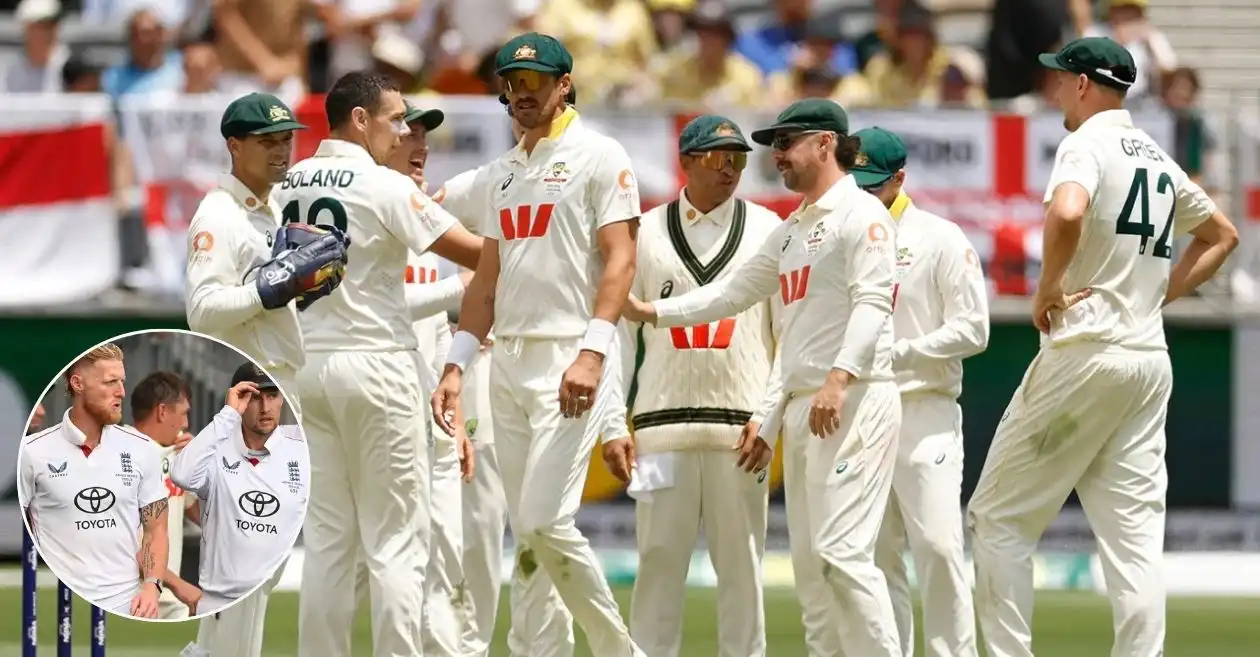
The Ashes 2025-26 series is set for a thrilling day-night contest, with the second Test at The Gabba, Brisbane, scheduled from December 4th to 8th, 2025. This match pits England’s ‘Bazball’ against Australia’s established dominance in pink-ball cricket. The home team’s record in day-night Tests is staggering—winning 12 of their 13 home matches before a recent rare loss to West Indies—a testament to their masterful understanding of the moving pink Kookaburra ball, particularly under the floodlights.
For England, who have never won a pink-ball Test against Australia and have struggled with the extra movement, this match presents a significant psychological hurdle. While the entire Australian squad carries this pink-ball pedigree, some specific players possess the perfect blend of skill and tactical importance to make life miserable for the English batters and bowlers alike.
3 Aussie players who can dominate England in the pink-ball Test
1. Mitchell Starc: The pink-ball wizard
If there is a player synonymous with day-night Test success, it is Mitchell Starc. His left-arm pace, coupled with the extra lacquer of the pink Kookaburra, transforms him into a near-unplayable force when the lights take full effect—a period former England captain Joe Root noted can see the game “turn around” instantly.
The deadly stat: Starc is the undisputed leading wicket-taker in day-night Test history, boasting an astounding 81 wickets in 14 matches at a sensational average of 17.08. No other bowler is close to his tally.
The threat: The pink ball’s seam and lacquer allow Starc to find prodigious swing, often late and fast, making the perfect outswinger to the right-hander—which targets the stumps—his stock delivery. His ability to produce a devastating late-evening spell, often coinciding with the fall of natural light, is a psychological weapon that can dismantle England’s top order. The memory of Starc bowling Rory Burns first ball in the 2021-22 Ashes day-nighter will be fresh in the minds of the English openers.
2. Steve Smith: The anchor against the glare
While Steve Smith‘s career average hovers near 56, his numbers in day-night Tests are surprisingly subdued, averaging around 37.04 from 13 matches with only one century. However, it is precisely this narrative, and his meticulous preparation for this specific challenge, that makes him a player to watch.
The deadly stat: Despite his overall pink-ball average being below his lofty standards, Smith remains Australia’s second-highest run-scorer in day-night Tests (815 runs). Crucially, at the Gabba, he has an excellent record against the pink ball, suggesting a localized comfort with the venue and conditions.
The threat: Smith has openly admitted the pink ball’s glare and movement at twilight is his biggest challenge, going so far as to experiment with anti-glare ‘eye-black’ strips in the nets before the Test. His determination to conquer this one weakness, combined with his technical genius, means a big score is always around the corner. If he can survive the initial onslaught and occupy the crease through the challenging twilight session, his presence alone will demoralize the English attack, allowing the rest of the order to play around the best crisis-manager in the game. His resilience and hunger to perform where he has previously struggled make him a massive threat.
Also READ: No Steve Smith! England legend James Anderson names his all-time combined Ashes XI
3. Scott Boland: The Gabba specialist
Scott Boland may not have the extensive pink-ball history of Starc, but his unique combination of pitch-whispering accuracy and phenomenal record at the Gabba makes him a lethal component of Australia’s attack under the lights.
The deadly stat: Boland’s overall Test average of 17.66 (before this series) is elite, but his average at the Gabba is an astonishing 10.20 from a significant sample size of first-class and Test cricket. He has taken 31 first-class wickets at this ground at an average of 15.90.
The threat: The pink ball, especially at a venue like the Gabba, demands laser-like accuracy to exploit the slightly greater seam movement under lights. Boland’s bowling is built on hitting the perfect spot repeatedly, applying relentless pressure, and extracting subtle seam movement off a good length. While the search results show he had a tough first innings in the previous Test, his bounce-back 4/33 in the second innings showcased his ability to learn and adjust quickly, a key trait in the rapidly changing conditions of a day-night Test. England’s batters, who like to score freely, will be severely tested by his unyielding line and length.
