Editor’s note: This story is the fifth in a series related to Purdue’s 2000 football season.
In 1999, Purdue‘s defense had no answer for the duo of Michigan quarterback Tom Brady and running back Anthony “A-Train” Thomas.
Advertisement
A year later, in what was a make or break moment in Purdue football‘s 2000 season, the Boilermakers sat in the locker room at halftime facing a similar fate. In the first half, the Boilers had a dropped pass in the end zone and had to settle for a field goal, and had another drive stall when Drew Brees was intercepted in the end zone.
“It was kind of a gut check at that point,” tight end Tim Stratton said. “The start of that game didn’t go extremely well.”
Thomas and quarterback Drew Henson led the Wolverines to a 28-10 halftime lead at Ross-Ade Stadium, including a 16-yard touchdown on third-and-goal in the first half’s final seconds. A Purdue team with Big Ten championship aspirations was on the cusp of falling to 1-2 in conference play.
After a week of being warned that Michigan was the best offense Purdue’s defense would see, it was confirmed in just two quarters.
Advertisement
“I just felt like we weren’t going to stop them in the first half no matter what we did,” linebacker Gilbert Gardner said. “But we just hung in there.”
Purdue football’s comeback over Michigan changes 2000 season
“There was a weird calmness in the locker room. We knew we had made some mistakes. We knew things weren’t going our way yet,” kicker Travis Dorsch said. “Drew spoke up as the leader he was. It took the coaches 10 or 15 minutes into halftime before they even came in and spoke a word. They just gave us a space.”
“I remember walking into that locker room and everybody sits down and it was a silence,” cornerback Chris Clopton said. “Normally, that would put fear in a coach. Everyone had this ah-ha moment at the same time. They aren’t this giant. We came out more confident and relaxed.”
Advertisement
“We got dominated in the first half, but we had the ability to say ‘OK, let’s reset and go back and do your job.’ If you do your job and trust the process, we’ll come back and win,” defensive end Akin Ayodele said.
Steve Ennis capped an 11-play drive to open the second half with a 1-yard leap over the defense on a third-and-goal. The defense answered by forcing a punt on Michigan’s first drive of the second half. Montrell Lowe scored on a 16-yard run to cut the score to 28-23. After a Jeff Del Verne field goal for Michigan, John Standeford caught a 10-yard touchdown pass in the fourth quarter, but Purdue’s two-point try failed.
Michigan led 31-29 with 6:45 to go.
After six miscues with the punting unit already during the season costing Purdue in a pair of two-point losses, Tim Stratton became Purdue’s long snapper and Dorsch was relieved of punting duties, focusing solely on kicking while Scott Kurz was elevated to No. 1 punter.
Advertisement
“Coach (Joe) Tiller told me you’re going to have to hit a game-winning field goal for us and we don’t want your leg tired from punting,” Dorsch said. “That was a cop out if I ever heard one.”
The year 2000 had been an extremely tough one on Dorsch, who started it on the wrong foot. Dorsch missed an extra point and three field goals in the Jan. 1, 2000, Outback Bowl, a game Georgia rallied from 25 points down to stun the Boilermakers. He’d missed a field goal the week prior to Michigan in a 22-20 loss at Penn State.
With 2:15 to go and Purdue trailing the Wolverines by two, Dorsch had a chance at redemption, lining up on the left hash from 32 yards.
“That was a really windy day and a really challenging day,” Kurz said. “That field goal was into the wind in the horseshoe side of the stadium.”
Advertisement
“I trot out knowing full well I am going to make the kick,” Dorsch said. “I had a great warm up. I was kicking well that day. It was my time and I just pulled it a little bit. When you’ve got a little adrenaline, you tend to fly the left foot open a little bit and open the hips much like a golfer might when they’re trying to snap hook it hard. I drew it just enough it ended up outside the left post before it got there. I am standing there watching it miss and thinking, ‘I really don’t want to run back to my sideline. I wonder if I can go to Michigan’s sideline.’ You’ve got to be a man when you play football and I trot back off. Everybody gave me space because they knew I needed it. Some folks were probably just so disgusted with me at that point they didn’t want to be close to me.”
Dorsch, though, had an intuition he’d get one more crack.
Matt Mitrione tripped up Thomas on first down and Warren “Ike” Moore did the same on second down. Michigan threw incomplete on third down and was forced to punt after burning just 19 seconds off the clock. Receiver Vinny Sutherland returned the punt to the Purdue 40 with 1:41 remaining.
Eight plays later, Brees took the snap, ran toward the center of the field and downed the ball. Dorsch, the scapegoat just moments earlier, had another opportunity from 33 yards.
Advertisement
“This is the first time in my career, high school or college, that I didn’t warm up,” Dorsch said. “I just stood there right next to coach Tiller and (special teams) coach (Scott) Downing. Eyes closed, visualizing a kick to win it.”
“We had faith he was going to deliver,” receiver Donald Winston said. “We used to do a drill in practice. If Travis hits this 50-yarder you guys don’t have to run sprints. He usually delivered.”
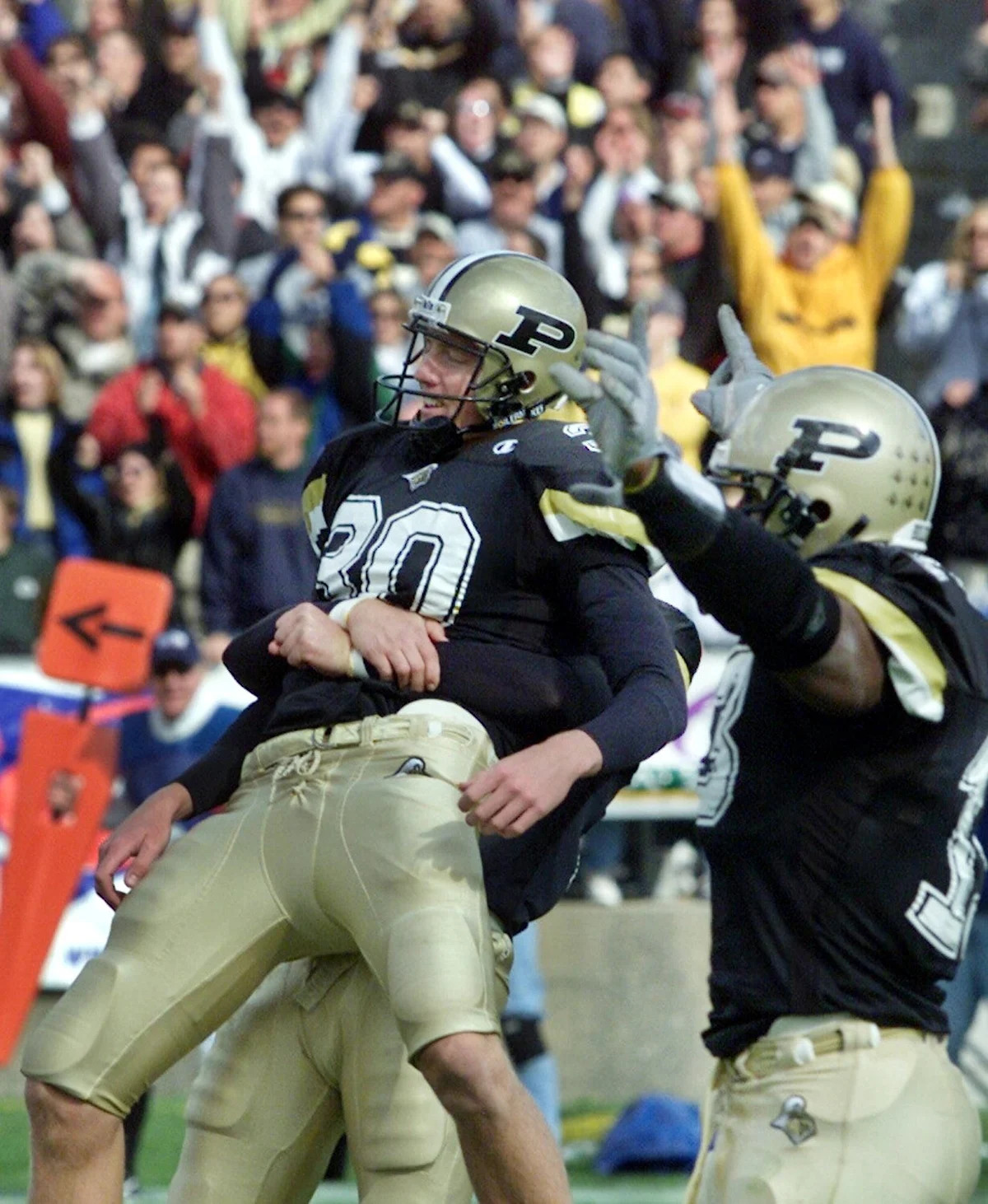
With a second chance, Dorsch’s kick this time snuck inside the left upright with four seconds left. An ensuing squib kick was scooped up and lateraled forward, which essentially ended the game, but freshman Patrick Schaub jumped on the ball just in case as fans stormed the field.
Purdue’s Travis Dorsch is lifted in celebration after kicking the game winning field goal during the Boilermakers upset win over the Wolverines 32-31 in West Lafayette.
“It was a stressful season for me, but I don’t think it compares at all the pressure that was on Travis,” long snapper John Shelbourne said. “I was impressed with how much he endured that whole season and how many he made. The whole season there was a lot of pressure on him from all sides. He had the mental fortitude to have to endure all that pressure and come out and hit a game winner against Michigan.”
Advertisement
“Travis had some games that year where he was on the struggle bus,” Sutherland said. “But we stuck with him and he kicked some big ones for us. That is one you never forget.”
“(Purdue radio play by play voice) Joe McConnell said finally pulled the monkey off his back. That was his call. Absolutely, I did,” Dorsch said.
During an on-field interview on the ABC broadcast after the game, Tiller said, “This is going to do a lot for our football team.” He didn’t know yet how right he was.
Stratton: “That was kind of a springboard for us.”
Tim Stratton’s helmet saga
The story of Stratton’s helmet in the aftermath of the Michigan game has become Purdue folklore.
Advertisement
Following the win, Stratton went with Brandon Gorin to go meet friends who played for Michigan. Stratton’s attempt to find Michigan defensive lineman Dan Rumishek was thwarted by the crowd rushing the field.
By the time Stratton made his way to the end zone to sing the fight song, Purdue’s football team already had left the field. Not to waste the moment, Stratton was crowd surfed to midfield before he realized he didn’t have his helmet.
“In that particular moment, coach Tiller was not very thrilled with me,” Stratton said. “He’s like, ‘How did a hundred other assholes get off the field with their helmet and you couldn’t?'”

Purdue’s Drew Brees finds a home in the arms of receiver Tim Stratton after throwing Stratton his second touchdown catch of the day during the Boilers 48-0 thrashing of Central Michigan at Ross Ade Stadium in West Lafayette on September 2, 2000.
Stratton used a backup helmet for practices the following week, noting the steel facemask was different than his typical titanium one.
Advertisement
“The whole week Tiller was threatening to suspend me if I didn’t get my helmet back,” Stratton said.
Stratton, from Oak Brook, Illinois, would miss a game at Northwestern, essentially a home game for him. Before Thursday’s practice, the backup helmet ended up missing too. A team manager spilled the truth that Tiller had Stratton’s backup helmet taken away. Stratton went to the shells practice (shoulder pads and helmets) with no helmet and was accosted by Tiller, who reminded Stratton he wouldn’t play at Northwestern without his original helmet that was lost in the aftermath versus Michigan.
“I go, Wonder Boy, which is my nickname for Drew, had his helmet taken two years ago after a bowl practice and nobody said a word about it,” Stratton said. “There’s no penalty for him, but I’m getting suspended? … I regret how I talked to the coach, but I was frustrated. Lo and behold, after that exchange my backup helmet came out to practice.”
That same night, linebacker Alex Tone received a call about 2:30 a.m. which caller ID labeled coming from a Purdue computer lab. The message said Stratton’s helmet was underneath the north end zone goal post in Ross-Ade Stadium where he’d left it after the Michigan game.
Advertisement
“Now the helmet is secured at my house,” Stratton said.
Purdue finally gets a road win
The win over Michigan improved Purdue to 4-0 at Ross-Ade Stadium, but the Boilermakers had yet to win a road game when they headed to Northwestern on Oct. 14.
“Coach Tiller did a great job keeping us focused,” Ayodele said. “It was right after that Michigan game and the most important thing was just win one more game. Focus on the game in the moment.”
Brees threw three touchdowns to Standeford and two more to Sutherland. Ayodele and Ralph Turner each had interceptions and Purdue won 41-28.
Advertisement
“We beat the crap out of Northwestern and we went on a run after that,” guard Ian Allen said.
A wild day in Wisconsin
In Purdue’s 1998 visit to Camp Randall Stadium, Brees threw an astonishing 83 times, completing 55 for nearly 500 yards. But the throw most remember is one intercepted by Jamar Fletcher and returned for a 52-yard touchdown at the end of the third quarter. Between the third and fourth quarters, House of Pain’s “Jump Around” played through the stadium speakers, the first time of what is now a longstanding tradition.
On Oct. 21, 2000, Chris Chambers’ 28-yard TD reception from Jim Sorgi had the Badgers up early, but Purdue answered with Brees’ 30-yard TD strike to A.T. Simpson on third-and-16.
Advertisement
“I think we practiced that play probably 40 times in practice, and it was just like how we scripted it. I think that that game, because we were so prepared, we never thought that we wouldn’t win,” Simpson said. “And as we know now, it’s extremely hard to beat Wisconsin, let alone up there.”
Seth Morales, a walk-on transfer from Butler, would make the biggest play of his career (until the following week) when Brees hit a 78-yard bomb for a touchdown in the third quarter, a nice birthday gift for Morales, who was the third option on the play. Purdue led 21-17 when “Jump Around” played.
“They do “Jump Around” and (Purdue center) Chukky Okobi was doing a dance off with (Wisconsin defensive tackle) Wendell Bryant at midfield,” Morales said.
“If you go back two years prior to the ’98 game where Drew threw so many passes I thought his arm was going to fall off, that was the first game they played ‘Jump Around.’ I remembered that. I remembered being in the huddle between the third and fourth quarter in ’98 and they played ‘Jump Around.’ Obviously it’s a big tradition now, but back then they’d never seen it before,” Okobi said. “It was so intense and incredible that going into that game in 2000, I was waiting for that moment. I had been thinking about that moment for so long and was so excited that I just let go. I just let how you feel take over. I was having fun.”
Advertisement
The game went to overtime. Wisconsin started with the ball. Ralph Turner and Gardner tackled Michael Bennett at the line of scrimmage on first down and Ashante Woodyard broke up a pass to Chambers on second down. Following a false start, Wisconsin faced third-and-15 from the 30. Ayodele came off the edge and sacked Sorgi, his third sack of the game.
“I called to bluff the pressure and we’d been running a lot of pressure and movement, so we had to do something different,” defensive coordinator Brock Spack said. “Our backers did a good job of selling the blitz. Akin, he is so quick and he made a huge play and ran right by the tackle. That put them behind the sticks and it changed the whole momentum. They were backed up for a long field goal.”
The Badgers sent kicker Vitaly Pisetsky to try a 58-yard field goal.

Purdue’s Travis Dorsch congratulates Ashante Woodyard, right, after Woodyard scored the game winning touchdown in overtime by returning a blocked field goal attempt in overtime at Wisconsin on October 21, 2000. Purdue won the 30-24 thriller.
“I was surprised they would take a shot at it from that long, but I am sure they felt like they had nothing to lose with it being a losing possession either way,” defensive lineman Craig Terrill said. “Long kicks are going to come out low, so if I can bust my head through the offensive line, I could get back there and get a hand on it.”
Advertisement
Terrill would go on to block a franchise record eight field goals with the Seattle Seahawks in his NFL career, but until this moment, he’d never blocked one.
“Craig just got great push and that’s really what you sell those D-linemen on, whether it’s an extra point or a field goal, is just having great pad level, getting off and then getting those hands up on that third step,” defensive line coach Mark Hagen said. “He obviously broke through, had great leverage, and those hands come up and you hear the thump, thump of the ball. And it just happened to take a perfect bounce.”
“The way the ball bounced to Ashante, it was like slow motion and it bounced right into his hands. It was pandemonium,” safety Brady Doe said.

Purdue’s Ashante Woodyard, right, feels the emotion of the moment as he celebrates with teammate Akin Ayodele in the locker room after scoring the game winning touchdown in overtime by returning a blocked field goal attempt in overtime at Wisconsin on October 21, 2000. Purdue won the 30-24 thriller.
“Ashante tore his ACL that May — that is a side note — I was out recruiting and I get a phone call from Denny Miller, our trainer, and he said, ‘I have some bad news. Ashante Woodyard just tore his ACL.’ He was playing basketball if I recall. It’s unbelievable,” Spack said. “He never missed a practice that I recall. It was like a miracle. That is six months-to-a-year rehab and he was back in less than two months.”
Advertisement
Woodyard showed no signs of a knee injury after snagging the blocked kick, returning it for a walk-off touchdown.
“Craig hit the ball and I saw it clear as day and said, ‘Man, I am going to be able to score a touchdown here.’ The ball bounced right into my hands,” Woodyard said. “All I had to do was avoid one tackle. I stiff-armed the kicker and the rest is history. The next thing I remember is I am on the ground with the whole team on top of me and I can’t breathe underneath the pile.”
Purdue’s 30-24 win set up a big game against Ohio State on Oct. 28.
Drew Brees fixes interceptions against Ohio State
During a month of miracles, Purdue had one more when the Buckeyes visited Ross-Ade Stadium.
Advertisement
“We should have beat them the year before in the rain. We didn’t. We knew winning this would put us in position to win out and we’re in,” Sutherland said. “Everything came down to that game basically. We’d already beaten Michigan. We already beat Northwestern. We lose that one we’re out. We knew that.”
Ohio State scored first, thanks to a Nate Clements interception, the first of four thrown by Brees. The final turnover is where the tale of one of the most memorable wins in Purdue history began. With 4:37 to go, the Boilers had the ball and a 24-20 lead. On third down, Brees, under pressure, threw into the flats off his back foot. Mike Doss picked off the pass and got to the 2-yard line before Brees knocked him out of bounds.
“Drew almost knocked himself out on his last interception. He definitely holds himself accountable,” Sutherland said. “He’s never shied away from that. We were only going to be as good as Drew and the offensive line and they were pretty damn good.”
Three plays later, Jerry Westbrooks scored the go-ahead touchdown for the Buckeyes.
Advertisement
The next 2:16 live on in Purdue lore.
“Drew was standing by himself on the sidelines, and so I just walked up to him and was like, ‘Hey, man, you put us in this. Get us out. You break it, you fix it,'” Moore said. “And the point that I remember most of that is when he turned to me and said, ‘I will.’ And he never talks about that. He looked me and said, ‘I will.'”
“Vinny was out (on the kickoff return). Chris Clopton took the ball and returned it about 35 yards,” Clopton said. “It put us in a whole different mode of operation. That was a critical return that gets lost in the throw to Seth Morales.”
Brees’ first-down pass was batted down. His second-down pass is the play coined “Holy Toledo” by ABC play-by-play announcer Brent Musburger. Morales got behind the defense. Brees went through his progressions and found the open man for a 64-yard touchdown with 1:55 remaining.
Advertisement
“Nine times out of 10, Drew is never going to throw that ball on the deep post or the skinny post,” Stratton said. “That was the great thing about him. He was able to read through and he did that even in walk throughs, he was always 1, 2, 3, 4, 5. Always great about that.”
A photo of Morales’ touchdown still resides in Purdue football’s press box today.
“It’s an iconic moment for Purdue diehards. It was definitely a defining moment for the program,” Morales said. “Moments like that happen every two or three or four decades. It had to be the right quality of talent, the right coaches and the right schedule and the stars aligned. You throw in a fourth option walk-on catching that pass late in the game, it’s the cherry on top of the whole era of Tiller and Brees and that run we had. I am one small chapter in a pretty good book.
“I would take a defining moment over being an All-Big Ten guy who started for three years and was on a mediocre team. Even if I went to the NFL, I would have taken this defining moment over a path like that. It has meant a lot in my life. Being an honorary captain and having my kids come back and watch me get celebrated, the stories continue on. It was a unique story.”

Purdue’s Seth Morales hauls in the game winning 64 yard touchdown catch in the fourth quarter as OSU’s David Mitchell watches at Ross-Ade Stadium in West Lafayette on October 28, 2000. The Boilers uspset the Buckeyes 31-27 to remain in first place in the Big Ten.
But the defining moment still relied on Purdue’s defense getting one more stop.
Advertisement
“Seth caught the touchdown pass. Ohio State got the ball back right after that and they fumbled and I was able to jump on that fumble to finish that off,” linebacker Landon Johnson said.
Purdue’s 31-27 victory over the Buckeyes culminated with a second field storming at Ross-Ade Stadium in October.
“It was the greatest moment I think Purdue’s ever had,” defensive backs coach Ken Green said.
Brees was asked about the finish and he gave credit where it was due: to Moore’s sideline motivation when the Boilermakers seemed down and out.
“After the game, he tells me you’re going to be the most talked about person in the media this week, because I told people what you said to me,” Moore said.
Advertisement
Said Hagen: “I’ve never been a part of a month of football like that ever. And this (2025 season) is year 30 for me as a full-time college coach.”
Purdue had an extended celebration after the fourth win in a row. The Boilermakers didn’t have a game the following Saturday. Come Nov. 11, all they had to do was win in East Lansing against 4-5 Michigan State, a team Purdue had beaten each of the previous three seasons, and the Boilermakers would clinch a Rose Bowl berth.
“It was kind of like a boulder rolling downhill,” strength coach Jim Lathrop said. “You feel the momentum develop and build. It was played almost perfectly. Other than that loss to Michigan State.”

Purdue University’s Seth Morales , bottom, is congratulated by team mate A.T. Simpson and some fans after catching the game winning pass from Drew Brees Saturday October 28, 2000 at Ross-Ade Stadium in West Lafayette. The Boilers beat Ohio State 31-27.
A nightmare in East Lansing
“We go to Michigan State and all we have to do is win this game and it’s over,” Spack said. “We win the Big Ten. We play bad. Everywhere. We couldn’t tackle anybody. We were a step slow. Coach Tiller said he’s never had a game that bad.”
Long story short, Michigan State beat Purdue 30-10, outscoring the Boilermakers 15-0 in the fourth quarter.
“That was a bad loss. We just didn’t come ready to play,” safety Ben Smith said.
“Everything felt off on that weekend,” offensive lineman Kelly Kitchel said. “Michigan State was a weird, weird game. I still hate going up to Michigan State because of that.”
“That was the enigma,” fullback Jacob Rowe said. “We were dead from the time we got on the bus to go to the airport. Nobody was excited. We were in such a great spot. That Michigan State thing, I don’t know.”
“Sometimes you put out what’s not your best effort and the other team, even if they’re not that great, they just shove it down your throat. That is what happened,” Kurz said. “I was named the radio station as player of the game and it’s never a good thing when your punter is the player of the game for any kind of competition.”
“Even when we got beat by teams that were maybe mediocre, it never changed our confidence in where we believed we could get to,” Winston said.
Purdue was down to one regular season game remaining.
“Once we got on a run there, we knew we were going to have a chance to win this thing and then we screwed it up at the end there,” defensive ends coach Gary Emanuel said. “We knew we were going to beat Indiana because we always beat Indiana.”
Nathan Baird and Sam King have the best Purdue sports coverage, and sign up for IndyStar’s Boilermakers newsletter.
This article originally appeared on Indianapolis Star: Purdue football Rose Bowl: Wins over Michigan, Wisconsin, Ohio State
