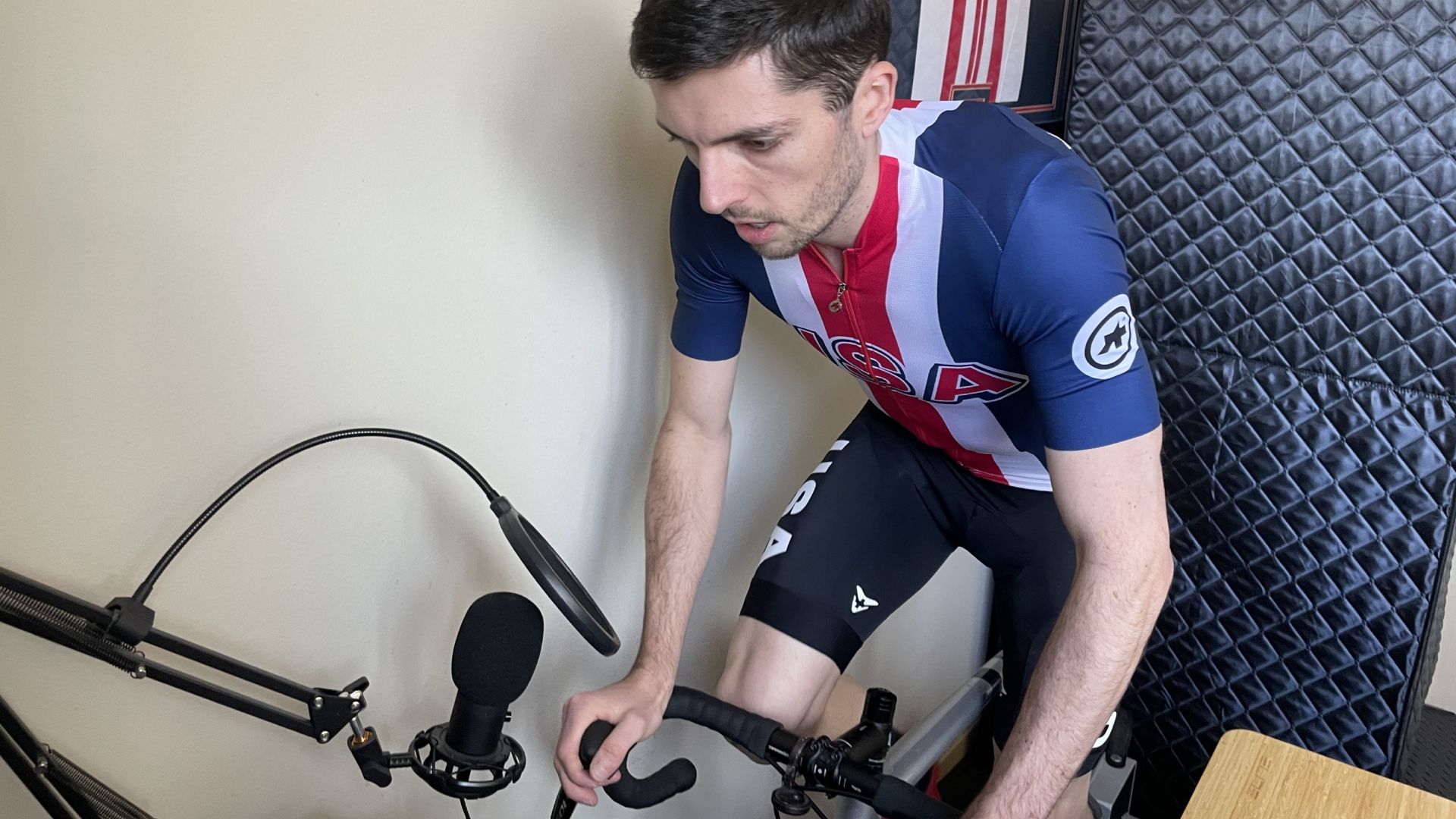
Throughout my life, I’ve only ever pushed the gas pedal about 80% of the way to the floor. I have worked hard and had some rewarding achievements, but I’ve never really gone all-in.
So that’s what I set out to do in 2026: to not only reach my goals, but to push myself so far past them that I no longer know what is possible. The first proving ground: attaining a Functional Threshold Power (FTP) of 450W.
The way I think about effort has changed a lot over time. Do you remember when you were a teenager and you thought you were working hard? You thought that homework, soccer practice and taking out the trash were big accomplishments for the day. The adults always told you that it would only get harder from there. That life would stack more time commitments and responsibilities on your plate every year until you can finally retire. By your late 30s, they said, you’d need a full pot of coffee just to feel human.
I didn’t want that life.
Over the next few years, I kept working, training and racing on the indoor trainer. Yet I also continued living a “normal” life alongside cycling. I was going out on the weekends, drinking with friends and eating fried chicken from the grocery store. I wasn’t living like a professional cyclist, not even close.
Lauf Gravel Worlds was next, and despite losing 30 minutes walking through mud, I finished the race with a Normalised Power of 300w for eight hours. My legs were good, but my technical skills were not. I went on to finish in the top half of the elite fields at USA Gravel Nationals and Big Sugar, yet something still felt unfinished.
I thought to myself: if I can perform like this while giving 80% of my effort, what happens when I finally give 100%?
That’s when I came up with the Road to 450w FTP. Since I was already at an FTP of 385w, 400w seemed too easy. I could get there in a month. So I upped the difficulty.
Sure, 420w would be a nice goal, giving me 6w/kg at 70kg, but again, that felt too safe. I don’t just want to be good, I want to see what “great” actually demands. So I landed on 450w, a number that would put me alongside the best riders in the world. These days, almost every WorldTour pro has an FTP of 400w, while the very best have far more in the tank.
Powerhouses like Filippo Ganna, Mathieu Van der Poel, and Wout Van Aert have FTPs closer to 500w. But they weigh 75–85kg depending on the time of year. These riders are taller and heavier than me, so I didn’t want to make a direct FTP comparison.
The best climbers in the world are 60–65kg, much lighter and shorter than me, with higher w/kg. Featherweights like Jonas Vingegaard, Remco Evenepoel and Primož Roglič likely have FTPs of 400–430w, but their small frames still allow them to hold nearly 7w/kg for half an hour.
Tadej Pogačar is the exception to every rule. Despite weighing ~66kg, the Slovenian likely has an FTP around 450w (6.9w/kg). The ease with which he drops the best riders in the world makes the data feel almost conservative.
The most direct comparisons for me are riders between 175–180cm who weigh 68–72kg. These riders can be exceptional climbers, time trialists, puncheurs or sprinters. Riders like Isaac Del Toro, Florian Lipowitz and Matteo Jorgenson fall into this category. Strong and powerful at roughly 70kg, these riders are pushing around 450w (6.4w/kg) for an hour. Gravel and eSport cycling widen the range even further with athletes like Matt Beers boasting an FTP of 480w (5.8w/kg).
Three-time UCI eSport Cycling World Champion Jason Osborne has an FTP of 460w (6.6w/kg), while also having the anaerobic ability to push 550w (8w/kg) for five minutes. Osborne is a step above every other rider in eSport cycling. He races like Pogačar; attacking at will, shredding the peloton and riding solo to victory in almost every race he starts. No one can compete with Osborne at the moment. So I asked myself a few simple questions: why not me? What is holding me back? And what is Osborne doing that I’m not?
As a racer and cycling coach, I’ve spent the last decade learning everything I possibly could about performance. While I’ll keep a few secrets to myself, I can share the pillars that are shaping this attempt.

1. Mental toughness and commitment
The biggest improvement that I’ve ever made to my performance is repeating this mantra before every race or workout: “I am going to give it my all today. If it doesn’t work out, that’s OK. But I will not choose to give up.”
For far too long, I was giving up mentally before my body gave up physically. I was quitting five-minute VO2 Max intervals at the halfway point because I thought it hurt too much. But as soon as I flipped the switch in my head, that I would never choose to give up, I suddenly found myself able to complete these intervals, push through the pain, and unlock better performances.
2. Zone 2 or VO2
My training plan is very basic. VO2 Max intervals, Zone 2 and recovery rides make up 95% of my training. That means lots of 40/20s, 30/30s, three-minute and four-minute VO2 Max intervals. You can play around with the structure a lot (e.g. 10x 30/30s versus 5 x 40/20s), but the main focus is VO2 Max power. Coupling this type of training with Zone 1 and Zone 2 rides has helped me make steady, long-term gains without burning out.
3. Torgue Intervals
Low cadence, high power intervals have helped me improve my fatigue resistance and overall power output. I perform torque intervals once every week or two in blocks of 4-10 minutes. The target cadence is somewhere between 40-60 rpm, while the target power is between tempo and threshold. I get the most out of these intervals by performing them seated, though a few seconds out of the saddle helps break up the monotony and utilise different muscle groups.
Those are the three biggest changes that I’ve made to my training in 2026, and if you’re reading this, you can do the same. While I don’t recommend jumping into extremely hard VO2 Max workouts right away, I do recommend working on your mental game first. This sets the framework for not just your cycling performance, but your entire life.
Once you find yourself in a good mental space, you will have the ability to accomplish more than you ever thought was possible. As you advance your training, you can try the workouts described above. Remember to start slowly and ease yourself into a new type of interval or session. Progressive overload is the key to making major gains and lifelong fitness improvements.
For example, try three sets of four minutes at 85% FTP and 55 rpm for your first torque workout. While the pros can handle 4x5min at 100% FTP and 40 rpm, that is a recipe for disaster as a beginner to torque. Ease into the sessions, give yourself ample recovery time, and you will feel the long-term gains stacking up.
When it comes to my own journey, achieving a 450w FTP isn’t about the end goal. It’s about the process and everything I will learn about myself along the way. It’s the loftiest goal that I’ve set in my entire life. I truly don’t know if I can do it, but I am certainly going to try.
Throughout this challenge, I’ll be racing both gravel and virtually. The gravel races will be anywhere between four and eight hours long, with punchy hills and sketchy descents, while the eSport races will be quite the opposite: full gas for an hour, never having to brake or position.
With a 450w FTP, races should theoretically become easier. My zones will shift, making it easier for me to sit in the pack and save energy. If my Zone 2 is 300w when I have a 400w FTP, it could be 330-350w when I have a 450w FTP. I could be recovering in Zone 2 while others are suffering.
But all this is easier said than done. I certainly hope that getting stronger also helps me go faster. Stay tuned to find out.
