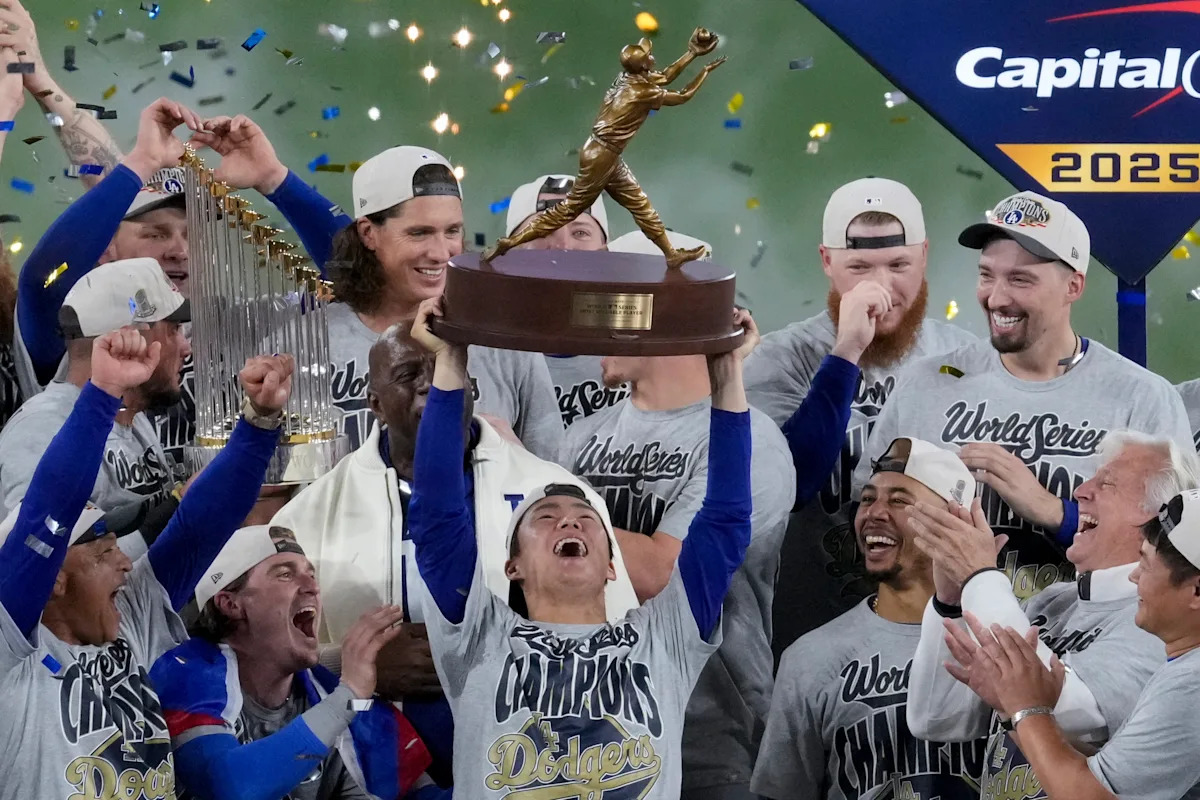
The Los Angeles Dodgers can do whatever they want.
MLB’s two-time defending champs, the sport’s new evil empire, remain a juggernaut of horrifying proportions. Their dominance was laid bare on the diamond in October, and it might take center stage once again during hot stove season. That’s because president of baseball operations Andrew Friedman is able to conduct business with (1) a seemingly bottomless budget and (2) one of the best farm systems in the game.
Advertisement
As the Dodgers seek to upgrade and revitalize their roster for a three-peat, Friedman can wield the organization’s unprecedented might in both free agency and the trade market. Los Angeles already pounced on the former, signing Edwin Díaz, one of the best relief pitchers in the world, to a three-year, $69 million deal. And still they lurk, like Jaws in Edgartown, waiting to strike on their next target.
But despite their status as baseball’s behemoth, the Dodgers are not a perfect club. Their outfield mix, which ranked 17th in bWAR among MLB outfields in 2025, is relatively pedestrian. Los Angeles’ bullpen — a unit so undermanned that it was essentially sidelined during the postseason — is still a work in progress, even with Díaz in the fold. Friedman could also stand to inject some youth into a position-player group that had the highest average age in MLB last season.
No matter what happens, the Dodgers for the most part are running things back. Why wouldn’t they? Whenever they bring back free-agent-in-name-only Kiké Hernández, L.A.’s projected Opening Day club will have 12 of the 14 players from the World Series roster (swap in Dalton Rushing for Ben Rortvedt at backup catcher and swap out defensive replacement Justin Dean).
In other words: The Dodgers have fewer questions than any other team in baseball. But they still have questions.
1. How will the outfield mix shake out?
It’s a first-world problem, but the Dodgers’ outfield was a casserole of mediocrity in 2025. Andy Pages, a flawed but productive presence in center field during the regular season, was painfully overmatched in October. In right, Teoscar Hernández took a step back offensively in his age-32 season and remains a defensive detriment. Michael Conforto, who didn’t take a single postseason plate appearance, was an unmitigated disaster in left.
Advertisement
The end of the woebegone Conforto Era means an open spot in the outfield. Ideally, Los Angeles fills that hole internally — by moving Tommy Edman from second to center and using the keystone as a carousel for youngsters such as Alex Freeland and Hyeseong Kim. But Edman underwent ankle surgery in October to fix an ailment that mostly limited him to infield duty in 2025, so the Dodgers might paper things over until Edman is full-go.
Pages, Teoscar, Alex Call and the yet-to-debut Ryan Ward could hold down the fort for the first few months. An external addition is also not out of the question, but given the layout of the roster, it’s unlikely to be a massive piece such as Cody Bellinger or Kyle Tucker, both of whom the Dodgers have interest in, but only on a short-term, high-AAV deal.
2. Are they out on this year’s Japanese free agents?
The past two winters, Los Angeles reeled in Shohei Ohtani, Yoshinobu Yamamoto and Roki Sasaki, three of the most sought-after Japanese free agents in baseball history. That transactional dominance created frustration amongst non-Dodger fans, who started to believe that the Japan to Chavez Ravine pipeline was preventing their favorite teams from having a chance to sign the next big NPB star.
Advertisement
But this year, none of the three major characters making the trans-Pacific leap — Tatsuya Imai, Kazuma Okamoto and Munetaka Murakami — appear to fit on Los Angeles’ roster. In fact, the Dodgers might be the only team in MLB with no need for Imai, a 27-year-old, right-handed pitcher. As the World Series just emphasized, L.A.’s starting pitching staff is an embarrassment of riches with Yamamoto, Ohtani, Blake Snell and Tyler Glasnow all under contract for a while. Signing Imai would all but relegate Sasaki to the bullpen and prevent homegrown arms such as Emmet Sheehan, Ben Casparius, Justin Wrobleski, et al., from taking turns in the rotation.
Okamoto, 29, and Murakami, 25, are both corner infielders, spots very much locked down by Freddie Freeman and Max Muncy. In theory, the Dodgers could have declined a $10 million option on Muncy and pivoted to either Japanese slugger, but they decided to keep the veteran third baseman around for 2026. Freeman isn’t going anywhere, and the DH spot obviously belongs to Ohtani. So barring a trade or a positional game of musical chairs, the Dodgers are probably passing on this year’s crop of NPB talent.
[Get more Los Angeles news: Dodgers team feed]
3. Is there a way for the roster to get younger?
The Dodgers were one of just two teams in 2025 whose position-player group’s average age was over 30 years old (Philly was the other). Father Time never loses — it might be the only force stronger than the Dodgers — which puts this roster in a fascinating spot moving forward. Mookie Betts is 33 and showed signs of offensive decline last season. Freeman is 36. Muncy is 35. Hernández is 33. Ohtani turned 31 in July. Will Smith will play 2026 at 31, relatively old for an every-day backstop.
Advertisement
It’s another first-world problem, but Friedman would love to find roles for the next generation of Dodgers regulars, including Freeland, Kim, Rushing and, eventually, hot-shot prospects Josue De Paula and Zyhir Hope.
Trading for a controllable outfielder under 28 would make some sense, and the Dodgers have the pieces to make it happen, but there aren’t too many obvious candidates afoot. L.A. made a push for Steven Kwan at the deadline and could revisit that option. Or perhaps the Red Sox’s glut of outfielders makes them a fit. If not, the Dodgers probably just roll in 2026 with an old team. Maybe all that Guggenheim money can finance a flux capacitor or something.
4. How many more external additions will be made in the bullpen?
By the end of the World Series, manager Dave Roberts was working with a bullpen of starting pitchers. In that unforgettable Game 7, Roberts called on five relief arms — Wrobleski, Glasnow, Sheehan, Snell and Yamamoto — none of whom is actually a reliever. Roki Sasaki’s emergence as a viable bullpen option was transformative, but the Dodgers still view him as a starter moving forward.
Advertisement
While the current bullpen looks strong on paper, particularly with Díaz in the fold, Friedman and Co. know how empty such projections can be. Tanner Scott arrived last winter on a record contract, then proceeded to stumble and bumble his way into irrelevance. A bounce-back from him would be massive. There’s other talent in this ‘pen — no doubt — but it wouldn’t be shocking to see the Dodgers bring in another dependable veteran arm such as Brad Keller, Pete Fairbanks or Luke Weaver.
5. Is a Tarik Skubal deal realistic?
With the two-time defending AL Cy Young just 12 months from free agency, rumors have swirled around Skubal like Charlie Brown’s rain cloud. The Dodgers, MLB’s Big Bad, have understandably emerged as a potential landing spot. For now, it’s all hearsay and clickbait, hopes and daydreams. Skubal probably isn’t getting traded. And if he were, other contenders without loaded rotations would probably be willing to trade more prospect capital to get him.
Advertisement
But if Tigers president of baseball operations Scott Harris changes course and decides to deal away the best pitcher on Earth, the Dodgers could put together quite an enticing package led by 20-year-old slugging outfielder Josue De Paula. It’s the type of trade that would send the entire baseball world into a frenzy, creating the kind of uproar not seen since Alex Rodriguez was dealt to the Yankees in 2004.
