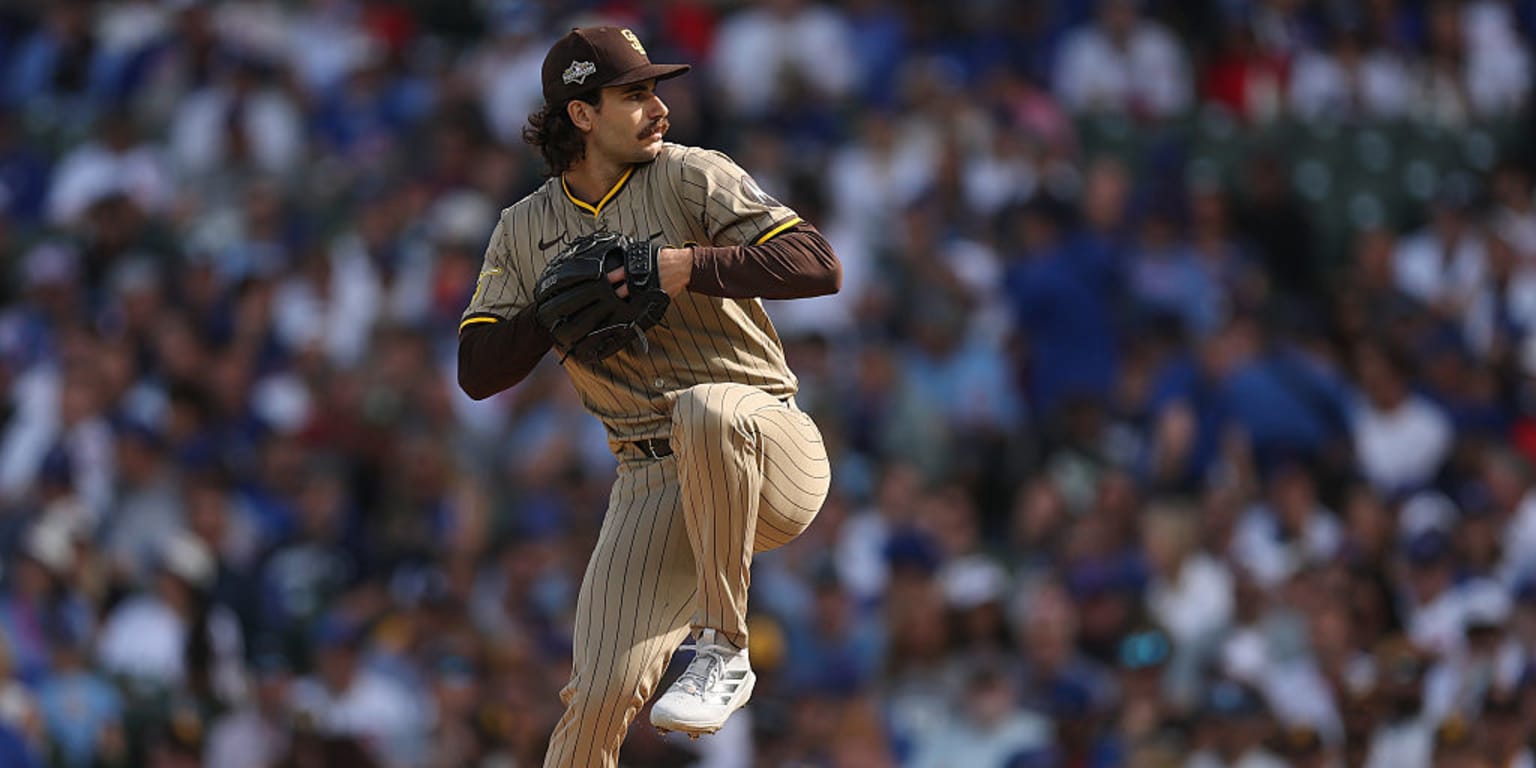
This year’s free-agent class of starting pitchers isn’t quite what it was a year ago, when proven aces like Corbin Burnes and Max Fried commanded deals north of $200 million. The crazed search for a front-of-the-rotation starter will be muddier this winter.
That’s where Dylan Cease enters the picture. The righty is the top-ranked starting pitcher on MLB.com’s Mark Feinsand’s top-30 free agent list. But his case is polarizing, especially after posting a 4.55 ERA with the Padres last season in an underwhelming walk year.
How comfortably, if at all, does Cease fit the bill of a front-end starter? It’s a question that front offices are already grappling with, and there’s no easy answer. Let’s explore Cease’s curious free agency case, taking both a glass half-empty and glass half-full approach.
Glass half-empty: 4.55 ERA
A year removed from a fourth-place finish in NL Cy Young voting – just a handful of votes behind third-place finisher Paul Skenes – and earning down-ballot MVP votes, Cease saw his ERA inflate by a full run, from 3.47 to 4.55. Seventy different pitchers threw at least 150 innings last season, and only 15 had a higher ERA than Cease. His ERA is sandwiched between Jack Flaherty and Luis Severino, two veterans who didn’t live up to the multi-year deals they inked last winter.
We know that ERA isn’t the end-all be-all that it once was, otherwise Cease wouldn’t be headlining this year’s class of free agent starting pitchers, nor would he be likely to receive a nine-figure deal. But it is still a barometer, and a 4.55 ERA equated to a 94 ERA+, or 6 percent below league average. That’s certainly not indicative of an ace-caliber pitcher.
Glass half-full: 3.43 xERA
As one NL executive told Feinsand, Cease is “better than his 2025 ERA.” Statcast’s Expected ERA (xERA) certainly agrees. By xERA – which attempts to credit the pitcher for the moment of contact, stripping the effects of ballpark, defense and luck – Cease resembled a front-of-the-rotation starter. Cease’s xERA in 2025 was in the 74th percentile, mirroring his 78th-percentile xERA from ‘24.
If you’re counting, that’s a 1.12-run gap between Cease’s 4.55 ERA and 3.43 expected ERA, one of the largest among qualified pitchers. The discrepancy stems from a blend of poor luck and poor defense.
Last season, Cease allowed a .320 BABIP – a player’s batting average on balls hit into the field of play – which was fifth highest among qualified starting pitchers. Intuitively, we’d expect pitchers with high BABIPs to allow a lot of hard contact, since harder-hit balls are more likely to turn into base hits. But it isn’t always that neat and tidy, and it’s certainly not with Cease, who posted the second-best hard-hit rate of his career (37.5%) last season, roughly in line with the league average. He allowed softer contact than he did the prior season, when his BABIP was just .263. From ‘24 to ‘25, Cease experienced one of the largest year-to-year BABIP increases in baseball, despite little change in the quality of contact that he allowed.
What’s happening here is that the Padres played exceptionally poor defense when Cease was on the mound. Cease allowed fewer unearned runs last season (six) than he did in 2024 (seven). But just as there are new ways to measure pitching, there are more nuanced metrics to assess defense, too. With Cease on the mound, the Padres posted -7 Outs Above Average. The year before, it was -2. Only seven qualified pitchers benefited less from their defense than Cease did. San Diego just didn’t make enough plays behind him, leading to a high BABIP and inflating Cease’s ERA.
What does this actually look like? Well, the play below — a “triple” aided by miscommunication in the outfield — ultimately led to an earned run.
Expected stats are not built to be predictive. But they can show us what happened – and in Cease’s case, it describes a remarkably different season than his surface-level ERA would indicate.
Glass half-empty: 9.8% walk rate
Command has long been Cease’s Achilles heel. This past season, he posted a walk rate in the 20th percentile, a step backwards from the 41st-percentile mark he had in ‘24. That may have been an outlier, because Cease has never run a walk rate better than league average in his career.
This reveals itself in a lot of the ways that you’re probably thinking about. For one, Cease struggles to throw strikes, with a 46.5% zone rate that ranked 213th of 221 starting pitchers to throw at least 500 pitches. Only eight pitchers had more three-ball counts than Cease. He walked multiple batters in 20 of his 32 starts, with a six-walk outing against the Dodgers in August.
The other problem here is this: When Cease falls behind in the count, he’s much less effective. Batters posted a .539 OPS against Cease when the righty had the count advantage; flip the advantage, and the hitters posted a 1.007 OPS. That’s essentially the difference between facing Shohei Ohtani and facing Joey Ortiz.
And yet, poor command isn’t an automatic deterrent. Just look at last winter, when the Dodgers signed Blake Snell to a five-year, $182 million contract, in spite of his 10.9% career walk rate.
Glass half-full: 29.8% strikeout rate
Everyone wants to miss bats, and no qualified starting pitcher missed more bats last season than Cease. He led the league with a 33.4% swing-and-miss rate, more than double that of his former Padres teammate, Randy Vásquez. These are ugly swings, too: Only three pitchers induced more swords last season than Cease, who routinely tied hitters in knots.
That translates to a whole bunch of strikeouts. Cease’s strikeout rate – 29.8% – was sixth highest in baseball, behind five legitimate aces. Only Zack Wheeler, Chris Sale, Logan Gilbert, Tarik Skubal and Garrett Crochet racked up strikeouts at a higher rate. In total, Cease recorded 215 punchouts, his fifth straight season with 200+ strikeouts.
Cease is consistently elite at this. Since 2021, 288 starting pitchers have faced at least 500 batters. Only four have a higher whiff rate than Cease (32.9%), and only 12 have a higher strikeout rate (29.7%).
Why since 2021? Well, that’s when Cease overhauled his pitch shapes, creating a four-seam fastball with exceptional ride and a harder, tighter slider. It’s his bread-and-butter, and he hasn’t looked back since.
Glass half-empty: 5.25 innings per start
Cease will take the ball every fifth day — more on that in a moment — but he may not stay out there for long. Among qualified pitchers, only Will Warren (4.92) and Clay Holmes (5.19) threw fewer innings per start than Cease. That’s not great company with Holmes, a reliever-turned-starter, and Warren, a 26-year-old rookie who, while solid as a No. 5 starter, isn’t vying for a nine-figure deal. Of the 22 pitchers to make at least 32 starts last season, only Warren pitched fewer innings than Cease (168).
This is at least a little about the third time through the order penalty, since managers are more cautious about letting their starters see the lineup a third time. Cease is not immune to that. Here are his splits by time through the order last season:
But Cease’s inability to go deep into games is really a lot about pitch count. At some point, the walks and three-ball counts become prohibitive. Cease averaged 18.1 pitches per inning last season, the most of any player who threw at least 150 innings. He threw at least 100 pitches in 11 starts, but in four of those, he completed five or fewer innings.
Glass half-full: 32+ GS for 5th straight season
There is still something to taking the ball every fifth day, which Cease does better than anyone. He has made at least 32 starts in five consecutive seasons, and may very well have added to that stretch in 2020, when he made 12 starts in the 60-game season.
Only three other pitchers — José Berríos, Patrick Corbin, and Kevin Gausman — have made at least 30 starts in each of the past five seasons. No one has matched Cease, whose durability stands out in an era where making every start is a lost art. Only 22 pitchers made at least 32 starts last season, one shy of the lowest single-season total in the Divisional Era (since 1969), excluding the lockout-shortened season in 1995.
Cease hasn’t been on the injured list since 2021. Even then, he didn’t miss a start, despite being struck by a 110.4 mph comebacker on his pitching arm.
There’s also value in reliability. In 2025, San Diego’s ace, Michael King, made just 15 starts. So did Yu Darvish. Depth options like Matt Waldron and Jhony Brito dealt with injuries. Already, the Padres had to scramble to fill rotation spots via call-ups and waiver claims. An injury to Cease would have prompted the Padres to reach deeper into their organizational depth chart, likely for a replacement-level player.
