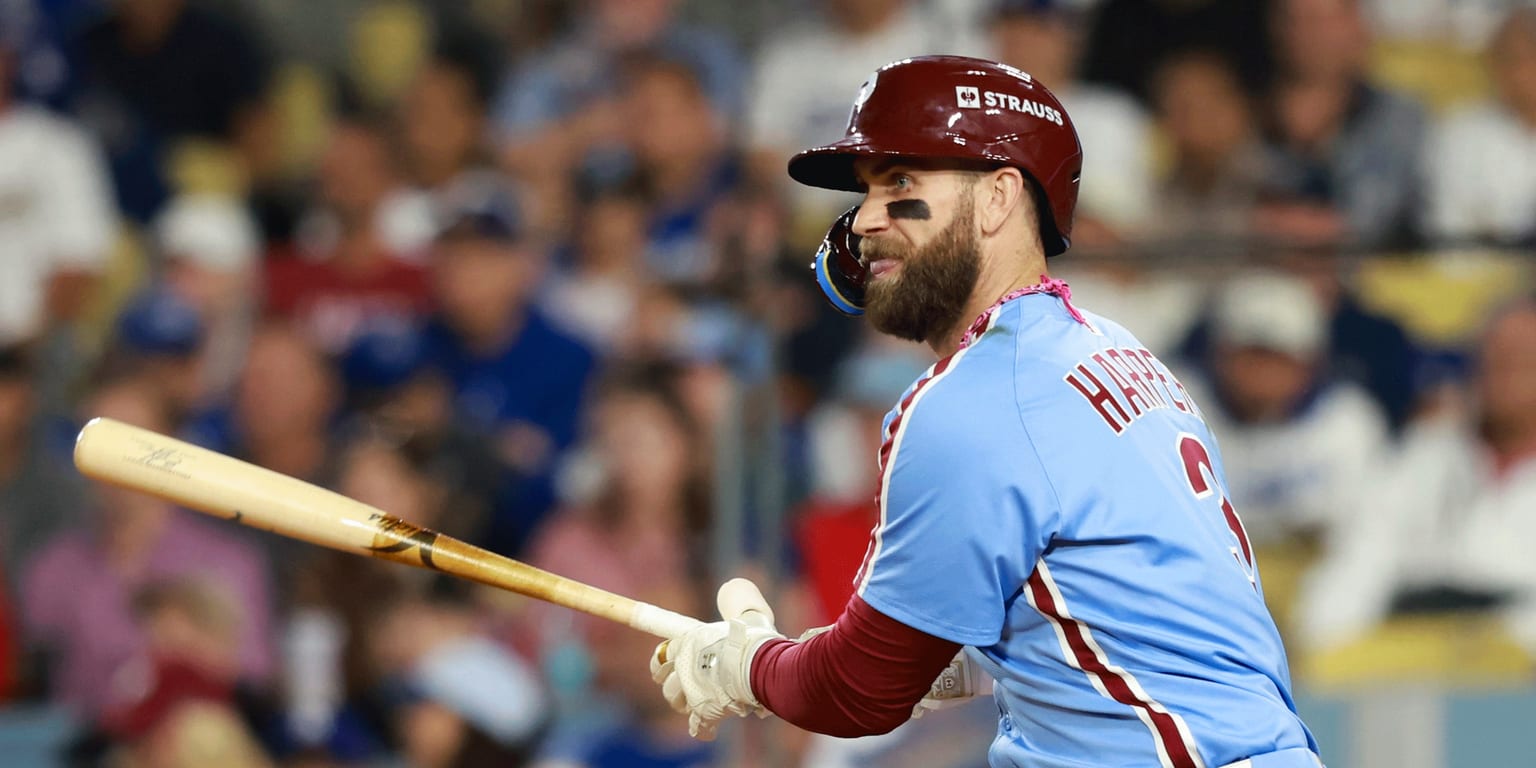
Another quick postseason exit fueled some hubbub earlier this offseason in Philadelphia, when Dave Dombrowski questioned whether Bryce Harper could rise to a truly elite level again.
The stir has since quieted. Dombrowski, the Phillies’ president of baseball operations, said he had a “nice conversation” with Harper, who was initially “hurt” by Dombrowski’s comments. This will soon be forgotten, especially by next season, when Harper is again the anchor of a Phillies team that expects to contend for a World Series.
Harper is also past the halfway point of the 13-year, $330 million contract he signed ahead of the 2019 season. He’s 33 now, and another critical year looms. Here are three reasons for optimism — and three for concern — for Harper heading into 2026.
He’s still hitting the ball hard
Last month, Harper’s agent, Scott Boras, responded to Dombrowski by comparing Harper to a Ferrari.
“You put gas in the tank, and the Harperi — meaning the Ferrari — works,” Boras said.
Pun aside, Boras has a point. Harper is still making the sort of violent contact that we’ve grown accustomed to. Last season, Harper’s hard-hit rate (47.5%) and average exit velocity (91.3 mph) were either equal to or better than his career averages. His barrel rate (12.3%) was a significant improvement from the 10.6% barrel rate he posted in 2024. These are good signs, because hard-hit balls and barrels — think hard-hit balls in the air — lead to drastically better outcomes for the hitter.
The power is in there, too
On one hand, Harper just posted a .487 slugging percentage in 2025, his lowest in a single season since ’16. On the other hand, Statcast’s expected stats — which are based on quality of contact rather than outcomes — point us in a different direction.
Harper’s expected SLG (xSLG) in 2025 was .486, which aligned with his SLG. Another way to look at this is that he earned every bit of his slugging percentage. Context is important here: Even in a down season, Harper’s xSLG is in the 88th percentile of MLB.
The defense is a success
Harper’s transition to a full-time first baseman continues to be successful, even if he took a step backward last season by some of Statcast’s defensive metrics. Harper posted +1 Outs Above Average in 2025, after accumulating +11 OAA from 2023-24.
Looking deeper, though, we see that Harper was really only plagued by one bad month. He had -4 OAA in May, the same month in which he committed his only two errors on the season. In August and September, Harper put up +4 OAA, more in line with the production from the past two seasons. On the back half of a long-term contract, Harper’s position switch is a win for the organization, particularly when it comes to roster construction.
He’s struggling against breaking pitches
This isn’t anything new for Harper, a career .234 hitter against breaking pitches (curveballs, sliders and sweepers) who had a .238 average and a .438 slugging percentage against breaking balls in ‘25.
But here’s what’s different: Harper saw breaking balls 41.3% of the time in 2025. That’s an 8% uptick from ‘24, and the highest single-season rate of his career. Only four players (min. 75 PA ending on breaking pitches) saw a higher percentage of breaking balls than Harper in ‘25. He also had a 23.1% swing rate against these pitches, the highest rate of his career by nearly four percentage points. Until he proves he can either lay off or hit breaking balls, there’s little reason for pitchers to change their approach.
He’s not seeing much to hit
This has become a common talking point this offseason, so much so that Boras even weighed in. Harper saw pitches in the zone only 43% of the time, the lowest zone rate among 532 players (min. 200 pitches seen). His “meatball” rate — how often he saw true middle-middle pitches — was 6.3%, which ranks 497th in that same group.
There’s not necessarily an easy solution to this, either, because it’s not clear if adding another bat to “protect” Harper would actually give him more pitches to hit.
He’s chasing more than ever
Here’s the other thing: Because of the way pitchers are pitching him, Harper has altered his approach. He’s become significantly more aggressive, with a 52.2% swing rate and 54.1% first-pitch swing rate in 2025, both single-season career highs.
With that in mind, it’s not a surprise that his chase rate spiked to 35.6% last season. That’s in the 11th percentile of MLB. In fact, since his NL MVP Award-winning season in 2021, Harper’s chase rate is 34.4%. In the 10 seasons before that — from 2012-21 — Harper’s chase rate was just 28.3%, or roughly league average.
