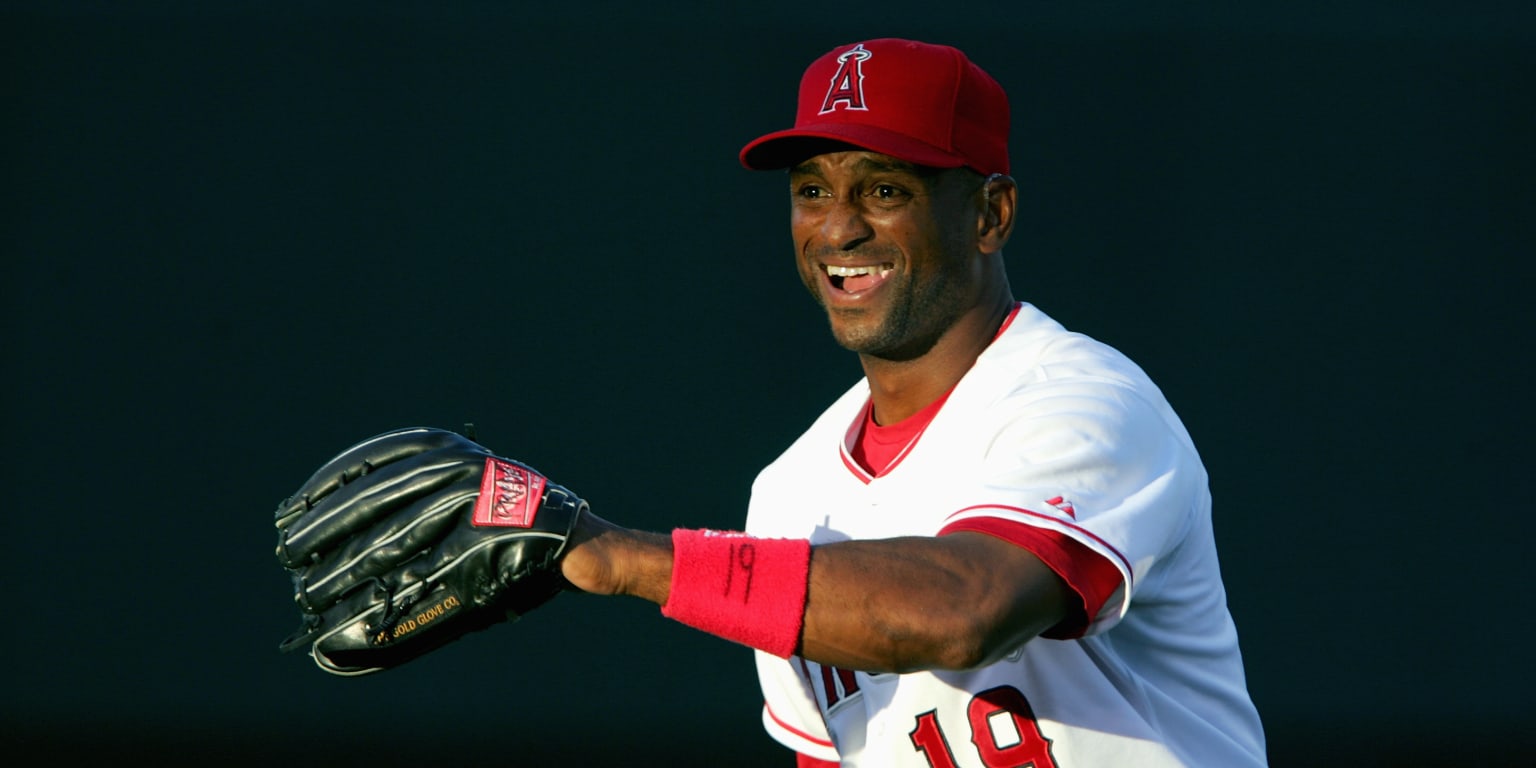
It’s the day he recorded his first big league hit and introduced himself to the baseball world.
“My first Major League hit — a two-run double against the Phillies — was in the middle of the pennant race,” said Pride. “I was standing at second base. There were 45,000 people cheering, and I didn’t know they were cheering for me.”
Pride, who was born deaf, did not realize the entire stadium was roaring for him until his third-base coach signaled for him to tip his cap to the fans.
“And that’s what I did,” Pride said. “It was very emotional. I tried to keep a straight face to let people know that I’m serious, I’m not a one-hit wonder or a charity case. I’m here to stay in the Major Leagues for a long time.”
Pride’s story of perseverance is one of the great modern tales of our beloved game. He is one of seven deaf players to play Major League Baseball, and arguably the one with the most successful (modern) career. Dummy Hoy also had a long Major League run, having logged more than 2,000 hits over a career spanning 14 years, from 1888-1902.
The other deaf players on record are Ed Dundon (1883-84), Tom Lynch (1887), Reuben Stephenson (1892), Luther Taylor (1900-08), George Leitner (1901-02), William Deegan (1901), Herbert Murphy (1914) and Dick Sipek (1945).
Pride found more success at the Major League level than many of his fully hearing-abled peers. He played for 11 years in the Majors, appearing in over 400 games and hitting 20 total home runs with six different teams (Montreal Expos, Boston Red Sox, Detroit Tigers, Atlanta Braves, New York Yankeesand Anaheim/Los Angeles Angels of Anaheim) across his career.
It didn’t take long for the baseball world to realize just how special a player and person Pride truly is. He was consistently encouraged to write a book about his life, an autobiography to share his story with the world.
“They would tell me they wanted to know more about my life,” said Pride. “What I went through, how I learned how to talk and struggle, how to deal with dismissiveness.”
His path is chronicled in “I Felt the Cheers: The Remarkable Silent Life of Curtis Pride.” Doug Ward, a writer and former publications manager with the Los Angeles Angels, co-authored the book, which was published in February. Ward and Pride know each other from his time playing in Anaheim.
“The book came together beautifully, and we’ve had so many great reviews,” said Pride. “I’m just very thankful for having so many wonderful people in my life who helped me make that story, which is an amazing dream.”
But Pride’s inspirational story is one that almost didn’t happen.
Back in 1992, a 23-year-old Pride was a then-prospect in the New York Mets Minor League system. After quick promotions from Single-A and High-A, he was struggling in his first season at Double-A Binghamton. On top of that, his first girlfriend had broken up with him earlier that year, and he had also found himself on the receiving end of some of his teammates’ tasteless jokes in the clubhouse.
“It kind of snowballed, and it kind of put a lot on my plate,” said Pride, during an interview with MLB.com. “I started to doubt myself. … I went through the worst season ever, and it got so bad that I wanted to quit … walk away from the game in the middle of the season.”
It was this avalanche of personal events that led Pride’s parents to make the trip to Binghamton for a cathartic and, unbeknownst to Pride at the time, life-changing talk.
“We had a long conversation in the hotel room where my dad was telling me that he did not raise me to be a quitter, and that he expected me to honor my commitment to finish the season,” Pride recalled.
Pride and his parents agreed that he would finish the season and take the offseason to decide whether to continue playing or explore other career avenues. At the time, he was a volunteer at his former high school in Silver Spring, Maryland.
“It was during the offseason when I worked as the instructional assistant for the special education program in my old high school,” said Pride. “I worked with a lot of the kids with learning disabilities.”
These kids were unaware that Pride was a professional athlete, let alone a few steps away from the Major Leagues. That is, until one day, one of his fellow teachers let slip that not only was he a former high school star but also a professional baseball player.
“And they were asking me, ‘How can you play professional baseball? You’re deaf,” Pride said. “And so that’s why I had to explain it to these kids. No matter what kind of disabilities we have, we all have goals and dreams that we hope to accomplish, and we should not allow other people to tell us what we can or cannot do.”
Pride remembers asking his mother, “What kind of a message would I be sending to these kids if I could quit baseball?”
“And so they sort of inspired me to feel like, ‘Wow, these kids are looking up to me. Man, I have to set the lead by example. I have to make an example of myself to show that anything is possible.’”
Sure enough, the next season, Pride quickly advanced through the Minors, ultimately making his Major League debut with the Montreal Expos on Sept. 14, 1993.
Making it to the big leagues, however, was just the beginning of a long baseball journey for Pride.
“[When] I got to a professional level, I would never have expected grown men to be making fun of me the way the kids back in my elementary school did,” said Pride.
“But there will always be cruel people in this world, and I had to learn to put my head down, stay focused, and not cause any waves in the clubhouse. I surrounded myself with good teammates, focused on the positive things. That’s what got me through.”
Pride’s message still resonates on and off the field, and it’s why he has cemented his name in baseball history.
“I was this close to quitting,” said Pride. “So I’m so grateful that I did not give up and that I was able to bear down to kind of be myself and work hard, and that’s the message that I want to get to other people.”
