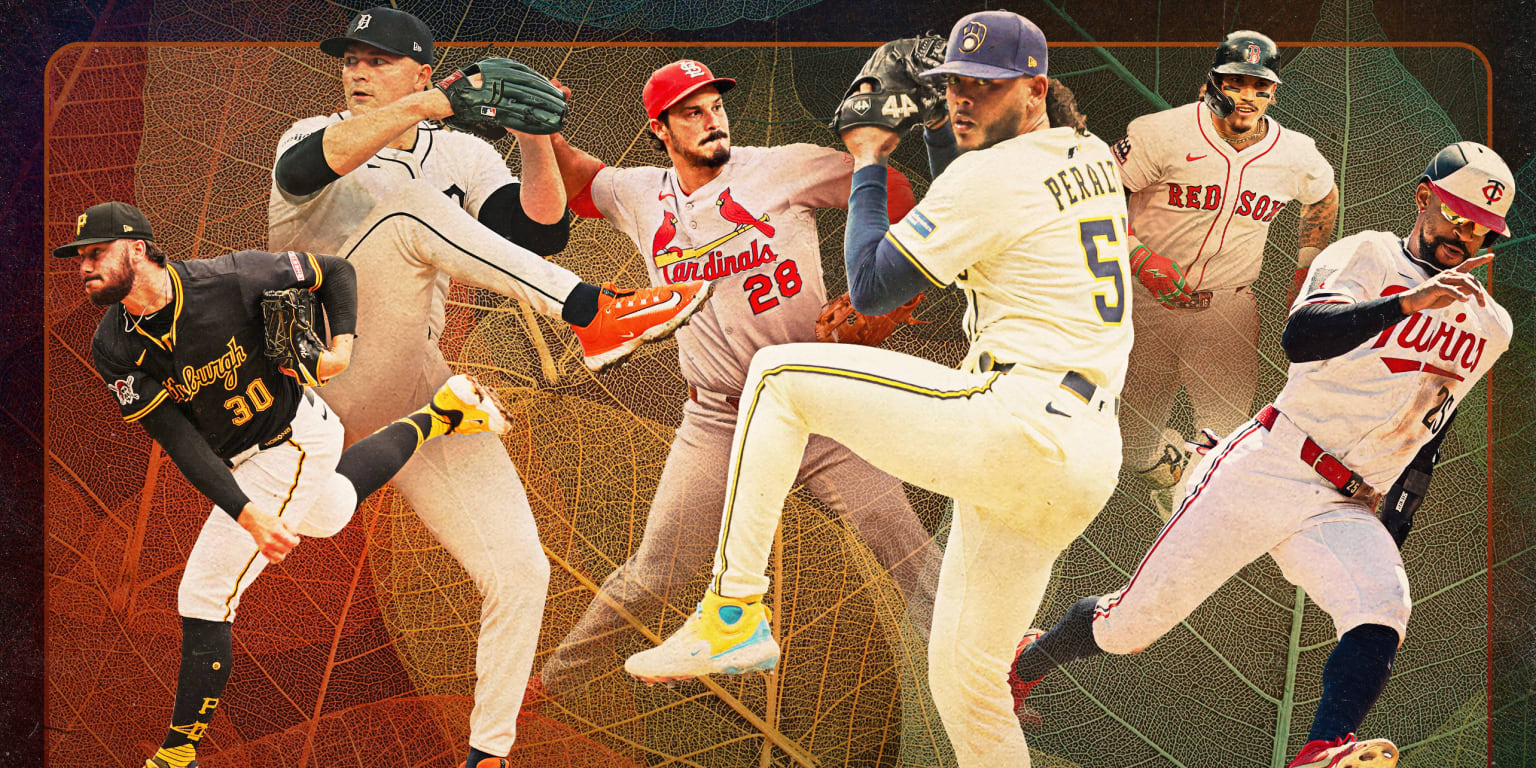
You are allowed to yell at me for what you are about to read here. And many of you probably will.
But the goal of this annual column is not to make friends. The goal is to make trades.
Star-for-prospect swaps? Sure, those are cool.
But in the spirit of the holiday, we are going to overstuff ourselves here.
What follows are big, bold — and, to be abundantly clear, UNLIKELY — trades not only involving names that have been in the rumor mill but, in every instance, involving three teams!
So yell at me, if you must. I can take it. When you concoct fake three-team trades, you run the risk of upsetting three fan bases at once.
That’s a risk I’m willing to take in the name of conversational content. Because few things are more fun than talking trades. Even fake ones.
1) The most Cys-mic swap of all
Mets get: LHP Tarik Skubal
Tigers get: RHP Paul Skenes
If the Tigers trade Skubal, then the Mets are the perfect fit. But unless the Mets were to move Rookie of the Year candidate Nolan McLean in such a deal, it’s hard to see a deal where the Tigers could still be taken seriously as a World Series contender.
Somehow getting Skenes would sure do the trick.
Here, I can’t stress enough that we’re trying to have some fun with these ideas and that we don’t actually expect the Pirates to deal Skenes (I’m also still skeptical the Tigers actually deal Skubal, but we’ll see).
This, however, is a scenario in which you could reasonably argue that the Tigers and Pirates are properly taking advantage of the trade value of their respective aces.
The Mets would be getting the bona fide ace their rotation sorely needs, and you’d have to like their chances of extending Skubal — perhaps before he even reaches free agency (à la Francisco Lindor).
The Tigers would replace one of the two best pitchers in the sport with … one of the two best pitchers in the sport. And Skenes is under contractual control through 2029 — a timeline that better meshes with their emerging core than what they have currently with Skubal.
The price would be necessarily steep for both squads, but the Mets would be improving their World Series aspirations for 2026 while the Tigers would be maintaining theirs and also better positioning themselves for the future.
As for the Pirates, they might be going into this winter with the intent to spend to amplify their offense for Skenes, who received all of 11 runs of support total in his 10 losses in 2025. But let’s be honest: They feel more than a (realistically priced) bat or two away from contention. This trade would give them a healthy stash of prospects (including four Top 100 guys in Williams, Tong, Clark and Rainer) that would make Pittsburgh a much more viable force in 2027 and beyond.
Who says no? Everybody. Although maybe the LSU alum Skenes would enjoy pitching for a team named the Tigers again.
Orioles get: LHP MacKenzie Gore, C Keibert Ruiz
Phillies get: C Adley Rutschman
The Orioles need front-line pitching, and there’s been some buzz this winter about them possibly dealing cornerstone catcher Rutschman after inking his understudy, Samuel Basallo, to a long-term extension.
That buzz is probably premature. Basallo might not be ready to inherit the catching role full-time, and the O’s would be selling low on Rutschman after a down 2025.
But our job here is to trade people!
Here, the O’s get Gore, who is two seasons from free agency and coming off his first All-Star season. While his second half (6.75 ERA) was nowhere near as strong as his first (3.02), Gore is coming off his age-26 season, and his struggles really revolved around a brutal four-start stretch in late July/early August. By and large, he misses a lot of bats, he’s made at least 27 starts each of the last three seasons, and there’s reason to believe that a team can unlock the ace potential of this former No. 3 overall Draft pick.
Given the cost of high-upside pitching, Gore is arguably worth more than Rutschman in a trade right now. So in this deal, the O’s take on the contract of Ruiz (owed $36.9M through 2030), who can share the catching duties with Basallo until the youngster is deemed ready for a more pronounced role.
The Phillies, meanwhile, get younger in the lineup and find a strong replacement for 34-year-old free agent J.T. Realmuto. Again, Rutschman is coming off an uninspiring year, but he certainly has the potential to boost the Phillies’ lineup and has some demonstrated upside.
In exchange for shoring up the catching spot and getting out from any personality issues and the $20 million owed to Castellanos in 2026 (money that can be applied to re-signing Kyle Schwarber or whatever the Phils wish to do with it), Philadelphia has to fork over a very valuable infield prospect.
As for the Nats, they’d deepen their system considerably and, importantly, they would also be getting out of the long-term entanglement with Ruiz by taking on a short-term entanglement with Castellanos, who can do some DH’ing for them until he’s cut loose or maybe dealt at the Deadline. This helps free up the books longer term for a new front-office regime.
Who says no? Everybody. Although one would have to imagine there’s some kind of “BaltiGore” marketing to be done with this deal.
Reds get: OF Byron Buxton
Astros get: RHP Brady Singer
Buxton declared himself “a Minnesota Twin for life” last summer, though it has been reported that he might reconsider if the teardown we saw at the Trade Deadline continues. (Buxton has a full no-trade clause, complicating any deal. Again, even fake ones.)
Here, to fulfill my duty to trade as many stars as possible, I’m operating on the assumption that the Minnesota rebuild does continue, even though that might not necessarily be the case.
Buxton would be perfect for a Reds team that could use its pitching depth to address a lineup in need. At roughly $15 million each of the next three seasons, he likely fits their payroll in ways the most prominent free-agent bats do not.
Singer, who is entering his final year of arbitration, does not fit a Twins team in transition but does fit an Astros team that needs an affordable mid-rotation arm.
So the Reds get an All-Star center fielder coming off perhaps his best season, the Astros address a rotation likely to lose Framber Valdez, while the Twins get prospects from each.
Who says no? Everybody … including, possibly, Buxton himself.
4) Call it a mini (Minny?) Mookie trade
Dodgers get: OF Jarren Duran
Red Sox get: RHP Joe Ryan
Well, if we’re going to design a rebuilding plan for the Twins, we might as well keep going. This trade reunites the three teams that conspired on the dual 2020 deals that ultimately brought Mookie Betts to the Dodgers.
This deal wouldn’t be as big a blockbuster as that one, but it’s still a big one.
I had this fake trade sketched out prior to Boston’s deal for Sonny Gray – a trade that improved their rotation but still leaves them in need of a Dude behind Garrett Crochet. The Sox get one here in Ryan, who is under control through 2027 and coming off an All-Star season in which he had a 125 ERA+ (25% better than league average) in 171 innings.
With Roman Anthony, Ceddanne Rafaela and Wilyer Abreu looking like an elite outfield, Boston possibly has the luxury of moving Duran, who is due to make $8 million in 2026 and is under control through 2028.
Given that control, maybe Duran would appeal to the Twins, but, again, we’re operating under the assumption that they’d be going with a full-scale youth movement here.
So instead, we send Duran to the Dodgers, who might stop short of paying top dollar for Kyle Tucker or Cody Bellinger but could surely stand to shore up their outfield with someone of the 29-year-old Duran’s power-speed combo caliber.
The Twins get another bounty of prospects here for what would instantly be one of the strongest systems in the sport.
Who says no? Everybody. Although you have to admit this trade would give the Twins some Hope.
Mariners get: UTIL Brendan Donovan
Mets get: 3B Nolan Arenado, RHP/LHP Jurrangelo Cijntje (Mariners’ No. 8 prospect)
Cash is a complicating factor in this trade, but let’s try it anyway.
The Mariners have highly touted prospects Cole Young and Colt Emerson as long-term options in their infield. But Young did not assert himself in 2025, Emerson has yet to debut and Seattle is clearly in win-now mode. Donovan, who has the ability to play second or third, fits their immediate need in the infield and is under control through 2027.
Seattle and St. Louis could, of course, just work out a swap together. But in this deal, in keeping with our three-team theme, we’re going to use the Mariners to help the Cards move some money.
Here, the Mets take on the $37 million owed to Arenado through 2027. While his bat has sagged, Arenado’s glove is a hot corner upgrade for a Mets team clearly focused on run-prevention (as evidenced by their trade for Semien). And to offset some of the financial burden they’re (ably) taking on, the Mets add the intriguing switch-pitcher Cijntje to their system.
Though it only costs them money and a flier of a prospect, I’ll be the first to tell you I don’t love this trade for the Mets, but I didn’t love the Semien swap, either. At least this move is intellectually consistent with that. It allows Mark Vientos to move to first if the Mets don’t re-sign Pete Alonso. And if they do sign Alonso, Vientos is trade bait.
The Cards aren’t getting as much back for Donovan as they would in a more straightforward swap of him. But in this deal, that Arenado money is off their books, plus they add the potential power bat of Montes (who could be big league ready as soon as 2026).
Who says no? Everybody except Arenado, who is more open to a trade than ever.
6) Brewing up a blockbuster
Braves get: RHP Freddy Peralta
Brandon Woodruff’s decision to take the qualifying offer won’t necessarily compel the Brewers to move staff ace Peralta a year ahead of his free agency, but it did increase the odds of a deal.
The Brewers obviously had a fantastic season with the lineup as it was, but the postseason was evidence that they need more power. A Peralta trade could help them land it, and here we’ve supplied them that in the form of Lowe and Díaz, both of whom are pending free agents on reasonable salaries. Lowe could take over second base, with the Gold Glove-winning Brice Turang able to slide over to short in place of Ortiz, whose bat didn’t pan out in 2025. Díaz can play first base, where Rhys Hoskins is a free agent and the magic of Andrew Vaughn may have begun to run out when he went homerless in his last 35 regular-season games.
Acquiring MLB’s No. 72 prospect in Caminiti and a fun lottery ticket in the 17-year-old Cuban native Tornes rounds out a nice package for a Brewers team parting with a year of Peralta and four of Ortiz.
The Braves strengthen their rotation considerably with Peralta, while chipping into Tampa Bay’s return. The Rays get a couple prospects and an MLB shortstop option in exchange for two guys on expiring contracts.
Who says no? Everybody. These are three teams particularly prone to surprising us when it comes to transaction activity, so I don’t claim to be able to forecast what they’re thinking.
Bonus Blockbuster: Record-breaking bartering!
*Red Sox get: 1B Jake Burger*
*Rangers get: C Ryan Jeffers*
*Marlins get: 1B Triston Casas*
*Diamondbacks get: RHP Sandy Alcantara*
*Guardians get: 3B Alec Bohm*
*Phillies get: CF Alek Thomas, RHP Braylon Doughty (Guardians’ No. 8 prospect)*
I was on such a roll constructing bad trades involving more than two teams that I figured I might as well go for the record for most teams involved in a single trade (good or bad).
The current record, as far as I know, is four teams. This seven-team spectacular (?) blows past it … and solves (?) a lot of roster questions in the process.
We start with an assumption that the Red Sox try to re-sign Alex Bregman and therefore are not necessarily deep in the market for Alonso. There would still be a need to improve the run-production. While getting a healthy Casas back by Opening Day would provide upside, perhaps they would be hesitant to go into a season assuming much from him after he posted a .580 OPS prior to a major knee injury.
So Boston gets Burger, who had his own struggles in Texas last year but still managed to produce league-average offense while dealing with a wrist issue that required offseason surgery. He comes with three years of club control and seems a decent bet to provide above-average offense going forward.
That, unfortunately, means selling low on Casas. Given Casas’ potential, that might be a faulty proposition that can send this entire house of cards crumbling. But Casas has basically missed two seasons of big-league development due to injuries and might fit better on a team like the Marlins (in his hometown, no less!) that’s trying to build a winner.
In exchange for Burger, the Rangers get catching help in the form of Jeffers, who provides better offensive production at roughly the projected salary of the non-tendered Jonah Heim.
In exchange for Casas’ potential, the Marlins are perhaps selling low on Alcantara after his iffy year but also moving the $17.3 million he’ll make in his final guaranteed year of control (with a $21 million team option for 2027).
Alcantara goes to a D-backs team in need of starting pitching and might be leery of long-term free-agent pacts given the way recent ones have panned out for them. They punt on Thomas, a center fielder whose well-rounded tools just haven’t come to fruition in the big leagues yet and who might benefit from a change of scenery.
The Phillies take on the 26-year-old Thomas for their iffy outfield and clouded center-field picture, hoping that he can blossom within their veteran-laden lineup. And they reinvent themselves a bit by moving on from Bohm, whose final year of club control looks relatively expensive, given his below-average defense at the hot corner and down year at the plate in 2025.
Bohm goes to the Guardians, bringing a needed right-handed stick to a team for whom even league-average production is an upgrade. While he can spell José Ramírez on occasion, Bohm’s primary role in Cleveland would be at first base and DH.
The rest of this monstrosity of a trade is rounded out by prospects — the Twins (who I believe we have sufficiently rebuilt in this column) getting a couple back for Jeffers, the Phillies offsetting the downgrade in proven productivity they’re taking on with Thomas.
Who says no? Everybody. That’s seven teams saying no. Itself a new record!
Now if you’ll excuse me, I’m going to mute my notifications and change my email address and identity.
