Benjamin Hill travels the nation collecting stories about what makes Minor League Baseball unique. This excerpt from the Baseball Traveler newsletter, presented by Circle K, is a mere taste of the smorgasbord of delights he offers every week. Read the full newsletter here, and subscribe to his newsletter here.
“OK, wow on 3. 1, 2, 3…”
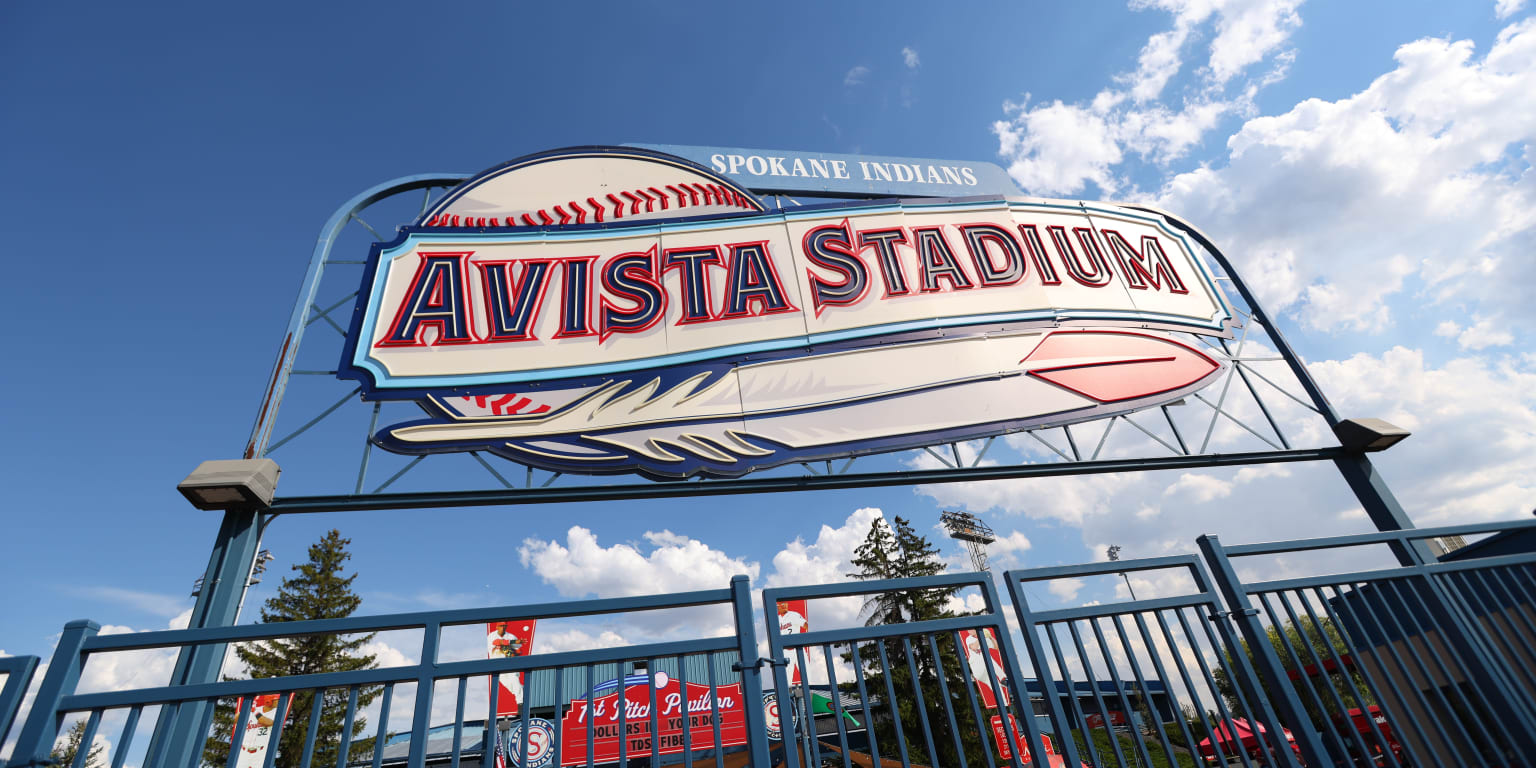
This rallying cry marks the conclusion of the Spokane Indians’ gameday staff meeting, held just prior to opening of the Avista Stadium gates. It’s an apropos ritual, because this is a team, and ballpark, with a definite “Wow” factor. I had visited once before, in 2016, and in the intervening nine years it had slipped my mind somewhat, this fact: Avista Stadium is one of the best places to see a baseball game, anywhere.
I say this with clarity, for this is a place where you can see the forest for the trees.
Avista Stadium, originally known as Fairgrounds Recreational Park, is a byproduct of Major League Baseball’s westward expansion. It opened in 1958, the same year the Brooklyn Dodgers moved to Los Angeles, built specifically so the Spokane Indians could serve as the Dodgers’ Triple-A affiliate.
Avista Stadium has seen innumerable improvements since 1958, including many in recent years in order to meet MLB’s facility standards. Nonetheless, a throwback charm endures.
The press box is on the roof, the scoreboard is rudimentary, and there are “skyboxes” with concrete boundaries at the top of the seating bowl in lieu of suites. The concourse is situated in front of the ballpark, serving as a buffer between the gates and the seating bowl.
The Indians remained the Dodgers’ Triple-A affiliate through 1971, fielding some of the most future star-laden teams in Minor League history along the way. The celebrated 1970 squad, managed by Tommy Lasorda, featured the likes of Steve Garvey, Bobby Valentine, Charlie Hough, Bill Russell, Davey Lopes and Doyle Alexander.
In 1983, the Indians switched to the Northwest League, and there they remain. They have served as the High-A affiliate of the Rockies since 2021, representing the Pacific Northwest within Colorado’s far-flung Minor League system.
The city of Spokane is named for the Spokane tribe, the first people to live in the region. Professional baseball has been played here since the 1890s, with almost every team using the Indians name. In 2006, the baseball team and the Spokane Tribe of Indians announced a groundbreaking partnership that included logos and signage featuring the tribe’s Salish language script. Salish can now be found all over the ballpark, including the primary home jersey.
The Indians front office, being a proactive bunch, incorporated me into the gameday experience in a variety of ways. It started before the gates opened, when I was asked to lead the “Wow!” to conclude the gameday employees meeting. I also spent time in the kitchen rolling hot dogs for the team’s “Dollar in Your Dogs promotion.” Cash vouchers, totaling $2000 overall, were included in select wrappers.
Then it was time for a wardrobe change, one involving a backpack and an air tube.
After all the straps were strapped and zippers zippered, I emerged onto the concourse and greeted fans in the guise of inflatable mascot KC. He was unveiled by the team in 2022 in collaboration with the nearby Fairchild Air Force Base, paying tribute to the KC-135 Stratotanker (a refueling tanker aircraft).
During my time in the team’s office area, I confirmed that a floor safe with unknown contents remains unopened (it was discovered during a 2013 renovation). When I wrote about the safe in 2016, Indians senior vice president Otto Klein speculated that it might contain “Jimmy Hoffa. Tommy Lasorda’s black book. A million dollars in cash. Fun stuff, whatever you can dream of.”
Klein has been with the team for decades, but he isn’t the team’s most prominent Otto. That honor goes to Otto the Spokaneasaurus, who arrived at Avisita Stadium in 1993.
Spokane’s mascot pantheon also includes Ribby the Redband Trout. He debuted in 2017 as part of the Indians’ Redband Rally campaign, dedicated to honoring and protecting one of the Spokane Tribe’s first food sources.
Ribby appears on the field in the sixth inning to rally the team to victory. On this evening, I served as one of his dancing minnows.
I did not make for a particularly convincing minnow.
As always, I felt more at home watching someone else eat a ballpark meal. My Designated Eater in Spokane was Andy Wodka; it would be his job to eat the ballpark cuisine my gluten-free diet prohibits.
Andy, a Chicago Cubs fan and longtime Washington state resident, had two items before him. First up was the Tanker Nachos, served in a batting helmet and sturdier than an aerial refueling aircraft.
Next was the Bavarian Burger, a homestand special that was topped with muenster cheese and fancy mustard (among other things).
Andy’s reaction to these items was captured on video, and those videos are unfortunately missing audio. I apologize for this subpar documentation of Avista Stadium’s concessions, but would like to note that the ballpark is home to both a double-decker “Wake Up Call” coffee bus as well as an outfield group area modeled after a replica train car.
The train car is called The Coors Light Caboose and offers an excellent vantage point to have a meal and watch the game.
Time for another garbage segue, but at least this one is literal. During the game I visited the team’s “Compost Corner,” part of the Indians’ Zero Waste campaign. Avista Stadium’s trash cans are divided into three categories: garbage, compost and recycling. These bins are then unloaded into the Compost Corner, with team employees sifting through the contents to ensure that each bit of trash is properly disposed of.
I spent a couple innings on Compost Corner duty and found the work to be fulfilling and relaxing. You quickly get used to the smell.
Between sorting garbage, rolling hot dogs, showcasing concessions and dressing in various mascot costumes, I didn’t get to see much Northwest League baseball action. Spokane won the game, 3-2, over the Hillsboro Hops. After the game, kids ran the bases.
Goodbye from Avista Stadium, where thought goes into every detail and there’s never a dull moment. If you’ve never been, put this one on your ballpark bucket list.
