With every passing year, the dream of a player hitting .400 continues to fade.
The 2026 season will be the 75th Major League campaign since the last .400 season by a qualifying hitter: 1941, when the great Ted Williams hit .406. Sure, there have been flirtations since, but barring major changes in the sport, it sure is hard to imagine any player keeping up a .400 average for a full season.
But what if we shifted our focus to a different milestone? Ever since the “Moneyball” A’s of the early 2000s, it’s generally accepted that on-base percentage, not batting average, is what matters most. A .400 OBP is impressive, of course, but hardly historic — so what about .500?
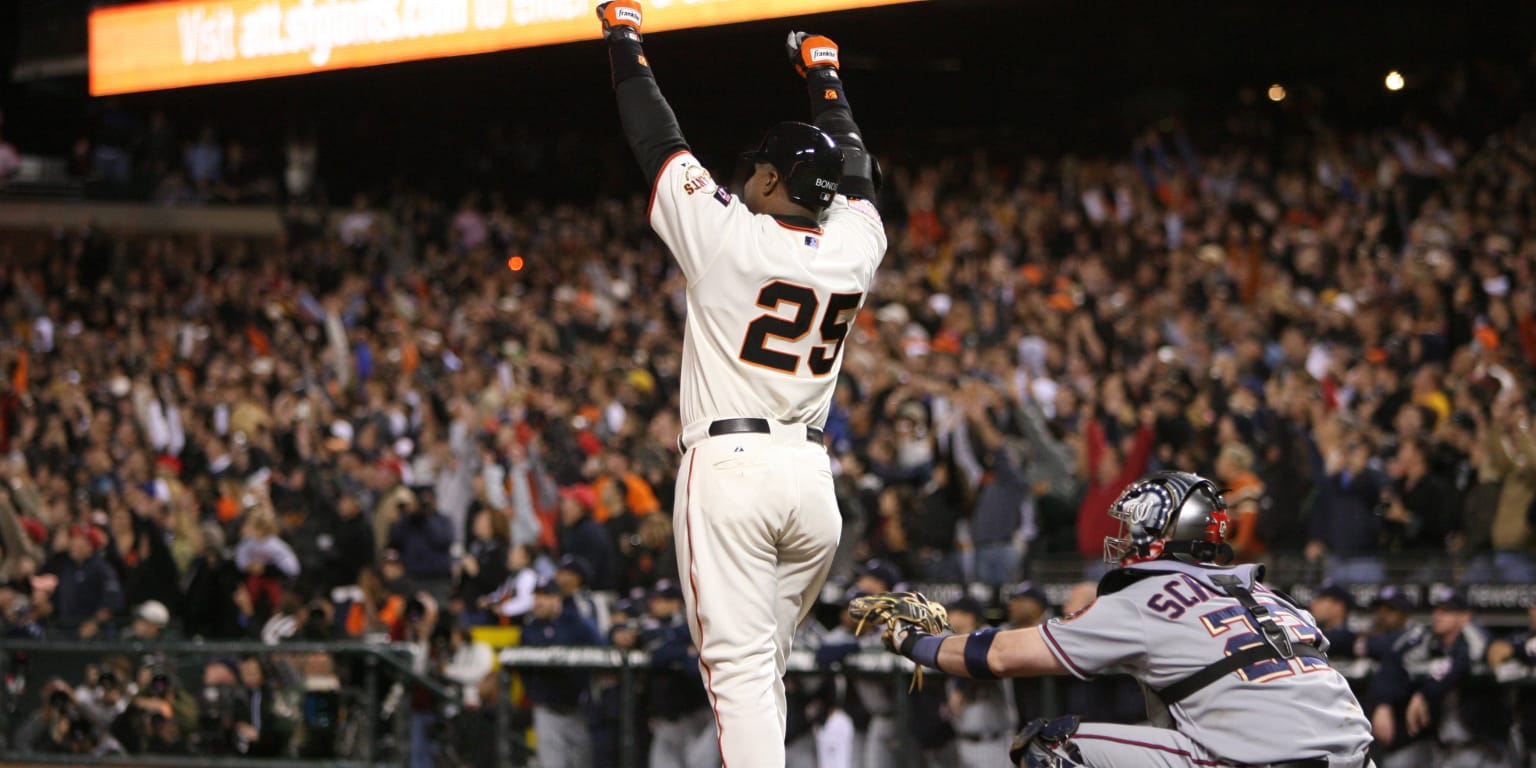
In MLB’s Expansion Era (since 1961), only Barry Bonds has posted a .500 on-base percentage in a season — four straight times, in fact. Bonds cleared the .500 OBP milestone easily every year from 2001-04, including an MLB-record .609 mark in 2004. But with Bonds long retired and no .500 OBP seasons in more than 20 years since, is that milestone any more realistic than a player batting .400?
Here’s a brief history of .500 OBP seasons, the chances of another ever happening and a few leading contenders to join an exclusive club of hitters.
Prior to Bonds, only five individual AL/NL hitters had posted a qualifying .500 OBP season in the Modern Era (since 1900) — 11 such seasons in all.
Babe Ruth: 5
1920 (.532 OBP), 1921 (.512), 1923 (.545), 1924 (.513), 1926 (.516)
Ted Williams: 3
1941 (.551), 1954 (.513), 1957 (.526)
Mickey Mantle: 1
1957 (.512)
Rogers Hornsby: 1
1924 (.507)
John McGraw: 1
1900 (.505)
All five are enshrined in the Hall of Fame (McGraw was inducted in 1937 as a manager but only after an excellent 17-year playing career). So far, anyway, only truly elite hitters have put up a .500 OBP — because, as Ron Washington once said about playing first base, “it’s incredibly hard.”
Consider this: The LOWEST batting average among the above group was .328, a mark eclipsed in 2025 by only Aaron Judge at .331. The highest? It’s not even Williams’ .406 average in 1941 — it’s .424, by Hornsby in 1927. As previously noted, the likelihood of anyone hitting .400 (much less .424) in today’s game is virtually zero.
Not only did all those players post sky-high batting averages — the group’s median was .372, for instance — but they also walked at astronomical rates. Bonds, of course, is an outlier there. His 2001-04 seasons, including 2004 (232 walks in 617 plate appearances = 37.6% walk rate) feature the four highest walk rates of any qualifying hitter on record.
No one else has ever walked more than 26% of the time in a season, with Williams’ 25.9% rate in 1964 (when he hit .345 with a .513 OBP) the next-highest total. Getting to the .500 mark requires some serious patience, though: Only one recorded .500-OBP season, Hornsby in 1924, involved a walk rate under 19%. (Again, Hornsby hit FOUR-TWENTY-FOUR, so a 13.9% walk rate can be excused).
Of the 15 players to post a .500 OBP, the average walk rate was a whopping 24.3%. By comparison, Judge led qualifying hitters in 2025 with a walk rate of 18.3%. Juan Soto in 2022 (20.3%) was the last player to walk at a rate above 20%, and Soto’s 22.2% walk rate in 2021 is the highest since … Bonds’ monster 2004.
Intentional walks, of course, are a big factor here. Bonds, who drew an incredible 120 of them during that 2004 campaign, remains the only hitter to draw more than 45 IBBs in a single season. But while intentional free passes are certainly a great way to pad a player’s OBP, they’re far less common nowadays. Judge’s 36 IBBs in 2025 were the most in the Majors since Albert Pujols had 38 in 2010, and the rate of IBBs has dropped by more than 50 percent since 2012.
Essentially, players hoping to surpass the .500 OBP threshold in the modern game must not only hit 20 points better than anyone in the Majors did in 2025 but also walk about 5 percent of the time more often than anyone else, without the benefit of more intentional free passes. In shorter words: Good luck.
But for as difficult as posting a .500 OBP is, it may not be impossible. A fair number of hitters have at least come within 50 points of that plateau in recent seasons, with nine qualified seasons of an OBP above .450 since 2005.
Qualifying .450+ OBP seasons, 2005-25^
Chipper Jones, 2008: .470
Juan Soto, 2021: .465
Albert Pujols, 2008: .462
Bryce Harper, 2015: .460
Mike Trout, 2018: .460
Joey Votto, 2015: .459
Aaron Judge, 2024: .458
Judge, 2025: .457
Votto, 2017: .454
^Excluding the 60-game season in 2020
If you include that shortened 2020 campaign, then the closest anyone has come to a .500 OBP year in the past two decades was Soto’s .490 mark that year, when he batted .351 and walked 20.9% of the time in 47 games for the Nationals. That’s right: Not even an average above .350 and a 20% walk rate were enough to reach the .500 milestone.
So is there ANYONE who has a shot at the first .500 OBP season since Bonds? Let’s take a look at a few leading candidates.
This list has to begin with Judge, who has been the closest player to a .500 on-base percentage in each of the past two seasons. He lapped the field in 2025, in fact, with his .457 OBP leading the Major Leagues by far — Toronto’s George Springer was second among qualifying hitters, way back at .399. With a .458 OBP in 2024 and a career mark of .413, Judge not only hits for prodigious power but gets on base at an elite level.
Even for a hitter of Judge’s caliber, though, getting to .500 will be tough. Judge’s MVP-winning 2024 and ’25 were some of the best offensive seasons in recent memory, and even then, he finished at minimum 42 points away from the .500 mark. The Yankees star’s combination of batted-ball skills and plate discipline gives him perhaps the best opportunity of any player to put up a .500 OBP, but the chances are still slim.
Soto has actually come closer than Judge to reaching the .500 OBP milestone (twice, if you count 2020). He hit .313 and drew an MLB-high 145 walks in 2021 en route to his .465 OBP, numbers he’d need to not only replicate but improve on to reach .500.
Soto batted just .263 in 2025, the first season of his 15-year, $765 million megadeal with the Mets, but he led the National League with a .396 OBP. With his natural pop and his unparalleled batting eye, Soto is as dynamic a hitter as any, but he will have to be at the height of his powers — and then some — to make this kind of history.
So far, Ohtani hasn’t come as close to .500 as Judge and Soto have. His career-high in OBP is .412, set in his second AL MVP Award-winning season with the Angels in 2023. Ohtani has posted OBPs of .390 and .392 in the two seasons since, with relatively high whiff and chase rates (among elite hitters) limiting his on-base capability. While his 15.0% walk rate in 2025 ranked in the 97th percentile of MLB hitters, he’d have to pair it with a batting average somewhere in the neighborhood of .400 to result in a .500+ OBP.
All that said … this is Shohei Ohtani we’re talking about, a hitter so feared that in World Series Game 3 he became the first player to be intentionally walked four times in a postseason game. No one is expecting Ohtani to keep reaching base nine times per contest, but if he’s hitting well enough to prompt opposing teams to put him on rather than give him a pitch to hit, it could result in a special season for Ohtani. That might not add up to a .500 OBP, but it’s hard to count anything out where Ohtani is concerned.
Judge, Soto and Ohtani are the usual suspects here, so let’s go with a dark horse pick to round things out. OK, maybe MLB Pipeline’s No. 1 overall prospect at the time of his 2025 callup isn’t the longest of shots, but putting a 21-year-old in the same breath as current (and future) Hall of Fame hitters is a little bold.
Still, Anthony had a pretty impressive rookie season, batting .292 with a .396 OBP (13.2% walk rate) in 303 plate appearances for Boston. He hardly chased pitches out of the strike zone, put up elite exit velocity readings and crushed fastballs in particular. To get near a .500 OBP, he’d have to hit for a higher average, cut down his strikeouts (27.7% K rate) and walk considerably more, but if any young player has the talent to do it, it just might be Anthony.
