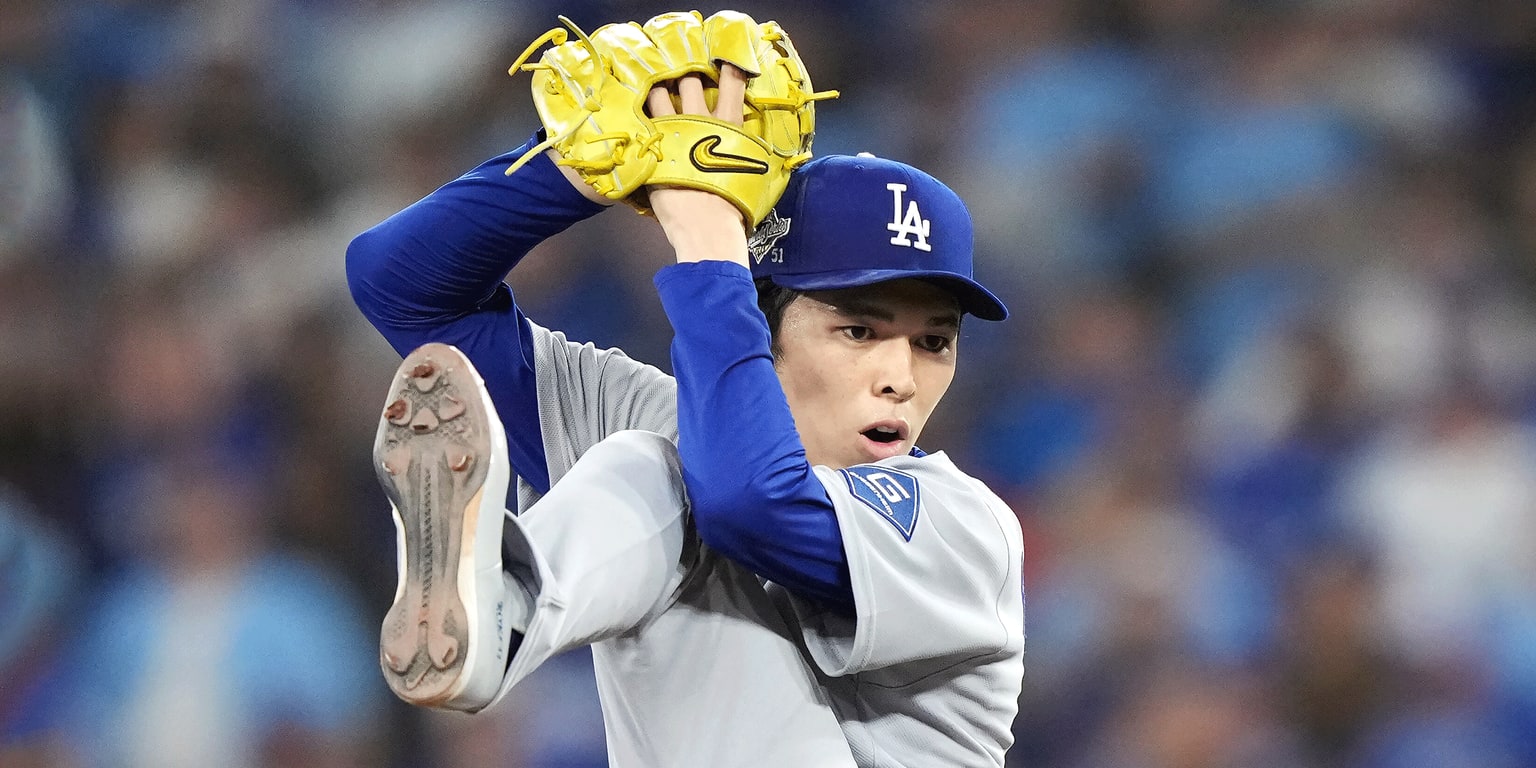
Roki Sasaki thrived while navigating an unfamiliar role on the postseason stage. Now a World Series champion with a year in the big leagues under his belt, the 24-year-old is going back to what he knows: starting pitching.
Sasaki’s shift to the ‘pen for the Dodgers’ championship run was predicated on his return to the rotation the following season. The success he enjoyed as the team’s postseason closer — three saves and just one earned run allowed in 10 2/3 innings — did not change that.
“I think for us, it was about trying to get his delivery back,” president of baseball operations Andrew Friedman said after World Series Game 7 in Toronto. “I feel like we made a lot of progress on that. And so for us, we’re definitely viewing him as a starter and a really good one, and we’ll continue to work this offseason and put him in the best position to be ready in Spring Training to help us win again.”
Here’s a look at the good, the bad and the unknown from Sasaki’s stint in the ‘pen and what it might mean for his return to starting:
Encouraging signs
Perhaps the best development for Sasaki was the return of his velocity. While he was in the rotation, Sasaki threw just eight pitches that registered at 99 mph or faster. From his first big league relief appearance on Sept. 24 on, he threw 46 pitches 99 mph or faster.
Not only was he throwing harder, but he was locating both his four-seamer and his nasty splitter. Sasaki had nearly as many walks (22) as strikeouts (24) as a starter, but he was able to cut his walk rate (14.3% to 10%) and raise his strikeout rate (15.6% to 20%) in relief. Opposing hitters could no longer afford to sit on the splitter when he was landing both of his pitches in the zone, leading to a 51.3% whiff rate on the offering.
Sasaki’s overall body of work as a reliever much more closely resembled the electric arm that was highly coveted when he was posted for Major League teams last offseason. He also pitched with the conviction that the Dodgers had been waiting to see from him all year long, which bodes well heading into next season.
Lingering concerns
From a high-level view, there are mostly positives to take away from Sasaki’s relief stint. But even as he got the results he needed throughout the postseason, there was a bit of a dropoff with his fastball.
After Sasaki averaged in the range of 99-100 mph with his four-seamer through the National League Division Series, he threw it a tick slower during the NL Championship Series and the World Series, sitting just over 98 mph in his final five outings. He also got more than one whiff on the fastball only twice in 11 outings. Overall, he upped his fastball whiff rate (10.1% to 20%) compared with when he was a starter.
It should be noted that the dropoff came after Sasaki’s heaviest workload of the postseason, his three perfect innings on 36 pitches in NLDS Game 4. He had three days of rest in between then and NLCS Game 1, during which he averaged 98 mph on his fastball and allowed his only run of the postseason.
To be determined
In reality, the unknowns might outnumber the knowns. The situations and workloads of the rotation and the bullpen are so different that some other factors might be equally important to Sasaki.
Sasaki could be working with an expanded arsenal. While he was rehabbing his shoulder, he worked on a cutter, which he threw during his Minor League rehab assignment but not in any Major League games. He also ditched his slider after returning from injury.
Having a full offseason as a Dodger might also be helpful for Sasaki, who signed with the team this past January. Whereas he only had a few weeks to work with the organization this year before Spring Training began, he’ll have months to prepare this time around.
The most important takeaway from his stint in relief is that the electric stuff is still in there. It’s just a matter of unlocking it.
