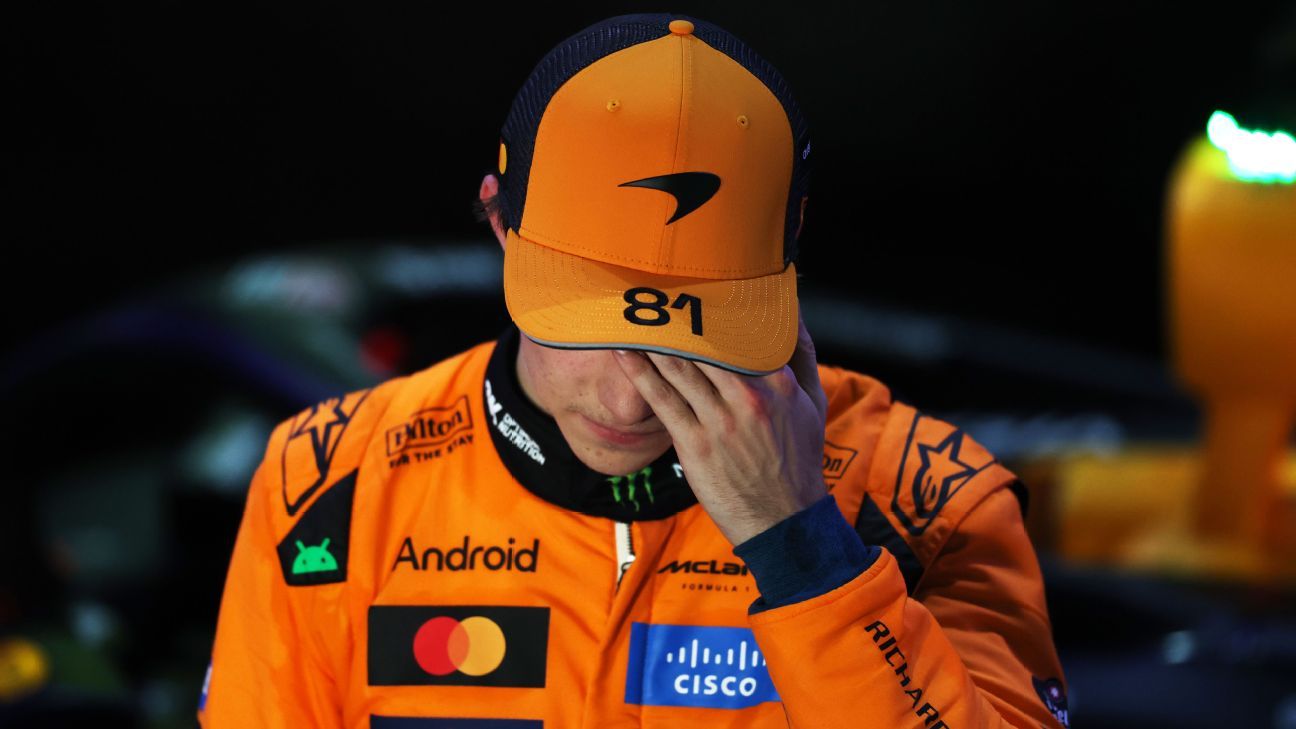
DOHA, Qatar — “Speechless. I don’t have any words,” said Oscar Piastri after crossing the line at the Lusail International Circuit. He wasn’t the only one in the paddock who felt that way on Sunday evening.
In the blink of an eye in the early laps of the Qatar Grand Prix, McLaren’s faltering Formula 1 team delivered a disastrous and mind-boggling triple whammy. Its decision not to follow the rest of the F1 grid by pitting under a safety car on Lap 7 of the race left the door open for Max Verstappen to win Sunday’s grand prix and continue his astonishing push for a fifth world title, deprived Piastri of a crucial and deserved victory in that same title fight, and botched Lando Norris‘ first opportunity to either knock Verstappen out of contention completely or win it outright himself and end the season’s three-way bout one race early.
Instead, the blunder — already a contender for one of the worst in F1’s history, and perhaps it will be in standalone territory should Verstappen be celebrating another championship next weekend — means the championship will be decided in Abu Dhabi for the first time since 2021’s infamous finish. While Norris is still comfortably in control of his own destiny at that event, the talent and aura of Verstappen are both sizable. By now it would be difficult to find a Formula 1 fan who does not have at least some belief that the magical Dutchman can complete the comeback of all comebacks, no matter the permutations required for it to happen.
“Obviously not our greatest day,” Norris said later, before remarking that he just wanted to go to bed.
Even more remarkable was that it was the team’s second mistake on both cars in a week, following its double disqualification from the Las Vegas Grand Prix for a minuscule-but-avoidable technical infraction related to plank wear.
After months of the narrative looming in the background as a viable outcome, Sunday was as if McLaren has actively been trying to pay homage to its infamous 2007 season, when the legendary fight between teammates Fernando Alonso and Lewis Hamilton allowed Ferrari’s Kimi Räikkönen to steal the championship from under their noses. As with then, McLaren has refused to back one driver over the other, causing frustration and misunderstandings along the way. As with then, Verstappen enjoys the singular backing of Red Bull as Räikkönen did with Ferrari by that stage of the season. As with then, Verstappen is now 12 points behind, as if just to underline how staggeringly familiar this McLaren capitulation is starting to feel.
McLaren CEO Zak Brown said earlier this year that he would rather see Verstappen beat his drivers to the title than deviate from the policy of letting Norris and Piastri fight freely. He and F1 team boss Andrea Stella have made their bed, and they may end up sleeping in it.
McLaren’s commitment to that philosophy — and the desperation to ensure neither driver is wronged over the other by the random events that dictate modern motor racing events — has been controversial.
Another wrinkle in the events of Sunday evening in the Middle East was that it was yet another moment when a McLaren decision seemed to cost Piastri, and not Norris, a significant haul of points, although both did lose out. Piastri infamously gave up six by moving over for his teammate at Monza, while those close to Piastri will tell you there are still lingering frustrations at Norris being allowed to use the alternate strategy that let him win the Hungarian Grand Prix, and that he got away with barging past the Australian on the opening lap of the Singapore Grand Prix.
Piastri is not mathematically out of the fight, but Sunday’s error has put him on the back foot. It came on a weekend when he had looked more like the Piastri who led the championship for most of the season, taking sprint pole and sprint victory before taking pole position for the race itself. He should have completed that run with the full 25 points from a Sunday victory. By walking away with the 18 given to second place, he still gained on Norris, but not by the decisive amount he would have done with victory.
He goes into Abu Dhabi 16 points back, a gap that will reignite the awkward question of whether he will be called upon to support his teammate in some way to ensure McLaren does not become only the second team in F1 history to repeat as constructors’ champions without winning a drivers’ title in either year. The Papaya outfit might just get away with it in Abu Dhabi, at the Yas Marina Circuit that should suit their car well, but given how the past fortnight has gone, it now does not feel crazy to suggest McLaren might just finish the bottle job itself.
The anatomy of a howler
Much like the minuscule technical infraction that led to its double disqualification in Las Vegas a week ago, McLaren’s latest mistake was borne out of Formula 1’s technical minutia. This year’s edition of Qatar’s race was held under a new rule mandating 25-lap stints after each pit stop, due to concerns with how Pirelli’s tires would cope with the small gravel pits on the edge of certain corners.
The timing of the safety car was almost too good to be true, coming after Pierre Gasly and Nico Hülkenberg‘s cars tangled on the seventh lap — the one all teams had identified as they key point in the race. Pit then, and you effectively gave your drivers two 25-lap stints remaining in the 57-lap race. It should have taken a race already lacking strategic alternatives and given McLaren a surefire double podium finish if not a nailed-on one-two finish.
Piastri had led into Turn 1, while Verstappen had got past Norris for second position, although the latter did not put up much of a fight given his title lead. The three had held those positions through to the safety car’s deployment, but as Piastri stayed out, Verstappen peeled into the pit entry — with Norris following his teammate down the main straight.
“When they called me in, I had to look and remember that we were going into lap seven,” Verstappen said. “So I was, like, ‘OK, now we can go to the end [with just one more stop].’ I was a bit surprised when I came out of the pit. I was like, ‘OK, I think this is a very good opportunity now for us to win the race.'”
The decision not to pit made little sense then and even less every time the lap counter ticked over and the scale of McLaren’s situation became more apparent. It was such an obvious call to pit that every other team did so.
With McLaren’s cars running close in first and third, and with its pit box at the end of the pit lane, an obvious scenario existed: the double stack, the art of pit crews completing two blink-and-you-miss-them stops one right after the other. If done right, the second car approaching does not even have to slow its usual entry to the box. On Sunday evening, Mercedes team principal Toto Wolff was asked why he felt they had not done so, to which he asked: “Did they have the gap for a double stack with Verstappen?”
When told the team had three to four seconds in hand, Wolff referenced Mercedes’ dominant championship era of the previous decade. One of the team’s calling cards back then was its lightning-fast and efficient double-stacked stop for Hamilton and his teammate — first Nico Rosberg, then Valtteri Bottas.
“So it could have been a double stack, yeah,” Wolff said. “It just needs to, you know what we’ve done with Nico and Lewis several times, you just need to create the gap between the cars to allow that.”
Norris had asked his race engineer Will Joseph the logic behind the call before the race even restarted, perhaps already sensing the team had fumbled badly. Joseph replied that it gave the team strategic flexibility that no one else had for later in the race. At other circuits, that would have made sense, but the sprint race had already demonstrated that overtaking was next to impossible at Qatar’s flowing circuit (which was purpose built for MotoGP in 2004), and by not stopping, McLaren ensured both its drivers would have to cut through the field in some way in order to make progress as they pitted out of sequence with everyone else’s one remaining stop. The clear air Piastri and Norris had been given at the front of the pack also was not enough to build the 26-second advantage needed to enter the pits, stop, exit pit lane and get out in front of the next car.
Norris later fell foul of the team being out of sequence and for a while ran fifth — a result that would have made next weekend’s permutations even juicier. A late Kimi Antonelli mistake allowed Norris past, although he did not have enough time to catch Williams’ Carlos Sainz, whose superb podium finish was completely overshadowed by the madness of his former team’s strategy call.
“We’ll have to assess some factors,” Stella said about why the team made the mistake it did. “Like, for instance, whether there was a certain bias in the way we were thinking that led us as a group to think that not all cars necessarily would have pitted. We will have to go through the review in a very thorough way, but what’s important is that we do it, as usual, in a way that is constructive, is analytical.”
There was some irony to the fact it was Stella who was forced to justify McLaren’s call, given that he was involved in the last strategic blunder of similar magnitude. Stella was Alonso’s race engineer at the 2010 Abu Dhabi Grand Prix when Ferrari, led by strategist Chris Dyer, made an infamous call that handed that year’s title to Red Bull’s Sebastian Vettel. Perhaps even more iconically, looking back at it, is that the call Stella’s team made that day was to follow the early stop made by Vettel’s teammate Mark Webber, who is now Piastri’s manager.
Webber has been a constant voice behind the scenes for Piastri to be given equal treatment to his teammate this season. Not everyone in the F1 paddock is convinced the Australian has been getting it, and this is where conspiracy theorists might have a field day. As Norris himself said after the race: “Both of us should have done [the double stack]. I would have been had over either way, because we would have double stacked, and potentially I would have lost time. A bit of time, maybe, I wouldn’t have lost a position, I don’t think.”
1:17
Verstappen overtakes Norris with electric start in Qatar
Max Verstappen overtakes Lando Norris to take second place on the opening lap of the Qatar Grand Prix.
Even if Norris had lost a position or two, opting against the double stack was the far riskier of the options available to McLaren. So why did it do so? Cynics might suggest that ensuring Norris did not lose positions was more important to McLaren than Piastri keeping his iron grip on the race. McLaren has denied accusations of favoritism at every turn, but events like Sunday’s will only embolden those who feel Piastri has come out worst in moments like this more often than his teammate this year.
The team game
One of the potential outcomes next weekend would only reinforce the bizarre tightrope McLaren has walked all season in trying to ensure fairness, when fairness in itself is subjective. Should Piastri win in Abu Dhabi ahead of Verstappen and Norris, he will lose the championship by the six points he gave up in Monza by playing the team’s game.
Then there’s a scenario in which Piastri occupies a position ahead of Norris that the Englishman needs to secure the title. What then? Would McLaren ask Piastri to give the position to his teammate? Would Piastri feel obliged to do so? He probably would, especially if he feels his longer-term future is at McLaren, but it would be a horrible situation to put the Australian in given everything else this season. Stella gave a hint at what he would expect to happen in that scenario, although he insisted Norris and Piastri will go into the event itself free to race.
“I think whatever call we make in terms of using the collaboration of our drivers, we will have to follow some of our fundamental principles, which are foundational to our approach,” Stella said. “We want to be fair to our drivers, we want to race with integrity, and we want to race in a way that doesn’t surprise our drivers. Between now and Abu Dhabi, there will be a further conversation with Lando and Oscar.
“We will confirm our racing approach, but certainly what I can say is that if any of the drivers is in a condition to pursue the quest to win the title, then we will respect this. There will be no call which excludes the other driver when the other driver is in a condition to win. So we will see what scenario will unfold, but definitely what I can say is that there will be conversations and there will be a way of going racing which is united between the team and the drivers like we have always done.”
Read into that what you will, but expect team orders and “Papaya rules” to dominate your news feeds in the days leading into F1’s 2025 showdown.
Here comes ‘Chucky’
A final word for the man who has applied the pressure McLaren has wilted under.
Verstappen has been imperious down the stretch. Speaking to ESPN sources on Sunday night, it is clear that Red Bull employees are stunned that they are still in the fight. What Verstappen has done with the team’s car since its upgrade at the Italian Grand Prix (five wins from eight races) has been bewildering, and even if he does not win the championship, his 2025 will go down as a season similar to Alonso’s 2012 near-miss for Ferrari in terms of how much it bolsters his own legacy.
Verstappen is clearly relishing the moment, too. He couldn’t help continue poking fun at McLaren after the race. Earlier in the week, he told F1 TV he would have already won this year’s title if he was driving a McLaren (a view that many share in the paddock, it should be said). When told about Brown’s comments earlier in the week that he was like a horror movie character who refuses to die, Verstappen laughed and said: “You can call me Chucky,” a reference to the protagonist of the “Child’s Play” franchise. The ruthless character might well be the stuff of Brown’s nightmares between Qatar and Abu Dhabi.
Perhaps the comparison to a character with a ruthless streak is not wide of the mark. Many in the paddock have already cottoned onto one blemish from Verstappen’s otherwise-incredible season — his flash of red mist at the Spanish Grand Prix earlier in the year, when he furiously rammed his car into the side of Mercedes’ George Russell while fighting him for fourth. It was a slam-dunk penalty and an obvious moment of crossing the line, with the penalty he got dropping him down the order to 10th. It cost him at least 10 points, perhaps 12 if he had come out of the Russell fight on top.
Although he was frustrated by questions about it at the time, Verstappen now admits it was wrong.
“I regret how I handled it at the time, but you also have to understand how I got to that point,” he said recently. In fairness, he then added: “At the end of the season, let’s say I miss out on the championship, it’s not a moment that I will say, ‘That’s the moment that I lost it.’ We’ve lost it because of our general performance, we’ve still been in it also because of our performance.”
Some would disagree, but either way, it probably speaks volumes about Verstappen’s season that the last genuine moment he appears to have lost points off his own back was in a flash of rage in May. McLaren is giving them up on a weekly basis at the moment. If that run continues into Abu Dhabi next Sunday, McLaren’s year might well go down as a fumble even bigger than the one it managed 18 years ago.
