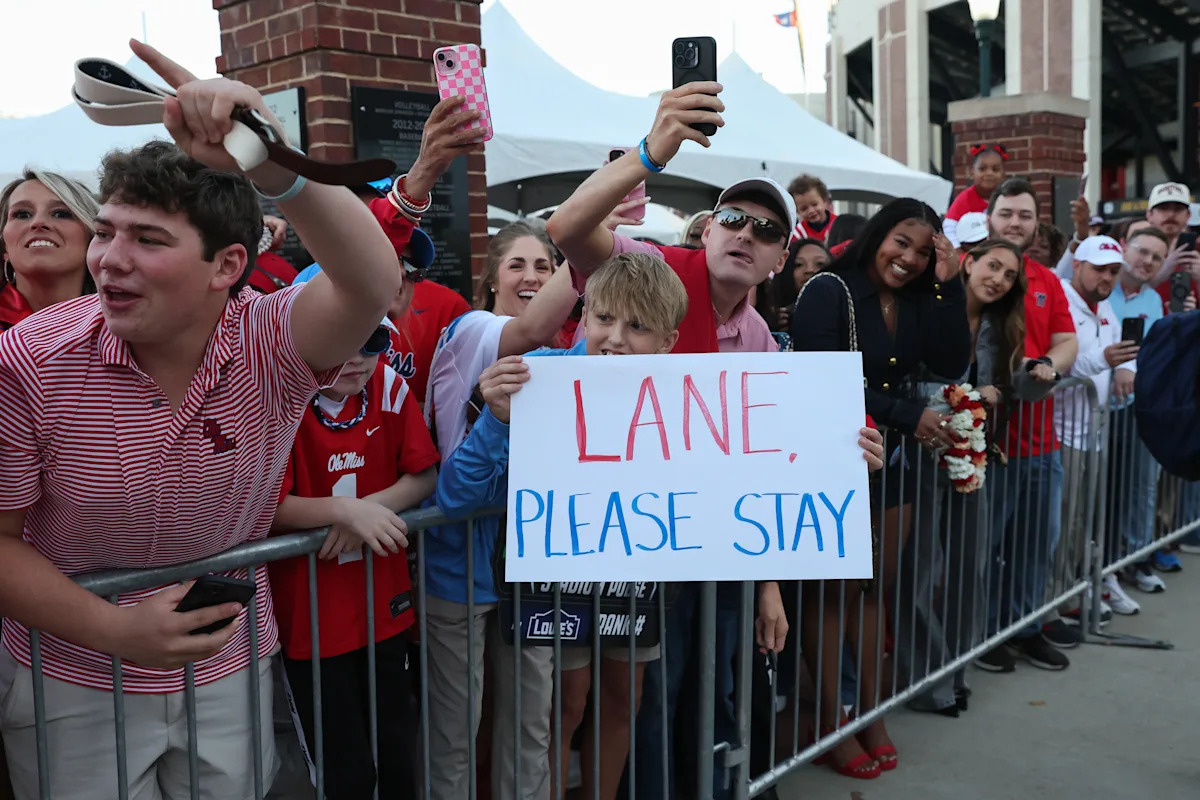
The most enduring image of Lane Kiffin’s weeks-long slither from Ole Miss to LSU came Sunday afternoon at the Oxford, Miss., airport, where a number of very loud Rebel fans cursed Kiffin as he boarded an LSU plane bound for Baton Rouge:
Spurned fans impotently booing a coach from behind barbed wire as he climbs into a private plane set to ferry him to a new job that will pay him tens of millions … man, the metaphor for modern college football doesn’t get any more on-point than that.
Advertisement
If you’re a high school football prospect with a chance of joining a major college program, these are good days. If you’re an administrator with access to the ever-increasing flow of athletic dollars headed into your university’s till, these are very good days. And, of course, if you’re a coach with the opportunity to jump to a new program or a fat buyout provision from your old one, these are the greatest days ever.
If you’re a good ol’ fight-song-cheering, tailgate-loving, bleed-school-colors fan, though … yeah, these are rough days indeed.
We’ve all known college football was headed in this direction once the billions in TV revenue started flowing in, once football coaches became the highest-paid public employee in virtually every state, once athletic departments began outfitting their locker rooms and football facilities like the Palace at Versailles, once schools gave in to legal pressure and common sense and began paying the players that support this entire endeavor.
And now that it’s here, the cost of the professionalization of college sports is becoming clear with every fundraising email, every season ticket payment plan offer, and every added charge that fans pay for every home game. Universities are taking in phenomenal sums thanks to media rights, but they’re spending even more to pay coaches, players and administrators and upgrade facilities. So where does a school go when it needs more cash? Right to the easiest marks it can find: devoted alumni.
Advertisement
Let’s say, for instance, you’re a graduate of the fine institution that is Louisiana State University, and you’d like to purchase season tickets to see the Bayou Bengals play under the leadership of their expensive new head coach. Well, in order to do that, you’ll need to join a request list, you’ll need to pay for your tickets … and you’ll need to give warmly to LSU’s Tiger Athletic Fund.
An Ole Miss fan holds up a sign for Lane Kiffin during the Walk of Champions before the game against Florida. Kiffin, ultimately, did not stay in Oxford. (Randy J. Williams/Getty Images)
(Randy J. Williams via Getty Images)
“LSU season tickets, parking permits, away game, postseason, and SEC Championship game tickets are allocated based on priority point ranking,” the . “The LSU Ticket Office uses two categories of points, lifetime and philanthropic, to allocate tickets.” In other words: If you’re not sure where you are on the ranking list, you probably ought to throw a few more bucks on the pile just to be sure.
This is not to pick on LSU; the Tigers aren’t alone in this sort of operation. Virtually every major college football-oriented university operates some variant of this scheme: “Donate” money for the right to request football tickets. “Donate” more money to get the opportunity to buy more tickets. “Donate” even more money to get the right to purchase parking. And keep on “donating” money, because if you don’t, someone else who does will jump you in the queue line. And you don’t want that to happen, do you?
Advertisement
Confused? Don’t worry. Just keep that wallet open, because you want to help “provide those resources” that are “vital to the success of the current student-athletes,” don’t you?
Universities dress up these pay-to-watch-’em-play schemes with a combination of evocative names and good old-fashioned fundraising shaming. At Georgia, the route to purchasing better tickets is called . At Ohio State, . Clemson has . Alabama? . And on and on. Whatever the name, the nuances may differ, but the end result is the same: weaponizing and monetizing your nostalgia and your love of the ol’ alma mater.
None of this is new, of course; schools have been doing this sort of undisguised arm-twisting for decades. But with the funding mechanisms already in place, and with fans softened up to expect to pay fees on top of fees, wringing ever more money out of the alumni base is simply a matter of adjusting a couple sliders upward and seeing who’s willing to keep paying.
All of these costs add up, and not just in the sense of “parking + concessions + souvenirs,” either. There’s a psychic cost to all this, too. Seeing your seats moved to a different part of the stadium than the one where you used to sit with your parents and grandparents … watching as ever-larger chunks of the stadium get turned into VIP lounges and high-dollar donor hangouts … seeing tailgates close to the stadium get homogenized into a sea of identical white reserved-and-paid-in-advance tents, while the quirky ones get banished to the far edge of campus … it all chips away at the foundations of fandom.
Advertisement
Now factor in the way that both coaches and players can jump ship without penalty, leaving your beloved alma mater in the lurch even after you’ve paid all those thousands, and, well … it’s not hard to see how universities will start shedding fans over all these seismic changes.
There’s nothing quite like a college football Saturday afternoon — the leaves changing, the tailgates sizzling, the marching band playing as you walk through the campus and the memories of your old school. Thing is, your old school knows how much that means to you, and they’re going to keep on charging you for the experience. It’s one more annual tuition bill from your university, and this time there’s no graduation to bring it to a close.
