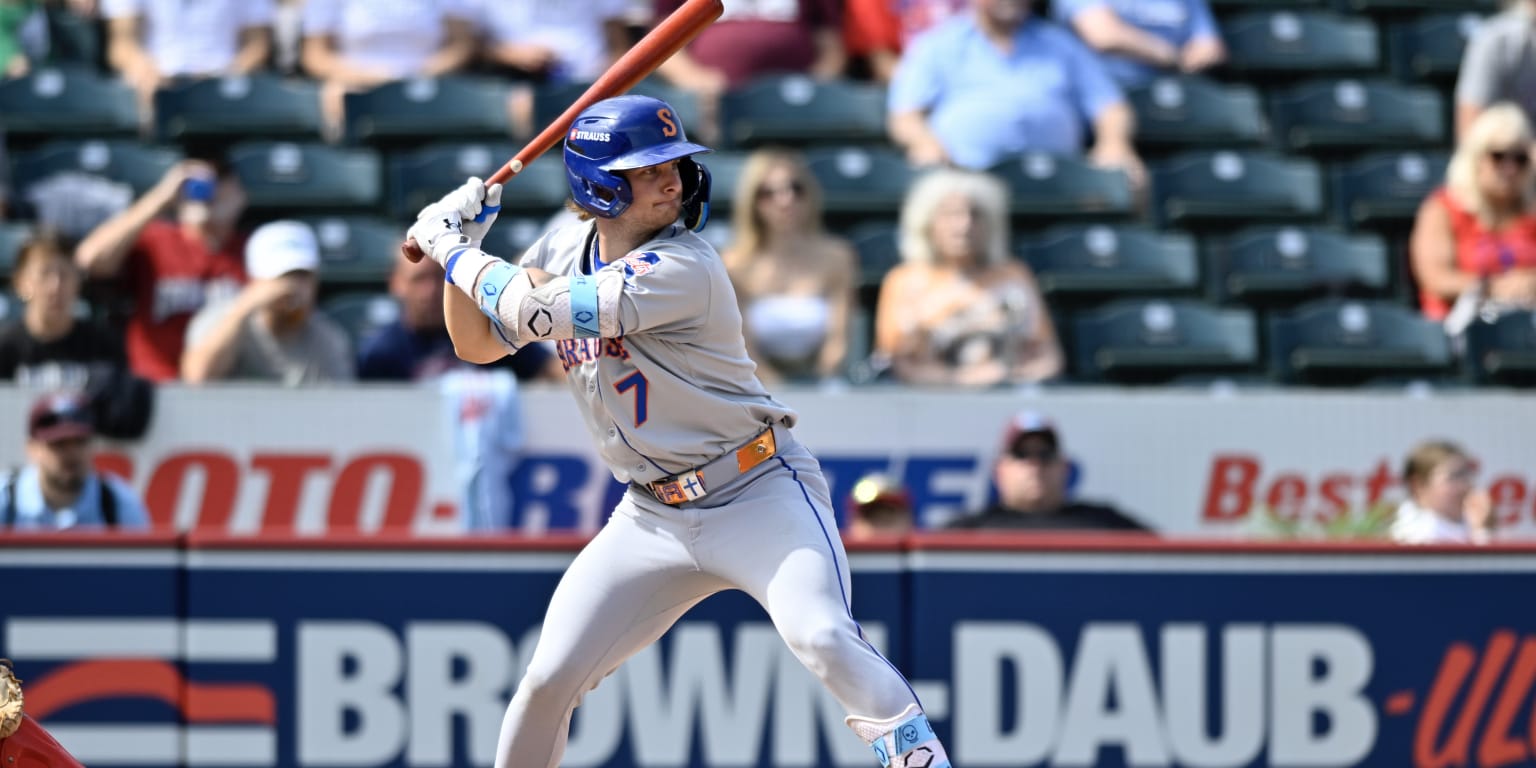
The Mets and Rangers swapping of outfielder Brandon Nimmo and second baseman Marcus Semien may have been a one-for-one trade (with some cash going to Texas, too), but it set up a series of dominoes on both sides, particularly when it comes to prospects. Last week, we covered how Mets No. 2 prospect Carson Benge (MLB No. 21) could become an Opening Day option in New York’s outfield, and he isn’t alone among Top 100 talents affected.
While Benge may see an opening, No. 30 overall prospect Jett Williams (NYM No. 3) may need to change lanes more permanently as a result of Semien’s addition to the Mets’ roster.
COMPLETE METS PROSPECT COVERAGE
The 14th overall pick in the 2022 Draft, Williams has been primarily a shortstop over his four seasons in the Mets’ system, but with Francisco Lindor locked into the position for the foreseeable future, he has mixed in plenty of reps at second base and center field in recent years.
The reason is simple. Living up to his first name, Williams is an absolute burner on the basepaths. In only 34 games with Triple-A Syracuse last year, he registered 13 Bolts, which are measured as sprint speeds of 30 ft/sec or higher. Luisangel Acuña (24) was the only Mets Major Leaguer to register more, and you have to go back to Nimmo (30) in 2022 to find the latest New York speedster to beat Williams over the course of a full season.
Defensively, Williams also unleashed two throws eclipsing 95 mph in Triple-A; the Mets as a team had two such throws all season in ‘25.
It’s that type of rare athleticism you want up the middle in some capacity. Also standing at 5-foot-7, Williams lacks the size typically associated with corner spots, both on the dirt and grass.
But a big reason why the Mets acquired Semien was for his elite glovework at second base, where many thought Williams might end up long-term. Even during his age-34 season with the Rangers, Semien was worth 7 Outs Above Average (per Statcast), putting him in a tie for fifth among Major League second basemen, on his way to winning his second career American League Gold Glove Award.
It’s an easy call to slide the veteran atop New York’s depth chart at the keystone, ahead of Jeff McNeil, Ronny Mauricio and Acuña, each of whom got starts at second last season. Brett Baty actually made the second-most starts there, with 46, but is expected to be a better fit at his more natural position of third base. Mets president of baseball operations David Stearns addressed the crowding at the position in his post-trade press conference last week.
“I think the good thing about the players who maybe have played second base for us over the last couple years who are a little bit younger or who may be coming who are infielders, there’s a ton of positional versatility with all of them,” Stearns said. “Whether that’s Acuña or Jett Williams or Ronny Mauricio, we have a high degree of confidence that all of these guys can play multiple positions and can play them at a high level. We don’t look at the Semien acquisition as necessarily blocking anyone from continuing their progression.”
McNeil has seen time in the corner outfield, and Stearns added he could be an occasional first-base option depending on how the rest of the offseason goes. Acuña and Mauricio have moved around the dirt plenty, with the former getting sparse looks in center, too.
But when it comes to the bat, none of the three have the long-term ceiling of Williams, who hit .261/.363/.465 with a career-high 17 homers in 130 games between Double-A and Triple-A last season.
Despite his size, the right-handed slugger does a good job of getting to his power by pulling and lifting the ball with regularity. Fifteen of his 17 homers came to left or left-center, and his 31.8 percent ground ball rate was sixth-lowest among the 209 Minor Leaguers with at least 500 plate appearances.
Plate discipline is Williams’ other offensive asset, as he rarely expands the zone against any pitch types. His walk rate dipped from 14.7 percent at Double-A to 9.3 at Triple-A, as pitchers with better command worked him better in the zone, but his overall mark of 13.3 was still sixth-best among Mets Minor League qualifiers, one spot ahead of Benge (13.1).
In other words, like Benge, Williams has put himself in line for some big league looks in ’25. Outside of speed, he may have more 50/55 grades on his scouting report than the 55/60s seen on Benge’s. But that shouldn’t stop his opportunities. Much will come down to how the Mets use the rest of their offseason with All-Star outfielders Kyle Tucker and Cody Bellinger still possibilities on the free-agent market. If the Mets were to acquire a truer center fielder (like Bellinger or another option via trade), Benge is the likelier prospect to move to a corner and still have a chance at an Opening Day spot.
With Lindor and Semien penciled in as the Mets’ double-play tandem, Williams should adjust his Spring Training packing list for Port St. Lucie, putting his outfield glove right at the top.
