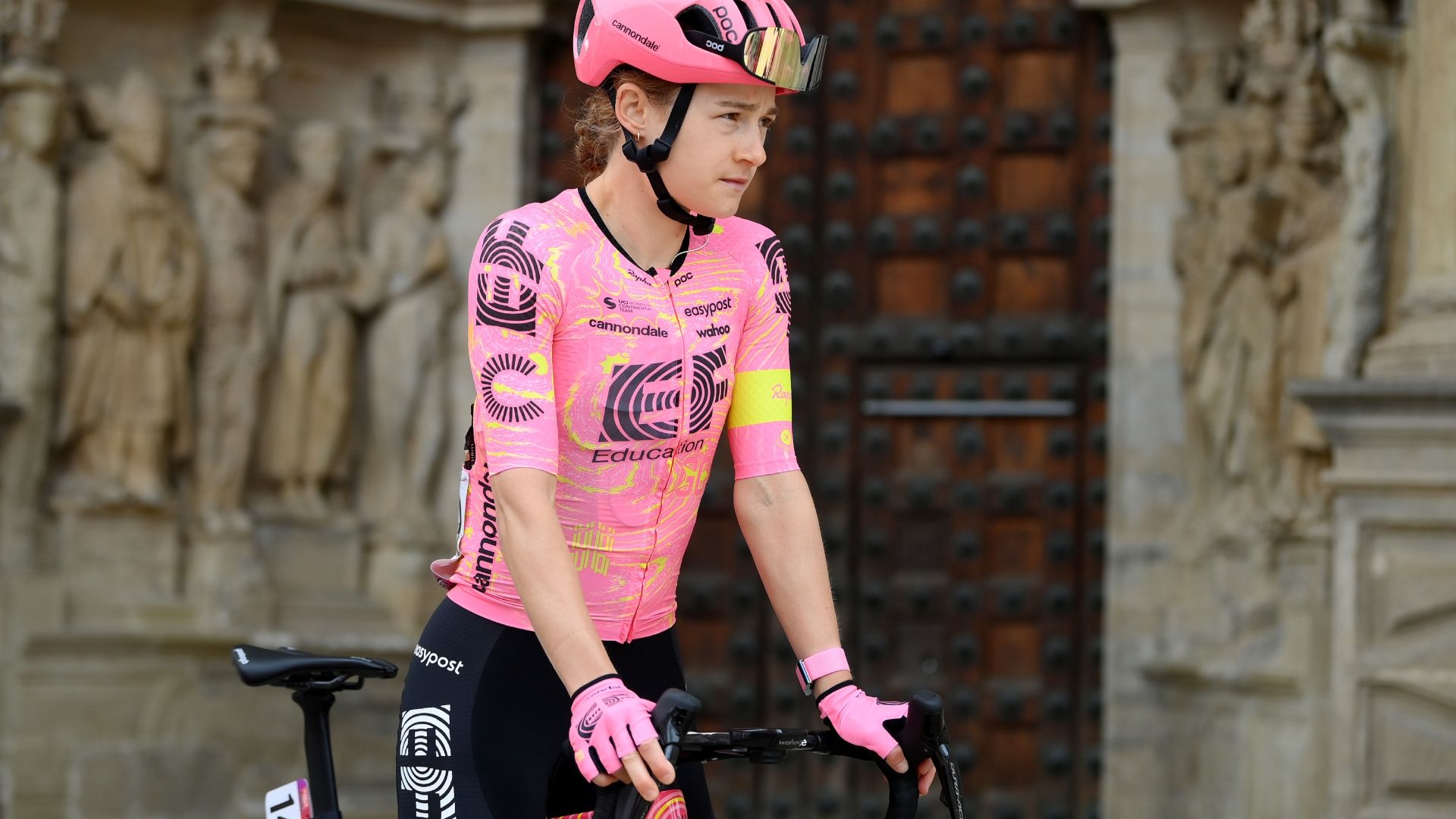
‘I’ve not had my period since 2014. My bones are weak. My gastrointestinal function is sh$’t’ – with those candid words, American climber Veronica Ewers, who emerged as one of the nation’s brightest talents in 2022, announced that she will step away from professional racing in 2026 to pursue full medical recovery.
The 31-year-old Idaho-native disclosed that a recent blood test showed that her hormone levels “were still nearly non-existent,” after years of severe hormone suppression and the long-term effects of an eating disorder.
Ewers said the results were devastating. Ewers took half of the 2024 season off to focus on healing, and returned in 2025 hoping to “continue my recovery journey whilst training and racing.”
But the dual focus proved impossible. “Trying to perform, which I physically couldn’t do until my hormones recover (stabilise), while trying to recover, which I couldn’t do until I stop trying to perform at the top level, was like beating my head against the wall,” she wrote.
“I’ve put myself into a hole by abusing my body for too long… My body needs a full reset before it can be at its best. I’m tired of being mediocre,” she said.
And beyond performance, she emphasised long-term wellbeing: “Most importantly, I want to go hiking, cycling, running, etc, when I’m older.”
(Image credit: Getty Images)
A decade-long struggle with disordered eating
Ewers’ rise in the sport was meteoric. She attended her first-ever group road ride in 2018, showing up on a too-big, hand-me-down Kona Jake the Snake cyclocross bike in leggings and tennis shoes. By the summer of 2021, she stood on the U.S. Pro Nationals podium with a bronze medal around her neck, and the following year she finished fourth at her first Grand Tour, the Giro d’Italia Donne, and ninth at the Tour de France Femmes avec Zwift.
But behind her ascent was a decade-long struggle with disordered eating and its physiological consequences, something she’s outlined at length in her own writing on Substack. She describes childhood anxiety dismissed as mere nerves, the pressures of collegiate athletics, and the gradual evolution of a restrictive-then-bulimic eating disorder that shadowed much of her twenties. She recounts not having had a period since 2014, accumulating weak bones, poor gastrointestinal function and, eventually, pushing her body to the brink of kidney failure during a dehydrated training ride in 2023.
While cycling initially provided stability and community, the transition to the European peloton reignited old habits. “The competition didn’t end at the bike race,” she wrote. “It kept going in the kitchen and at the dinner table.” Her “demon,” as she calls it, resurfaced in moments of injury, isolation, and the relentless need to prove herself.
After hitting “rock bottom” in 2023, she attempted to rebuild in 2024, taking months away from racing before returning for a fourth professional season with the EF Education-Oatly team. She remained optimistic yet the underlying hormonal damage did not resolve.
Now working with medical specialists, Ewers is focused on what she terms “restoring body weight” and navigating the identity shift that comes with stepping back from elite sport.
“I don’t know who I am when not an athlete,” she admitted, though she frames the future with resolve: she refuses to let the “demon” regain its hold and hopes to rebuild toward a healthier version of herself, one capable of returning to racing when she is ready.
“My goal is to come back eventually and show the world what I’m capable of in a functional body,” she writes.

(Image credit: Getty Images)
EF Education–Oatly released a statement in support of Ewers, acknowledging that Ewers had been “managing RED-S throughout her career” and received guidance and support from the team’s medical and nutritional staff.
“The health and long-term well-being of our riders is always our top concern, and that is what guided this difficult decision [to release Ewers from her contract],” said EF Education–Oatly general manager Esra Tromp.
The team praised Ewers for “doing everything within her power to support her recovery while remaining a committed teammate both on and off the bike,” and that the team’s medical staff, therapists and dietitians will remain available to her.
“Veronica has shown immense courage and dedication, and we are committed to supporting her as she focuses on her health. We hope to see Veronica healthy again very soon,” said Tromp.
