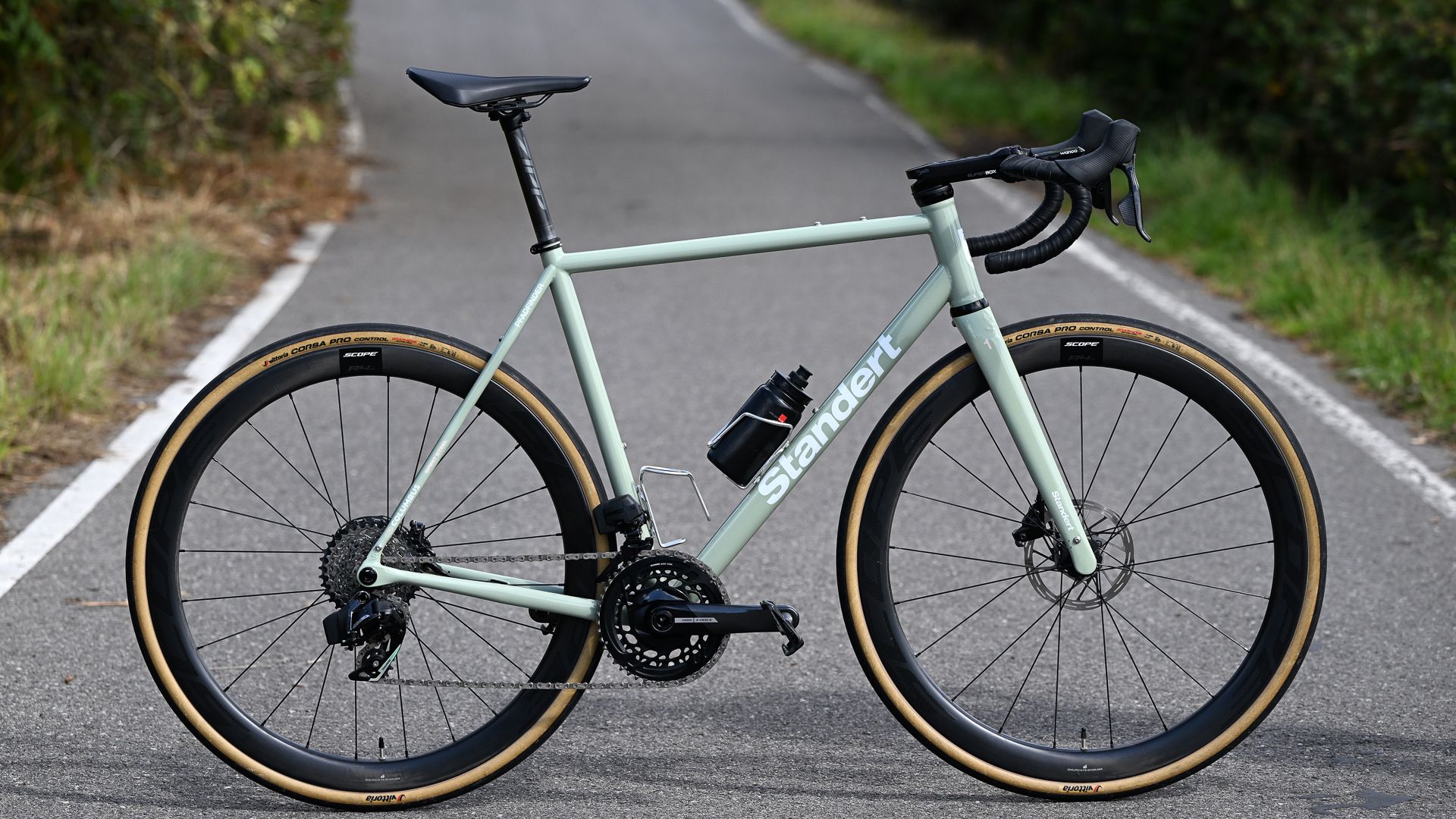
Standert is a bike brand that kind of happened in reverse. Rather than manufacturing bikes and then developing a community, Standert was born in Berlin from a cafe/shop-based cycling community, which then decided to build a bike or two. Clearly, this is a gross over-simplification, but it does serve to underline that Standert isn’t your normal bike brand, despite the brand name translating as ‘Standard’!

Perfect for quiet lanes and long days
(Image credit: Andy Jones)
All their frames are made from metal, be that aluminium, scandium, stainless or steel, with no carbon fibre in sight. However, this doesn’t mean that Standert is some kind of backwards-looking, rose-tinted retro brand; all of its bikes are thoroughly modern with up-to-date features and contemporary geometry. Standert is rightly proud of the fact that the Pfadfinder is manufactured in the Czech Republic, close enough to their Berlin HQ that Maxe Faschina, head of Product for Standert, rode the Pfadfinder there in a day for a meeting and then carried on to meet his family – a mere 900km over two days. The Pfadfinder is that kind of bike.

Designed in Berlin, made in Czech Republic
(Image credit: Andy Jones)
The original Pfadfinder started life as a kind of OG gravel bike, but has now morphed into an all-road/endurance machine with bikes like the Kieswerk and Kettensage taking on the true off-road duties.
It is available in sizes 48cm to 60cm and three colours: Sage Salida, Midnight Marauder and LTD V (or green, navy and white to you and me).
Construction
The Pfadfinder is Standert’s sole pure steel bike. The tubes are made from Columbus Spirit, joined together with only subtle weld marks visible, and the inside of the frame has been coated to prevent any possibility of steel’s arch enemy, rust. All cabling runs internally, giving the bike a remarkably clean look, especially when combined with the relatively slender steel tubes. However, it is worth noting that the Pfadfinder is only compatible with electronic groupsets; there is no potential to run gear cables on or through the frame.
There are a few nods to bikepacking mod cons; top tube bosses for a Bento box, an extra bottle cage bolt on the down tube to accommodate a frame bag, and mudguard mounts, but this isn’t a frame cluttered up with straps, bolts and cubby holes. There is, however, clearance for 38mm tyres, giving the option for endless on-road comfort and even a bit of off-road grip, depending on tyre choice.

The Pfadfinder includes Bento box mounts
(Image credit: Andy Jones)
Aesthetically, the frame is timeless, with full-height seat stays and a nearly flat top tube. The carbon fork is straight and purposeful-looking with a hidden thru-axle end. I am fairly ambivalent about the pale pastel green colour of the test bike, but it does kind of suit the slightly retro vibe (or maybe it creates it?). The dark blue of the Midnight Marauder paint job would probably be my choice – fast-looking but still classic.
Dotted about the green frame are a few pink details, one that says ‘Designed in Berlin’, another stating ‘Made in Czech Rep’ and a little Lucky Cat on the top tube. Standert uses a version of this classic Japanese good luck symbol on all its bikes, each adapted to the bike’s name. Thus, the Pfadfinder sports a cat wearing a neckerchief, as the name means ‘Scout’.

Lucky Cat with a scout neckerchief is the symbol for the Pfadfinder
(Image credit: Andy Jones)
3-D printed dropouts provide a modern twist, and the combination of a UDH hanger and a T47 bottom bracket should make life easier from a maintenance point of view. The chunky external headset bearings will also help with servicing, but do add length to the head tube and, to my eyes anyway, are the only clumsy-looking element of the bike – the juxtaposition of the slim stem, round steel tubes and the oversized headset is a bit jarring.

Headset, stem and frame interface looks a bit clunky because of the external bearings
(Image credit: Andy Jones)
Standert’s website has a configurator which allows you to select each component for the bike. The choice isn’t extensive, but does include SRAM and Shimano electronic groupsets, four wheelsets and four saddles, along with some tasty upgrades such as a power meter and some CeramicSpeed bling. Perhaps more usefully, the configurator allows you to choose your stem length, bar width and crank length.
The test bike was fitted with SRAM Force AXS with a 46/33t chainset and 10-36t cassette (but no powermeter), Scope R4.A wheels, 34mm Vittoria Corsa Pro Control tyres, Fizik Tempo Argo saddle, Deda Zero2 DCR handlebar, Deda Superbox DCR stem and Zipp Service Course SL seatpost.

45mm deep wheels and 34mm Corsa Pro Control tyres is a versatile combination
(Image credit: Andy Jones)
SRAM Force AXS, much like Shimano Ultegra Di2, is the smart choice in the world of groupsets; virtually all the performance of the range-toppers (for an additional few hundred grams) without the cost.
Scope was not a wheel brand I had come across, but Andy Turner was impressed when he tried some, so who am I to argue? A 36t ratchet hub, Sapim Sprint CX Sprint spokes, 23mm internal width and 45mm depth make them a very worthwhile all-round option that should work well with a wide variety of tyres and tyre widths, although at 1,583g, they could be a little bit lighter perhaps.
Neither the stem nor the aluminium handlebar is particularly light, but both look nice and, perhaps most importantly, the dimensions were spot on for me. Most 56cm bikes these days are fitted with a 100mm stem, but the Standert arrived with a lovely 120mm stem.
The ride
By very happy coincidence, the Pfadfinder arrived a couple of hours before my wife and I were due to depart on a 260km on-road bikepacking trip around the Yorkshire Wolds.
I quickly unboxed it, rode it up and down the street, switched the saddle and made a snap decision to take the Standert with me rather than my Cervelo Caledonia. In those 100 metres, I instantly felt right at home on the bike and it felt incredibly smooth and comfortable – exactly what I needed for a full weekend’s riding.
Over the next couple of days, the Pfadfinder repaid my confidence in spades. It was, to put it simply, the perfect companion for meandering through some fantastic Yorkshire countryside, up some steady hills and along some less-than-perfect lanes, all whilst carrying a bag or two.
The overwhelming feeling from the bike was one of serenity. Nothing troubled it. Cracks, gravel, potholes, hills, descents and even the odd farm track were all taken easily and in near silence. I don’t think I’ve ever ridden a bike this quiet. The steel frame and 34mm tyres absorbed every bump, and SRAM’s Orbit-equipped rear derailleur countered any chainslap, making for a sublimely serene experience. The low SRAM gears also came into their own on the hills, allowing untroubled progress and an easy cadence at all times.

Blue skies and minimal kit – the Pfadfinder was the perfect bike for a weekend adventure
(Image credit: Kim Russon)
Well, almost. Whilst I have no problem with the upgraded Scope R4.A wheels from a performance and comfort perspective, the ratchet freehub was pretty loud. I don’t mind a loud wheelset, and my favourite Scribe wheels are certainly not the quietest, but on this bike the ratchet noise felt very out of place, to the extent that I tried to avoid freewheeling as I coasted through the countryside and frequently soft-pedalled to keep the din down. A very personal opinion, but it just didn’t suit the bike’s demeanour or that particular ride.
On the plus side, I loved the alloy Deda Zero2 DCR handlebars; so much so that I returned home and ordered some for my Caledonia. The shape was comfy on the tops and drops with plenty of round section for lights and mounts.

(Image credit: Andy Jones)
Having hugely enjoyed the bike in its natural habitat, I put my big boy pants on and took it along to the Tuesday night thrashfest. It did look rather outgunned by the Dogmas, Aeroads, V4s and S5s, but it did OK. What it lacked in lightweight parts and aero features was, in part at least, made up for by the cosseting ride.
I didn’t have to waste time and energy avoiding every imperfection in the road surface, and the easy snick of each gear change, no matter the pressure on the pedals, allowed me to maintain optimum cadence.
Ultimately, when the pace really ramped up towards 50kph on the through-and-off section, I struggled a bit – whether it was the drag, my lack of fitness or the cumulative effects of having to keep up with 7kg bikes over the previous few hills, I can’t say for sure. What I can say, though, is that the Pfadfinder acquitted itself better than I had imagined it would (and potentially better than the race machines would have done on the gravelly Wolds ride…). It never felt like it was sapping my energy unnecessarily or that it was a chore to ride.

Stiff enough to reward out of the saddle efforts
(Image credit: Andy Jones)
Whilst sprinting and out of the saddle efforts are definitely not my forte, on the odd occasions I did really press hard on the pedals, the Pfadfinder felt remarkably stiff around the bottom bracket for a bike so comfy. I expected a little bit of sogginess, but there was none, and the response was surprisingly rapid and direct.
Equally, the geometry keeps the bike responsive in a true road bike fashion, without the slight compromise that some all-road/endurance bikes make for the sake of comfort and stability. I guess by using steel, some of that is baked in without the need to engineer it with angles. It was plenty long enough and low enough for me to feel totally at home straight away without needing to make the mental adjustment that I was riding a bike with mild gravel clearance. The head tube angle is noticeably steeper than many bikes of this ilk, keeping the handling nice and quick – I even got toe overlap at slow speeds; the wheelbase of the 56cm is just 1,001mm.
Value and conclusion
The Standert Pfadfinder is a bit like a modern performance SUV. You know that ultimately you are sacrificing a modicum of performance compared with a sports car, but, for the majority of us, that trade-off is more than worth it for the added benefits of comfort, convenience and its mile-munching abilities when compared with a hardcore Italian thoroughbred.

Standert has a strong brand image (and 38mm of tyre clearance)
(Image credit: Andy Jones)
To further wring out the SUV metaphor, I took the Pfadfinder off-roading (on the smooth, disused railway of the Monsal Trail), and even on its slick road tyres, it was great, and allowed me to bypass a busy main road and the town of Bakewell.
If you are chasing KOMs or seeking podiums, then you should look elsewhere. However, for the rest of us who simply enjoy two-wheeled travel without sacrificing all performance, the Pfadfinder is a very interesting option. If I had more room in my garage and a fuller bank account, then I could certainly see scope for adding one to my collection for days when the ride rather than the stopwatch was the priority.

(Image credit: Andy Jones)
As for value, at €6,399 (including the upgrades), the Pfadfinder is reasonable. The most similar bike that I’ve ridden, both in terms of groupset and feel, is the Cervelo Caledonia-5, which will set you back £7,400 in similar spec, but is 1.5kg lighter. On the other hand, the much vaunted but lower-key Fairlight Strael 4.0 is only £4,049 with SRAM Force AXS, which is a fair chunk of change; pick your brand allegiance.
