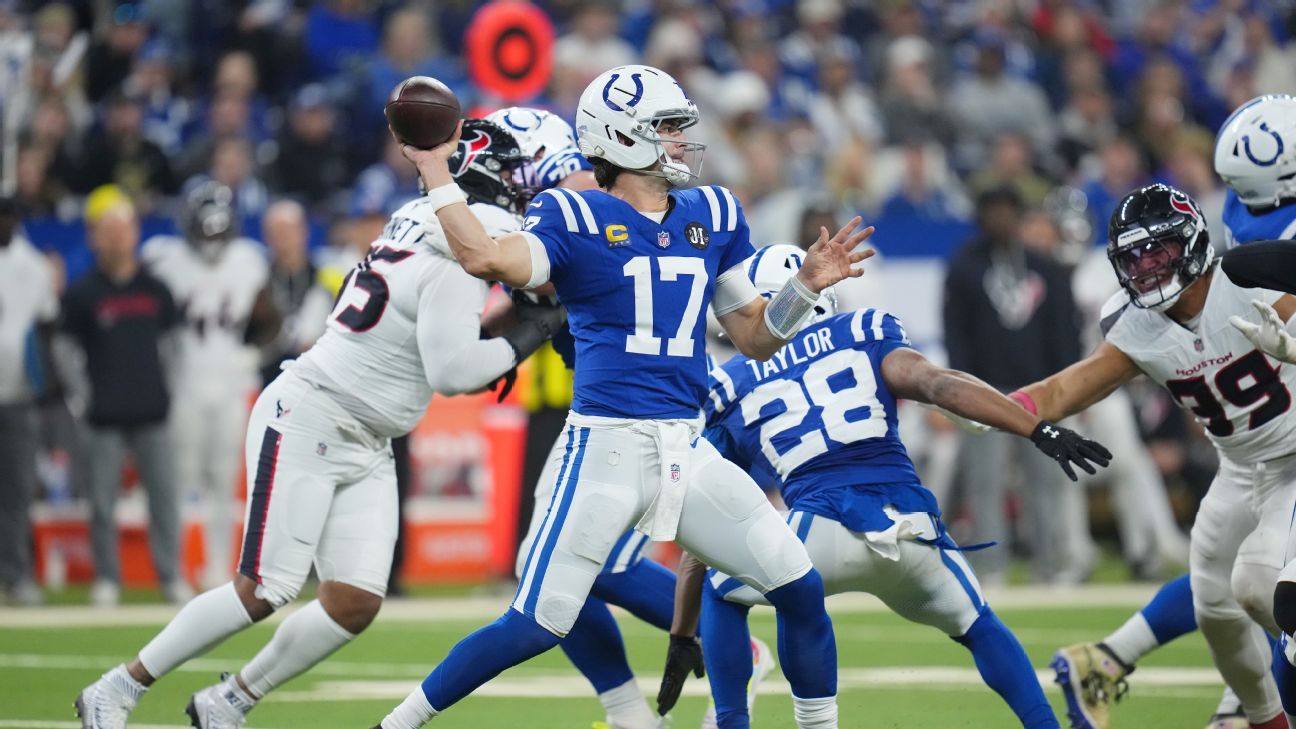
INDIANAPOLIS — Halfway through the NFL season, the topics dominating the conversation around the Indianapolis Colts sounded like those from the mid-2000s.
Indianapolis had the best record in the NFL after eight weeks (7-1), its offense was sizzling, and hopes of a deep playoff run were more than justified. It felt like a throwback to the Peyton Manning era, when the Colts were annually in contention for a Super Bowl run.
One month later, the Colts are reeling, losing three of four games, their offense has come back to earth, and the playoffs are no longer a sure thing.
The Colts (8-4) now find themselves in a tie for first place with the Jacksonville Jaguars for the AFC South lead as their mutli-game advantage in the standings has been erased. And the Colts’ final stretch run includes two games against Jacksonville, a road game at Seattle and another meeting with Houston, which beat the Colts on Sunday. This Sunday’s game at Jacksonville poses a major test for Indianapolis, which hasn’t won there since 2014.
Here’s a closer look at some of the issues that have led to the Colts’ recent struggles.

First-down production
One of the keys to the Colts’ early offensive dominance was their prolific production on first downs. The Colts were averaging 7.2 yards per play on first downs through Week 8 but are mustering just 6 yards per play since. That was a historic pace for Indianapolis. To put it in context, in the past 15 seasons, only the 2016 Atlanta Falcons, who reached the Super Bowl that season, produced more yards per play on first downs (7.6).
Why does this matter? It’s directly responsible for the Colts’ long down-and-distance situations in recent weeks, which has led to more failed drives and punts.
“Those third-and-long conversions, they come and go,” receiver Josh Downs said. “They’re not statistically high-percentage, so you’ve just got to try to stay on schedule.”
The Colts were 3-for-10 on third downs and 0-for-2 on fourth downs in Sunday’s loss to the Texans.
There’s no way around it: Daniel Jones‘ fibula injury has placed limits on the Colts’ offense.
Jones has been a limited practice participant multiple times in the past two weeks but hasn’t missed any games. But make no mistake: He’s playing hurt.
That’s not to say Jones has played poorly. He completed 14 of 27 passes for 201 yards and two touchdowns in Sunday’s loss. But the injury is limiting his mobility which therefore limits what plays the Colts can call. With run-pass options and bootleg throws comprising a big part of the Colts’ usual game plans, it’s likely that Jones’ injury has impacted coach Shane Steichen’s playcalling.
Jones attempted just one pass outside the pocket in Sunday’s game, rolling out and hitting tight end Tyler Warren for a 12-yard touchdown.
Defensive injuries
The loss of defensive tackle DeForest Buckner, who remains on injured reserve with a neck injury, has been difficult to overcome.
The Colts have made significant draft and financial investments in their defensive line, but with players such as Laiatu Latu creating pressure but not always closing the deal with sacks, the Colts have struggled to replace Buckner’s interior disruption.
The Colts expect Buckner back before the end of the season, but he must miss at least one more game.
The Buckner injury is compounded by the loss of star cornerback Sauce Gardner with a calf injury in Sunday’s game. Gardner averted an Achilles injury, which was initially feared. But he will still miss an undetermined amount of time in the lineup, Steichen said Monday.
The effect of Gardner’s injury was immediately evident: The Colts had intended to use Gardner and fellow perimeter cornerback Charvarius Ward in static right and left roles, respectively. But after Gardner left Sunday’s game, defensive coordinator Lou Anarumo immediately altered Ward’s role, assigning him the job of tracking Texans No. 1 receiver Nico Collins throughout the game. That’s likely to continue against top receivers, and it’s a much heavier workload than the Colts envisioned.
League rushing leader Jonathan Taylor was fueling talk of a run at Most Valuable Player after his stunning 244-yard performance in Week 10 against the Falcons. But in the two games since, Taylor has rushed a combined 37 times for 143 yards. That’s a 3.9-yard-per-carry average, far lower than Taylor’s 5.7-yard average for the season.
So, what’s at play here? There’s no singular answer. Some of it is consecutive matchups with two of the NFL’s top defenses, the Chiefs and Texans. Then, there’s the lack of success on early downs, which has forced the Colts into more passing situations and made them more predictable.
There’s an argument to be made that Taylor needs more touches, evidenced by the fact so much of his most impactful plays have happened late in games. But until the Colts are able to sustain drives, it might not matter.
Kicking questions
The Colts lost kicker Spencer Shrader to a season-ending injury after a collision with a defender in Week 5, sidelining the league’s leading kicker at the time.
In the seven games since, his replacement — Michael Badgley — missed three extra points, including one in Sunday’s loss to the Texans that left Indianapolis with a four-point deficit instead of three points on its final possession.
The Colts released Badgley on Monday and signed former Saints kicker Blake Grupe.
The loss of Shrader had a clear impact on Steichen’s in-game decision-making because Badgley had less range. That means Steichen has had to attempt some difficult fourth downs that he wasn’t entirely comfortable with because the alternative of attempting a field goal wasn’t seen as a good option.
Badgley was converting 43.8% on attempts of 50 yards or longer. The league average is 68.1%.
