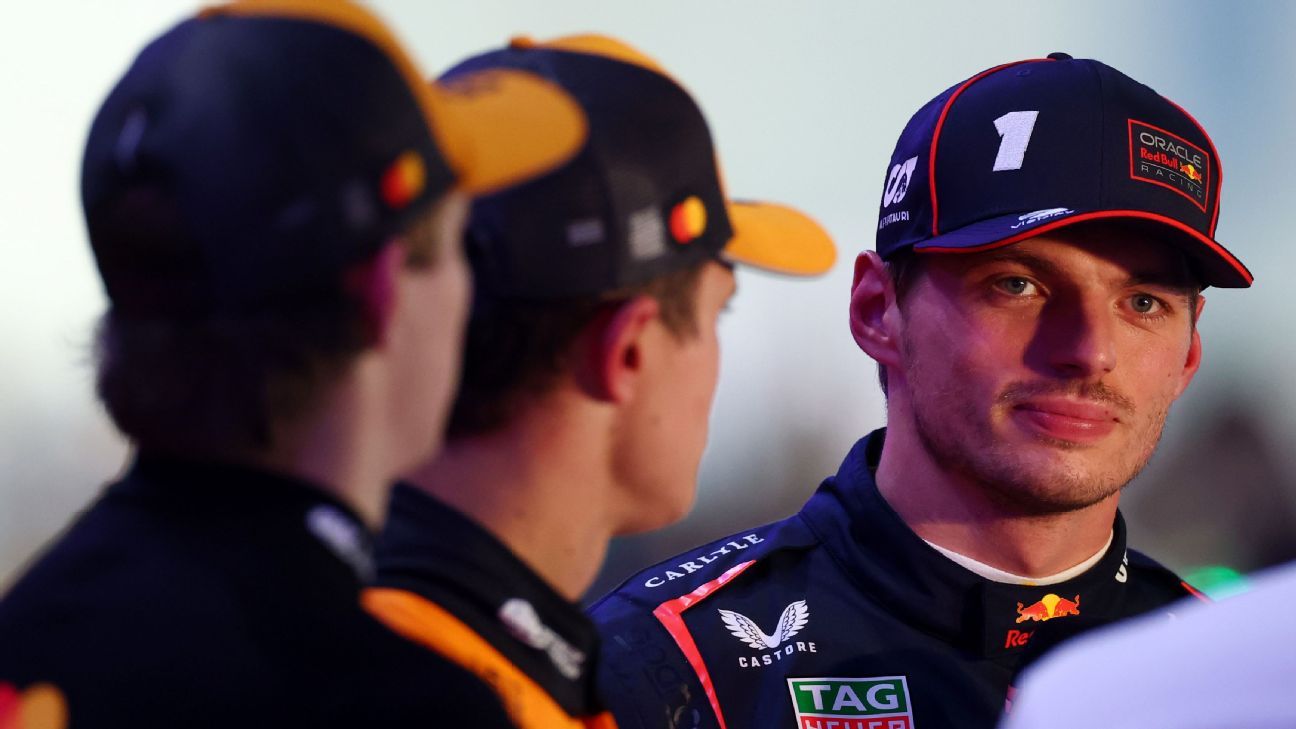
Strange things often happen when a Formula 1 title fight goes down to the final race of the season. Nerves ramp up, past form counts for nothing, and even the rules of the game — such as how a race director implements the safety car procedure — can get lost in the madness … just ask Lewis Hamilton.
Logical advantages — such as holding a 12-point margin at the top of the championship, like Lando Norris has over Max Verstappen — can hold little comfort when you qualify out of position and line up on the grid needing to make up places to secure the title. Each setup decision over a weekend can snowball in the wrong direction or you could, simply, become the unwitting victim of someone else’s accident, safety car or pit strategy gamble during the race.
And when there’s more than two protagonists in the running — like there is this year with Norris, Verstappen and Oscar Piastri all still mathematically in contention — it’s not unheard of for the outsider to emerge victorious. Minimizing pressure can sometimes be the easiest way to maximizing lap time.
To borrow a phrase from legendary commentator Murray Walker: “Anything can happen in Formula 1, and it usually does.”
What do the history books tell us?
Less than half of the sport’s 75 championships have been decided at the final round, with just 31 past instances of the biggest prize still being in play by the final race of the season.
Title showdowns have been particularly rare in the past ten years, with only two prior to this weekend’s: one in 2016, when Nico Rosberg beat Mercedes teammate Hamilton to the title, and, unforgettably, in 2021 when Verstappen emerged victorious after arriving at the final round tied on points with Hamilton. On the current 24-race calendar, Abu Dhabi pays big money to hold the last race of the season and has hosted a title decider on four of the 13 occasions it has been the final event.
Different versions of F1’s points systems and fewer races in the early seasons of the sport go some way to explaining the greater frequency of final-race deciders in F1’s distant past, but ultimately tight competition is the most important factor. In the 20 years between 1994 and 2013, the title went down to the final round on 11 occasions.
Final-round showdowns between teammates are not as common as you might think, with just five of the 13 down-to-the-wire deciders of the past 25 years featuring teammates. Even the legendary battles between Ayrton Senna and Alain Prost at McLaren were decided at the penultimate round rather than the final race.
Showdowns between more than two drivers, like this weekend’s in Abu Dhabi, are even less common. The last one was 15 years ago, in 2010, when four drivers were still mathematically in contention ahead of the final race, and there are only 10 examples in the sport’s history prior to that. Interestingly for Verstappen and Piastri, and perhaps worryingly for Norris, in six of those 11 examples, the driver leading the championship ahead of the race weekend has not emerged victorious at the checkered flag.
History repeating for McLaren?
The 2007 finale in Brazil was one such example of a three-way battle and has clear parallels to this year’s situation. Once again, McLaren had two teammates in contention, although the mood between Hamilton and Fernando Alonso within the team in 2007 was far darker than between Norris and Piastri this year.
Alonso, who joined McLaren as reigning champion at the start of the year, felt his new team had unfairly backed his rookie teammate at critical points in the championship. Turmoil behind the scenes was hard to contain, and nearly split the team apart when Alonso threatened to release internal emails to the FIA that were pertinent to the ongoing Spygate espionage controversy the same year.
Hamilton had an opportunity to wrap up the title in China one round before the season finale in Brazil, but beached his car in the gravel as he came in for a pit stop on extremely worn tires. Even with the unusual situation of two teammates fighting for the same title, the level of tension at McLaren in 2007 was off the charts.
Under F1’s old points-scoring system, Hamilton entered the final race of the season four points clear of Alonso and seven points clear of Ferrari’s Kimi Räikkönen in third place in the standings. For Räikkönen to win, he needed Hamilton to finish sixth or lower and Alonso to be third or lower (coincidentally a very similar outcome to what Piastri needs from third place this year).
Hamilton appeared to have half the job done when he qualified second behind Räikkönen’s teammate Felipe Massa (who was not in title contention), with Räikkönen third and Alonso fourth. But then fate intervened, with Hamilton making a poor start and dropping to eighth before a gearbox issue a few laps later briefly left him without drive a and he dropped to 18th.
Massa and Räikkönen built a comfortable lead over Alonso in third, with Massa eventually ceding first place to his teammate in the pit stops. Hamilton scrambled back to seventh place, but it wasn’t enough to claim the title and both McLaren drivers finished the season one point shy of Räikkönen.
Although the title was ultimately lost by Hamilton’s issues on the day, then, as now, there were questions over whether McLaren should have prioritized a single driver in 2007.
Although the modern-day McLaren has said it will work through various scenarios with its drivers ahead of the Abu Dhabi weekend so that there are no surprises on race day, as recently as last month CEO Zak Brown said he would rather lose the title to Verstappen in 2007 style than give preference to one of his drivers over the other.
“We’re well aware of 2007,” Brown said. “Two drivers tied on points, one gets in the front. But you know, we’ve got two drivers who want to win the world championship. We’re playing offense. We’re not playing defense.”
Whether McLaren sticks to those words this weekend remains to be seen. Brown was speaking before he knew the points situation ahead of Abu Dhabi, and just like Massa gave up a win at his home race in Brazil to allow Räikkönen by in the pit for the points to win the title, a similar scenario could unfold on Sunday.
If with a handful of laps remaining, Verstappen is winning the race, Piastri is third and Norris is fourth, McLaren’s only hope for the title would likely be switching its drivers. In such a scenario, Piastri would not stand a chance of winning the championship if he finishes third or fourth, but third place will be enough for Norris to clinch. It will likely be one of many scenarios the team will discuss before the cars leave the garages on Sunday evening.
How not to lose a championship
Further lessons can be learned from the 2010 title showdown when Sebastian Vettel came from third place in the standings ahead of the weekend to secure his first world title by the end of the evening in Abu Dhabi.
Alonso, by this time driving for Ferrari, led the standings by eight points from Red Bull’s Mark Webber going into the race, with Webber’s teammate, Vettel, 15 points off Alonso (again, take note Piastri). Also thrown into the mix was McLaren’s Hamilton — 23 points shy of Alonso, and therefore only really in contention if something dramatic happened to all three of his title rivals.
Vettel secured pole position ahead of Hamilton in second on the grid, Alonso in third and Webber down in fifth. A nasty collision on the opening lap between Michael Schumacher and Vitantonio Liuzzi presented an opportunity to pit under an early safety car and Renault driver Vitaly Petrov, who started the race 10th, was among those who made use of it.
Running in fifth place, one place behind Alonso, who had lost third to Jenson Button on the opening lap, Webber stood to lose the title to both Alonso and Vettel if he remained where he was. Red Bull took a gamble on pitting him relatively early on lap 11, even though it knew it would mean dropping him into traffic behind the early stoppers.
Ferrari, worried that Webber’s early pit stop could undercut Alonso and knowing that a fifth-place finish behind Webber would not be enough for Alonso to beat Vettel (remarkably on countback of fourth-place finishes), reacted on lap 15 and pitted its driver. It was a critical error as Alonso emerged behind Petrov and Rosberg, another driver to pit under the early safety car, dropping him to a net seventh place once all the pit stops had shaken out.
The Yas Marina circuit — completed less than two years earlier — was a notoriously difficult layout to overtake on, and without the help of a Drag Reduction System (introduced the very next year to aid overtaking), Alonso was stuck behind Petrov. Vettel went on to win the race, and with it the title, while Alonso and Webber were subjected to the most frustrating evening of racing imaginable.
Fifteen years on, Abu Dhabi 2010 is proof (if McLaren needs it after last weekend’s shocker in Qatar) that every decision from the cockpit and the pit wall is crucial in a title decider. And if anyone should be aware of the lessons of Alonso’s 2010 defeat, it’s current McLaren team principal Andrea Stella, who was race engineer to the Ferrari driver that night and performance engineer to Räikkönen in 2007.
Asked in Qatar how McLaren will approach this weekend’s race in Abu Dhabi, Stella couldn’t help but reference both races.
“The first element to focus on from a team point of view, I would say, is make sure that we are in condition, prepared, determined to execute perfect race weekends,” Stella said. “Because the pace has been in the car, the drivers are doing an exceptionally good job, but over the last couple of races, from a team point of view, we have not been in condition to capitalize on the good work of the drivers and the potential we have in the car.
“When it comes to the fact that we have two drivers in the quest for the world championship, our philosophy and our approach will not change. We will leave both Oscar and Lando the possibility to compete and pursue their aspiration.
“Oscar, from a points point of view, is definitely in condition to win the title. We have seen before in the history of Formula One that when you have this kind of situation, sometimes it’s the third one that actually wins.
“We have seen it in 2007, in 2010, and Oscar is fast. I think he deserves to be able to just realize his performance. We will let the drivers be in condition to race each other. What’s important for us is that we are in condition to beat Verstappen with one of our two drivers.”
Last weekend in Qatar, the story of Vettel’s 2010 triumph was also relayed to Verstappen as an example of why his 12-point gap to Norris could still be surmountable. The exact mathematics don’t quite match up, but it surely acts as proof of why the Red Bull driver is still very much in the hunt.
“Of course, those are great stories, but it doesn’t always go like that,” he responded with a smile. “We’ll just go in there with a positive mindset and we will try everything we can.”
Verstappen, it seems, is only interested in making his own history. And that might just be the perfect approach to a season finale.
