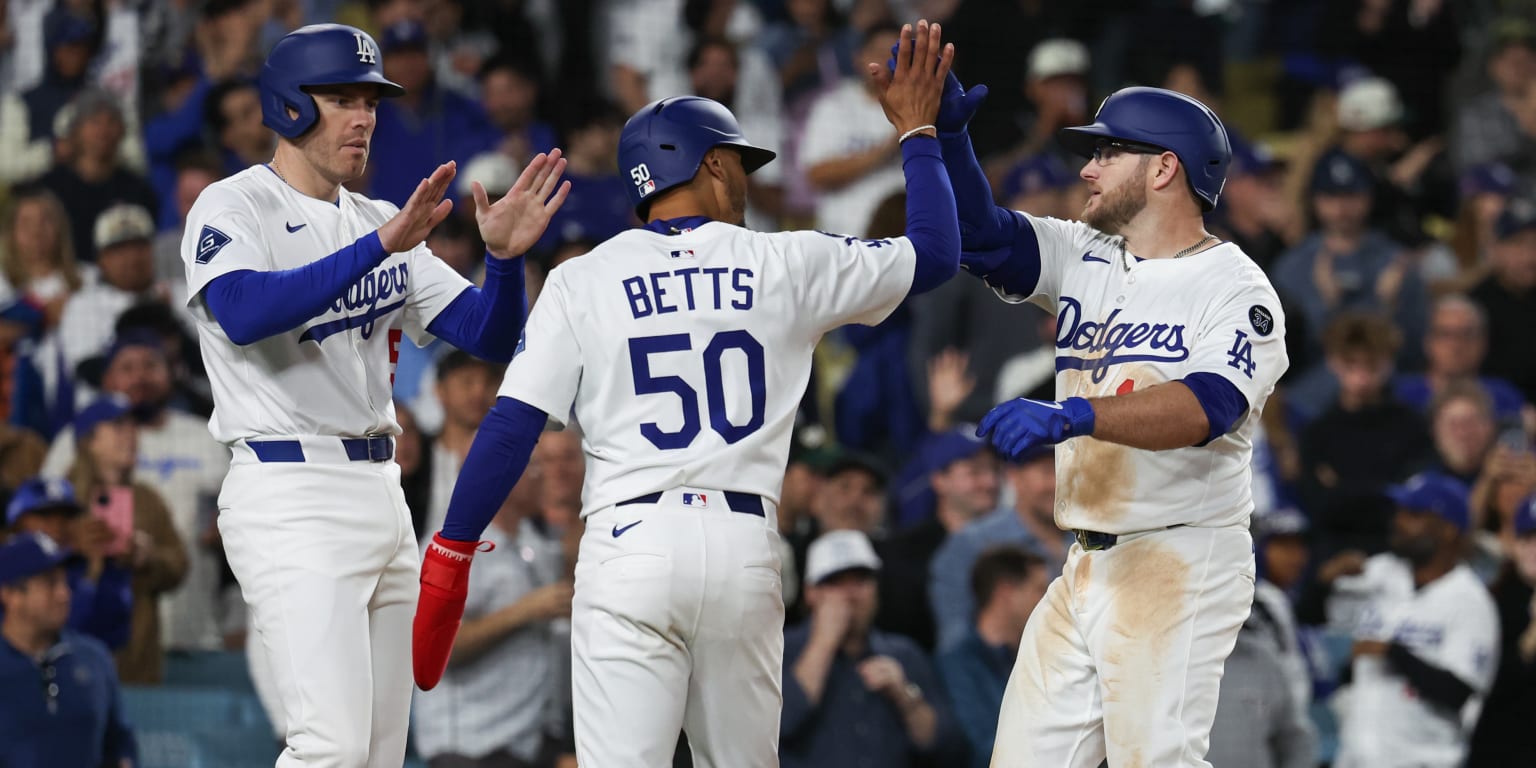
When you look at the Dodgers’ projected 2026 lineup, the first thing you notice is that the three players at the top are all MVP winners who are likely headed to the Hall of Fame someday. But one other thing that stands out? It’s this:
Those four help lead a lineup that also features three position players heading into their age-31 seasons: DH Shohei Ohtani, catcher Will Smith and second baseman/center fielder Tommy Edman. As things stand, the Dodgers’ lineup will feature only two players under the age of 30, and that’s if they don’t add another 30-plus veteran or two to the mix this offseason.
Of course, this “problem” isn’t new for the Dodgers — and it hasn’t really been a problem, either. This is, after all, a team that has won back-to-back World Series titles, and the hitters in question have been some of the best in the game. At the same time, age only goes in one direction, even for all-time greats like Betts and Freeman, which means this is an issue that could grow more pronounced for Los Angeles in 2026 and beyond. Muncy is signed only through next season, but Hernández and Freeman through ‘27 and Betts all the way through ‘32.
There was a time when it was more common for position players to remain productive into their mid-to-late 30s, but that has dwindled, perhaps due to factors such as rigorous PED testing and a rapid escalation in pitching velocity and spin. Consider these numbers:
No team since the 2014 Phillies (Marlon Byrd, Jimmy Rollins, Carlos Ruiz, Chase Utley) has fielded four players age 33 or older who each reached the 100 OPS+ and 3 WAR thresholds. Other than the 2024 Dodgers (Freeman, Muncy and Miguel Rojas), no other team has even fielded three of them since the 2009 World Series champion Yankees (Johnny Damon, Derek Jeter and Alex Rodriguez).
So what can the 2026 Dodgers expect from their key quartet of aging position players? Here is a closer look:
SS Mookie Betts (age-33 season)
2025: 150 G, 104 OPS+, 4.9 bWAR
On the plus side, Betts pulled off his latest mind-blowing feat in a career full of them by successfully making the full-time move to shortstop. Playing a premium position at a high level accounted for a significant chunk of that impressive WAR total, which kept him among the 25 or so most productive position players across MLB. With that said, his offensive performance collapsed — albeit to a still-league-average level. Betts did hit far better over his final 47 games of the regular season (.892 OPS), which lent credence to the idea that an undiagnosed stomach illness he contracted in the spring sapped his strength and hindered him throughout the first half. If that’s the case, an offensive rebound could be in order in 2026. However, the fact that Betts’ hard-hit rate and sprint speed both have regressed by a huge amount over the past few years — and that his bat speed ranks near the bottom of the league — are causes for concern.
1B Freddie Freeman (age-36 season)
2025: 147 G, 141 OPS+, 3.5 bWAR
For the seventh time in as many full seasons, Steady Freddie played in more than 145 games in 2025, posted an OPS+ of at least 135, topped 20 homers and 80 RBIs and made the All-Star team. His offensive numbers were basically identical to 2024. The only real step back came on the defensive side, where Freeman (minus-6 Outs Above Average) graded out below average, per Statcast, for the first time since 2019. Offensively, there were a few warning signs underneath the surface, including a bump in chase rate and one of the steepest increases in whiff rate among any hitter. Those didn’t really hamper Freeman’s overall production, though he did endure a lengthy slump in the middle of the season. While it’s hard to imagine Freeman doing anything except delivering the same sort of performance he always does, those trends are something to watch, warily, in 2026.
OF Teoscar Hernández (age-33 season)
2025: 134 G, 103 OPS+, 1.5 bWAR
Hernández became a clubhouse and fan favorite after signing with the Dodgers before the 2024 season, when he produced arguably the best season of his career (135 OPS+, 4.3 bWAR). The vibes remained strong in ‘25, but Hernández’s effectiveness unquestionably took a sizable step back. That was most noticeable on the defensive side, where he ranked among the bottom 10 outfielders in Statcast’s Fielding Run Value metric, at minus-9, and had a few high-profile misplays during the postseason. But even Hernández’s bat had its issues. A career-low walk rate helped lead to a career-low .284 OBP, and even his quality-of-contact metrics, while still good, declined noticeably. Given the presence of Ohtani in the DH spot, the glovework may be of greater concern going forward, although it could help if the Dodgers are able to shift him over from right field to left.
3B Max Muncy (age-35 season)
2025: 100 G, 136 OPS+, 3.6 bWAR
Picking up Muncy’s $10 million club option for 2026 was a no-brainer, as he once again was one of the team’s best hitters when healthy. In fact, over the past two seasons, Muncy has been as productive offensively — on a rate basis — as any third baseman in the Majors. However, he has lacked the durability of the others on this list, playing the equivalent of just over one full season in that span (173 games, 681 plate appearances) due to injuries. Muncy’s plate discipline remains elite, he always ranks near the top of the league in walk rate and when he makes contact, he drives the ball in the air better than almost anyone. There are no glaring red flags on the offensive side, so any concerns are more about Muncy’s ability to stay on the field and whether his already below-average defense will decline further, on a team with no ability to slide him to first base or DH.
