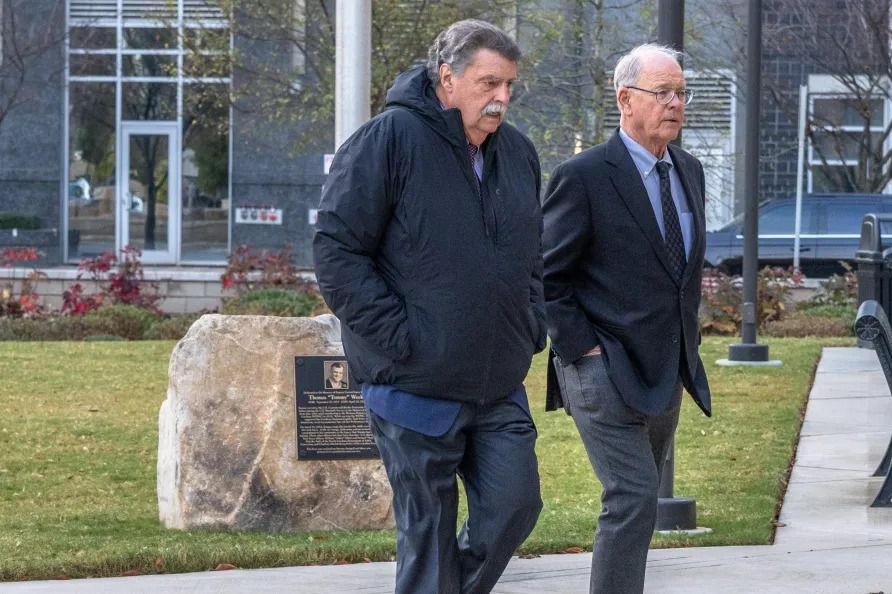
On the third day of the 23XI Racing and Front Row Motorsports v NASCAR antitrust trial, testimony was concluded from Executive Vice President and Chief Strategy Officer Scott Prime and began for FRM team owner Bob Jenkins.
Prime spent the second half of Tuesday on the stand, examined by 23XI and FRM attorney Jeffrey Kesseler and then cross-examined by a friendly attorney before being reexamined by Kessler.
Advertisement
First a recap of Prime’s testimony from Tuesday is in the link below.
Read Also:
What happened in Day 2 of NASCAR’s antitrust trial
On Wednesday, Kessler continued his examination of Prime and their exchange was occasionally contentious, with the attorney even apologizing to Prime and the court for raising his voice.
“It’s okay — I understand there are passions,” Prime said in response.
Kessler’s initial line of questions to open the morning surrounded the goodwill provision, which is basically the clause in the charter agreement that prevents team owners from competing in another competitor series or owning one without NASCAR approval.
Advertisement
Kessler: “Why not call it what it really is?”
Prime: “I’m not a lawyer.”
Kessler: “It should be called anti-competitive will.”
This got an objection from the NASCAR bench and Kessler moved on.
Specifically, anyone who has a 10 percent ownership stake in a team is subject to the goodwill provision. Further, if a team owner or partial team owner decides to leave the Cup Series, that individual must wait 12 months before owning a car in a different series or ownership in a different series.
Advertisement
Kessler: “And you think that’s goodwill?”
Prime: “I do.”
Read Also:

How NASCAR’s ownership charter system works
Then attention was turned to the NextGen car, with Kessler seeking to paint its intellectual property restrictions as a tool utilized to restrain trade and prevent competition — one of the pillars of the lawsuit.
In previously discovered documents, Prime had expressed concern that the previous generation of car, known within the community as Gen-6, had an ‘increased risk to NASCAR of copycat series’ due to looser Intellectual Property restrictions.
Advertisement
In other words, NASCAR was concerned that teams could seek to race their cars in non – NASCAR series or race cars similar to those used in the Cup Series. When asked about it, Prime said that was never a point of contention.
“It was never an issue with the teams,” Prime said. “They understood the Next Gen car design and all the protections that went with it, yes.”
Kessler: “Did teams vote … were they asked if they wanted restrictions?”
Prime: ‘My understanding is that there was never an issue with the teams…’ and that they wanted protections and a degree of cost containment. ‘They understood the NextGen’s protections and endorsed it.’
Advertisement
Kessler pointed out that the teams don’t have a formal vote under charter rules.
During the negotiations over what became the 2025 charter extension, an email on February 10 from Prime to Phelps said he was ‘quite disappoint(ed)’ over the decision from the race teams to cease negotiating with NASCAR and instead were ‘forced to recommit our energy to exploring all our options.’
The teams wanted four things before that point — 1) 45 percent of industry revenue, 2) not having to pay into the Driver Ambassador Program, 3) 30 percent of new revenue where team IP was leveraged and permanent charters.
Advertisement
That wasn’t agreed upon and Prime, through the discovered documents, was concerned that the teams would look to join or otherwise create a ‘breakaway series’ and then pondered options that included the following:
Reduce charters to 32 and offer them ‘first come first serve’ amongst the preexisting 36, which Kessler likened to musical chairs, and was a tactic to create scarcity and competition. Another option was a hard deadline, which is more or less what happened on September 6, 2024. Another idea was Project Gold Codes, where NASCAR would take the sport vertical, and runs races independent of teams and hires drivers and fields cars themselves.
That is detailed at the link below.
Advertisement
Read Also:

NASCAR contigency plans to run Cup races in house revealed in legal filing
“You accurately reflected our options,” Phelps replied over an email. “They are playing with fire. Lots of options but all have the same theme: Pick a date and they can sign or lose their charters. It is that simple.”
Kessler said that was an example of what encouraged the lawsuit.
“Only a monopolist could say this,” Kessler said. “Only a monopolist has the power to say, ‘Take my offer and if you don’t take it, you will no longer be in this business, and someone else will take your place.’”
Advertisement
For his part, during friendly negotiations, Prime said there was more to that email, which is true. Those options were just ‘Path 1’ and the ‘Path 2’ was the continued efforts to ‘find a middle ground with the teams,’ which is actually what happened.
Despite the deadline passing, NASCAR did not enter into an agreement with any new team owners for the 2025 season.
Prime’s position was that NASCAR just needed to have contingency plans in the case the teams former their own breakaway series.
Advertisement
Kessler asked where they would race since NASCAR’s track exclusivity clauses prevent such a division from racing on Cup Series caliber facilities.
Prime said there were plenty of tracks, citing short tracks and street courses. He said that NASCAR didn’t start with superspeedways. Kessler said this isn’t 1948. And regardless, Kessler said it wasn’t realistic to expect a potential competitor to just race on street courses since NASCAR lost $50 million over three years in Downtown Chicago.
Prime said messages of ‘locking up tracks’ had nothing to do with a breakaway series but was just a part of a multi-year agreement to schedule races. The example he gave was that TNT wanted Atlanta on their slate because it was in Turner Sports’ back yard.
Advertisement
Kessler said that didn’t require the new exclusivity clause built into it for multiple years.
Kessler: “Has any track asked you to be excluded from any other events that could make them money?
Prime: “I have never considered the question.”
The Amanda Chart
Amanda Oliver NASCAR document by mattweavermedia
Kessler turned his attention back to a topic from the day before, The Amanda (Oliver) Chart, which reflected a series of 22 asks made by the race teams and showed only a single ‘win’ for the teams as they negotiated with NASCAR.
Advertisement
Oliver is NASCAR’s chief legal officer and the subject of a May 20-21 text thread between Prime, O’Donnell and Phelps showed that the senior leadership disagreed to a point with how CEO Jim France was posturing his approach.
—
O’Donnell: Lesa called. “Spoke to Gary (Crotty, NASCAR legal), Mike (Helton, president emeritus) and Jim (France). They all thought meeting was productive and that we just need to keep trying to move the needle. Teams won’t get everything they want and hopefully we can just meet in the middle. I just listened as she didn’t want to hear any opinions but I of course didn’t hold back. I just asked for someone in the mtg to point out how any of our positions are going to grow the sport and position us for a big rights renewal in the future.
Advertisement
Phelps: Productive? Insanity. Look at the Amanda (Oliver, Chief Legal Officer) chart – zero wins for the teams.
Phelps: The draft must reflect a middle position of we are dead in the water – they will sign them but we are fucked moving forward. I feel better now. Thanks for that.
Prime: The approach of ‘here is a bit more money, fuck off everywhere else’ is a bold strategy
O’Donnell: And one that Lesa said both Mike and Gary thought is getting us close. Close to a comfortable 1996, fuck the teams, dictatorship, motorsport, redneck, southern, tiny sport.
Advertisement
—
Despite the best efforts for the leaders to persuade France and the NASCAR board, the teams were given a hard deadline of September 6 on September 6 to sign an extension agreement that carried only that single win to the teams. They were told to sign it within an hour, although NASCAR did eventually relent and gave the teams until midnight that day to sign it.
Prime called it a ‘gun to the head’ offer and Kessler seized on that moment in the questioning.
Advertisement
Kessler: “Gun to the head. Isn’t that what Jim wanted?”
Prime: “I don’t know what Jim wanted.”
13 of the 15 teams that compete in the Cup Series signed by midnight, but 23XI and Front Row did not, and eventually issued this lawsuit against NASCAR.
For his part, Prime did say in a May 20 text message to Phelps that he really did try to get teams permanent charters when he met with the Board of Directors.
Prime: “No bueno with Jim on Charters. Can say OD and I put our best foot forward but it was a brick wall. Ben (Kennedy) didn’t speak up at all, Gary just rolled over on everything.
Phelps: “I heard from steve. I’m sorry to hear this – super disappointing. I’m going to speak with Lesa at 1:30.
Advertisement
But Prime said repeatedly over the past two days that NASCAR never considered taking charters away teams, which is true to a point, because two deadlines passed and no charters were issued to other parties.
But Kessler wanted to know what would happen if 23XI and Front Row, or any other team, ultimately didn’t sign before the 2025 season.
“There was a deadline.”
What would happen if they didn’t sign?
“There needed to be a deadline set so NASCAR could prepare for 2025.”
Advertisement
Kessler said ‘you said gun to the head and that’s what happened right?’
‘There was a deadline.’
Kessler again asked what would happen?
“The charter agreement would expire.”
So what would happen?
“Their terms would no longer be valid.”
He let it go, but his point was made, that NASCAR would indeed take the charter away at a certain point … because they are not evergreen.
Bob Jenkins testifies

Bob Jenkins is the party to this lawsuit that garners the least amount of attention compared to Denny Hamlin and Michael Jordan but he took center stage for testimony and partial cross examination in the second half of Wednesday.
Advertisement
There, Jenkins said he loses $6.8 million per year and has never turned a profit under the race team banner and doesn’t draw salary for his ownership of the team either. Under cross-examination, Jenkins said he only attends a dozen races a year and goes to the shop 6-7 times a year.
He says he spends $4.7 million a year on car components now under the NextGen model where he spent $1.8 million before under the previous generation of car.
Specifically, he cited that when the NextGen came out teams were allowed to repair the parts and pieces themselves and now the parts have to be sent back to the NASCAR-mandated vendor to repair.
Advertisement
Jenkins said it costs him $30,000 a week to get an undamaged car refurbished. So why does he do it?
“That sounds like something my wife would say,” Jenkins said. “I just believe in it. It’s why I feel so strongly about changing this system. There are 150 employees at that race shop who believe in me to make this work.”
The moment the aforementioned ‘take it or leave it’ offer came in on September 6 of last year, he was at dinner with his parents, having no idea this was coming. He didn’t even have cell service.
Advertisement
When he left the restaurant, he says he had dozens of texts and phone calls.
“There was a lot of passion, a lot of emotion, especially from Joe Gibbs, he felt like he had to sign it,” Jenkins said. “Joe Gibbs felt like he let me down by signing. Not a single owner said, ‘I was happy to sign it.’ Not a single one.”
Jenkins called the final agreement ‘backwards’ in some many ways.
“It was insulting, it went so far backward,” Jenkins said. “NASCAR wanted to run the governance with an iron fist, it was like taxation without representation. NASCAR has the right to do whatever it wants.”
Advertisement
Jenkins testified to that while also saying that charter system, which was first introduced in 2016 was conceptually sound, but just needed refinement that didn’t ultimately come with the 2025 document.
And that’s to say nothing of the well-documented process that led up to the 13 teams signing it but two others that sued NASCAR instead.
“If we ever do get this right, NASCAR teams will be valuable.”
“This is not about bashing the France family. They’ve made a lot of great decisions. This charter is not one of them.”
“I think it was a step forward but it wasn’t fair.”
During his cross-examination, Jenkins received the same line of questioning from NASCAR attorney Lawrence Buterman that Denny Hamlin received on Tuesday. How could he sue NASCAR for placing non-compete clauses in their schedule and charter contracts while placing non-compete clauses in his driver contracts.
Like Hamlin, Jenkins said it’s because he’s not a monopoly and that drivers have options for where to sign.
Buterman questioned Jenkins’ claims of losses and accused him of hiding profits through his other companies. For example, Jenkins has frequently offered potential sponsors or pay drivers the chance to donate to the Lakeway Christian Schools he founded instead.
Matt Tifft paid $2.6 million to race for Front Row in 2020 but was given that same option and would have paid $500,000 to the school before a health issue ended that season prematurely. Chandler Smith paid $1.5 million this year to race for FRM’s Truck Series team.
Jenkins testified that, despite the option, no sponsor or driver has donated to Lakeway.
Buterman, like he did with Hamlin, then asked why Front Row only pays its drivers 8.5 percent of team revenue while claiming that NASCAR underpaid teams at 25 percent of Sanctioning Body revenue.
He repeatedly called it ‘apples and oranges’ since teams incur larger expenses like the $350,000 NextGen.
“A basketball doesn’t cost $350,000,” Jenkins said. “You don’t wreck a $350,000 basketball.”
Buterman questioned the losses Jenkins said he incurred despite choosing to run Long John Silvers on cars that didn’t have sponsorship for five races. Long John Silvers is a franchise he owned and gave to his four sons.
The NASCAR lawyer said Jenkins chose to run that car unsponsored as opposed to taking less.
Jenkins said the sponsorship costs what it costs, and he couldn’t sell those five races for less, and then turn around to Love’s and justify making them spend more. It would unravel his entire business.
Buterman said Front Row is just asking NASCAR for more money to compensate for a business that was losing money even before the charter system was instituted.
He said that Jenkins was an advocate for smaller field, and getting rid of open entries just to give his team a larger split of the NASCAR pie, to which Jenkins said a more exclusive entry point raises the value of everyone inside the system.
Jenkins also said that open teams are generally slower field-filler that ‘do not add value’ to the series with the exception of the Daytona 500.
His cross examination will continue on Thursday.
To read more Motorsport.com articles visit our website.
