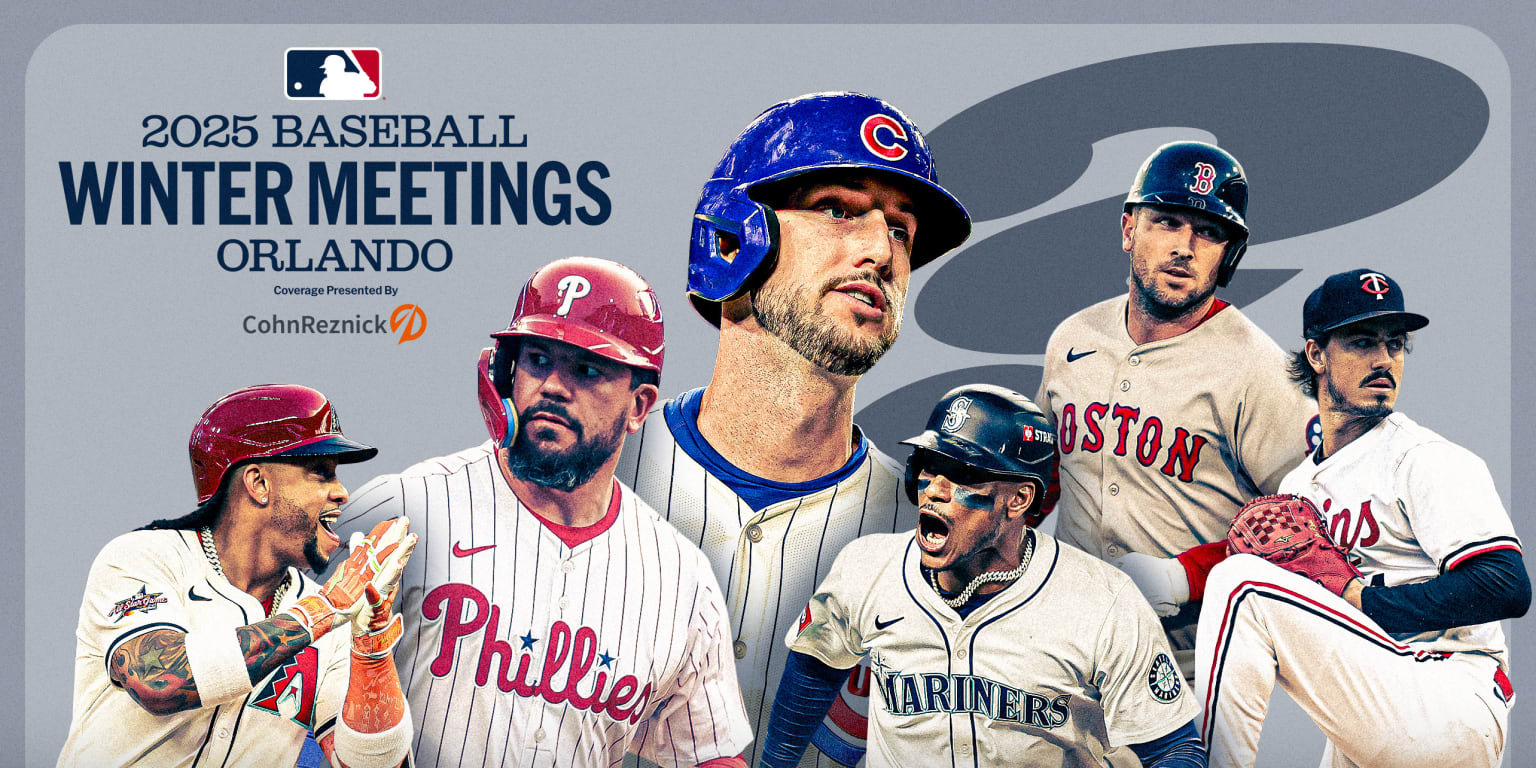
With executives from all 30 teams set to descend on Orlando, Fla., for the annual Winter Meetings, the Hot Stove may be on the verge of heating up.
Though some clubs have already made some moves this offseason, every team still has plenty of questions to answer between now and Spring Training — but some of those questions are bigger than others.
Here’s a look at the most pressing question facing each team heading into the Winter Meetings:
Blue Jays: Will Bo Bichette be back?
Yes, the Blue Jays will be involved in the Kyle Tucker sweepstakes, but that’s just stating the obvious for any serious team with cash. However, the biggest question hanging over Toronto entering the Winter Meetings is whether Bichette will remain with the only big league club he’s ever played for. The beloved homegrown star has said the same thing all along: “I’ve said I want to be here from the beginning,” Bichette said just hours after the Blue Jays’ crushing loss in Game 7 of the World Series. It won’t come cheap, as Bichette — who turns 28 in March — figures to garner plenty of interest this offseason.
Orioles: Could the O’s reel in one of the marquee free agents?
The Orioles have already shown increased aggressiveness with the multiple moves they have made early this offseason, and they’ve also expressed a willingness to expand their payroll. But Baltimore has still never made a huge free-agent splash since Mike Elias became the head of the baseball operations department in November 2018. Perhaps that soon changes. The O’s need another starting pitcher near the top of their rotation — a vacancy that would make sense to fill with an arm such as Framber Valdez, Ranger Suárez, Michael King or a pitcher of that ilk.
Rays: What’s their next move?
So far, the Rays’ biggest additions of the offseason are veteran center fielder Cedric Mullins (source) and outfielder Jake Fraley, a player they claimed off waivers before cutting and re-signing. They’ve added some pitching depth, namely reliever Steven Wilson and potential starter Yoendrys Gómez, but they also lost closer Pete Fairbanks and starter Adrian Houser to free agency. They’ve made a number of moves on the margins, but nothing to make anyone feel differently about their roster next season. Something’s got to give with their glut of outfielders, and they have needs in the rotation, behind the plate and at shortstop. Where will they focus first?
Red Sox: How aggressively will the Red Sox pursue bringing back Alex Bregman?
There was enormous enthusiasm back in February when the Sox signed the veteran leader to a three-year, $120 million contract that included deferrals. However, the contract also included opt-out clauses after the first two seasons and Bregman took advantage of that by opting out after the World Series. There has been radio silence from the Red Sox about Bregman since, with chief baseball officer Craig Breslow unwilling to tip his hand on the club’s level of interest in exploring a long-term deal with Bregman. Boston’s clubhouse would certainly be thrilled to have Bregman back as he became the team’s leader instantly upon arrival.
Yankees: How much will they change from the 2025 club?
Aaron Judge has captured three of the last four American League MVP Awards, establishing himself as one of the most dangerous right-handed hitters the sport has ever seen. He is also the reigning batting champion. And when he says he would trade all of it for a World Series ring, it rings true. After matching the Blue Jays for the AL’s best win total at 94, there is a temptation inside the organization to bring back most of the 2025 group. Club officials believe the gap between the Yankees and Blue Jays — along with the Dodgers, now back-to-back champions — is smaller than most outsiders think. Do they actually have enough to reward Judge’s prime with a title? That will be the question hanging over everything they do in Florida.
Guardians: How will they improve their offense?
This is the Guardians’ biggest question this offseason. Even with another stellar campaign by perennial MVP candidate José Ramírez, Cleveland ranked 28th in MLB in runs per game (3.97) in 2025, ahead of only the Rockies and Pirates. Young players taking a step forward would help improve the production next season, but whether it’s through trade or free agency, the Guardians should still augment the group with external acquisitions.
Royals: When will they make a move for a bat?
The Royals haven’t been quiet about their desire for a bat or two that can impact the middle of the order or provide reliable depth at the bottom. An outfielder or versatile utilityman are the likeliest paths for an addition. What has been quiet, though, is actual action. They added outfielder Kameron Misner after the Rays designated him for assignment, but that was purely a depth move. The Royals have pitching depth to trade for a bat if they can find a match with another team. Sometimes those conversations move slowly — or they can pick up at a moment’s notice.
Tigers: Will they give a boost to their offense?
Though president of baseball operations Scott Harris and general manager Jeff Greenberg have made it clear pitching is the priority, particularly in the bullpen, Harris has also been up-front about Detroit’s hitting woes down the stretch last season and the need for improvement next year. The only move so far to that end is the return of Gleyber Torres on a one-year deal. Will the Tigers count on continued growth from their young hitters carrying the day, or will they make a move for help, such as a second try at free agent Alex Bregman or a potential trade for second baseman Ketel Marte?
Twins: Are they done trading veterans?
Last July’s Trade Deadline sell-off shook the clubhouse and the fan base. There aren’t a lot of pricey veterans left in Minnesota, but they’re all key pieces: Pablo López, Joe Ryan, Ryan Jeffers and Byron Buxton. The Twins could still look to contend this year if they were to trade López or Ryan, especially if they got Major League-ready pieces in return. If more than one is dealt, then they’re probably looking at something resembling a total reset. Buxton has a full no-trade clause but reportedly has indicated that if the team moves more veterans, he might waive it.
White Sox: What’s their level of activity?
The No. 1 question for the South Siders centers on getting the No. 1 pick through the Draft Lottery taking place on Tuesday. A top selection could provide another major impact as this rebuild gradually moves out of purely acquisition and development and into contention. They have the best odds entering Orlando. But the White Sox are looking to improve, and while the big-market end of the spectrum isn’t on their radar, general manager Chris Getz said a multiyear deal is possible if it made sense overall. Developing the young core, which made a strong debut in 2025, remains the focus, though Getz could work through trade or free agency to help get his team stronger.
A’s: Will they add another proven starting pitcher?
The A’s have a solid offense led by the core of unanimous AL Rookie of the Year Award-winner Nick Kurtz and runner-up Jacob Wilson, along with Shea Langeliers, Brent Rooker, Tyler Soderstrom and Lawrence Butler. That group remains under contract for the foreseeable future with super prospect Leo De Vries potentially joining the mix as early as next season. But if the A’s are going to improve upon their 76-win total from last season and make a serious playoff push, they will need more from their rotation, which combined for a 4.85 ERA that ranked 27th in the Majors.
Last year, the A’s helped set the market for starting pitching by striking early in the offseason to sign Luis Severino, then traded for veteran Jeffrey Springs shortly after. Those two remain their only starters with any sort of real track record of success in the Majors. After that, you’re looking at a talented but very inexperienced group that includes Jacob Lopez, Luis Morales, Jack Perkins, Gunnar Hoglund and J.T. Ginn, with MLB Top 100 prospects Jamie Arnold and Gage Jump on the horizon. Ideally, the A’s would like to add another veteran starter.
Angels: What will happen with Anthony Rendon?
It was reported by ESPN that the Angels are working toward deferring the $38 million Anthony Rendon is owed next year, after which he would retire after undergoing hip surgery that forced him to miss the 2024 season. That would be a big financial relief for the Angels, as it would give them added payroll flexibility after also saving roughly $13-$14 million this year by trading outfielder Taylor Ward for promising right-hander Grayson Rodriguez. If the Halos indeed work out the Rendon situation, it’ll be interesting to see what they do with that freed up salary.
Astros: What’s the future of outfielder Cam Smith?
Smith, who was one of three players acquired from the Cubs a year ago, made an impressive position switch in Spring Training and won the Opening Day job in right field, where he was ultimately a Gold Glove finalist. Offensively, he regressed through the season — he had a .489 OPS in 170 plate appearances after the All-Star break — and wound up platooning with Jesus Sánchez, who started against right-handers. Astros general manager Dana Brown said at the General Managers Meetings last month that Smith would have to play with more consistency or he could be sent to Triple-A. Smith’s struggles against right-handed pitching (.617 OPS) could cause the Astros to start him in the Minor Leagues to get everyday at-bats, especially if Sánchez doesn’t get traded.
Mariners: Will they make a move in Orlando?
The Mariners in recent years have either been incredibly active at the Winter Meetings or mostly stood pat, an approach rooted in where they are at competitively with their roster for the upcoming season. With a few notable needs — albeit none nearly as paramount as the move they already made to bring back first baseman Josh Naylor on a five-year, $92.5 million free-agent contract — this could be a time for president of baseball operations Jerry Dipoto and general manager Justin Hollander to make headway in other areas. That includes netting at least two relievers, preferably one left-handed to pair with leverage option Gabe Speier, and potentially, another infield bat, with a Jorge Polanco reunion still very much in play.
Rangers: How will the budget/payroll situation affect their offseason moves?
President of baseball operations Chris Young said there is a “rough idea” of the budget the club has to work with. That being said, it’s not completely set just yet. Over the past five years, the Rangers have handed out big free-agent contracts to important players such as Corey Seager, Marcus Semien, Jacob deGrom and Nathan Eovaldi (twice) — but big splashes likely won’t happen this offseason.
“I think as we go here, we do have room to operate,” Young said. “We’re excited about what we have in place right now. It’s our job as a front office to round out this roster. When there’s the ability to go out and get something that’s going to help us win, ownership has been very good about allowing us the ability to do that.
“It’s not going to be at the levels it was the last couple years. We know that. We’re good with that. We don’t need that. … We expect to have the resources we need to round out a really good roster.”
Braves: Is there a need to add a big bat?
If Mauricio Dubón will be the shortstop, the Braves seemingly need to add a big bat to their lineup. But even if Ha-Seong Kim ends up returning to Atlanta to fill the shortstop role, you can argue the Braves need to replace what was at least expected from designated hitter Marcell Ozuna this past season. The top of the lineup has great potential with Jurickson Profar, Matt Olson, Ronald Acuña Jr. and Austin Riley currently available to fill the first four spots. But the inconsistency that both Michael Harris II and Ozzie Albies have experienced the past couple of seasons creates concern about the lineup’s depth. Should the Braves take a chance on an Ozuna rebound? Or should they find a player who could add value to the DH spot and also provide some defensive value?
Marlins: How much will they add to the roster?
Since the entire roster is under club control for multiple years, Miami’s players are relatively young and affordable. The team is coming off a 17-win improvement, and both Sandy Alcantara and Eury Pérez are further removed from Tommy John surgery and recovery. Braxton Garrett will be returning from his own procedure to aid the starting-pitching depth, but the Marlins, as manager Clayton McCullough has repeatedly said, can’t simply assume everyone will get better. Regression happens. Other teams improve. Outside help could be the lift Miami needs.
Mets: How will they address their rotation?
The Mets already made a significant position-player splash in dealing Brandon Nimmo to the Rangers for Marcus Semien. They’ll almost certainly make at least one more, either at first base or in left field (or quite likely in both places). They also agreed to a three-year deal with two-time All-Star reliever Devin Williams. What’s less clear is how they’ll fix a rotation that ranked among the game’s worst over the final four months of last season. While the Mets have plenty of veteran depth returning and a good amount of prospect upside (shoutout Nolan McLean), they could very much use a battle-tested ace. It remains entirely unclear how aggressive president of baseball operations David Stearns might be in pursuing one.
Nationals: How aggressive will they be in free agency?
This is president of baseball operations Paul Toboni’s first offseason at the helm of the Nationals. In recent years, the Nats have added to their young roster by signing veterans to short-term deals. Will Toboni take the same approach? Or will he be more active in inking long-term contracts? This winter will be the first glimpse into the 35-year-old’s approach to constructing a roster.
Phillies: Will they run it back again or shake up the roster?
The Phillies need Kyle Schwarber and J.T. Realmuto back, but they can’t just re-sign those two and call it an offseason. They need to do more. If they really want to start 2026 with a fresh mix, they will probably need to trade players from the current 26-man roster. It might mean difficult decisions, but it’s doable. The Mets just traded Brandon Nimmo to the Rangers for Marcus Semien, an acknowledgement that changes are often needed — even if it means trading a homegrown favorite.
Brewers: How much will they change the roster?
The Brewers are coming off a 97-win season in which they ranked second in the Majors in team ERA, third in runs scored and third in Statcast’s Fielding Run Value. And their departures since the end of the season — Rhys Hoskins, Jose Quintana, Danny Jansen, Erick Fedde and Shelby Miller (plus the injured Jordan Montgomery) — were on the minor side. So, will they run it back with their young core, or get creative in trades to get better? The biggest trade chip, of course, is right-hander Freddy Peralta, who is coming off 17 wins and a 2.70 ERA and is set to earn $8 million in his final season before free agency. The Brewers don’t have to trade him, but they could reload for the future by doing so.
Cardinals: Which vets will be left by Spring Training?
New president of baseball operations Chaim Bloom made his intentions of building for the future known when he dealt Sonny Gray and approximately $20 million for two young, unproven pitchers and a player to be named later. Who’s the next to go? Nolan Arenado, Willson Contreras, Brendan Donovan, Lars Nootbaar and Nolan Gorman are available for the right return. Will the Cards have to package Donovan and Arenado to rid themselves of the $42 million left on the 10-time Gold Glover’s contract? On the pitching side, lefty reliever JoJo Romero should fetch a nice haul of prospects if Bloom can find the right deal.
Cubs: Will they surprise people and add an impact bat?
The Cubs knew that trading for star outfielder Kyle Tucker last offseason might very well lead to a one-year partnership between the team and player. With Tucker on the free-agent market, Chicago is tasked with either trying to keep him in the fold or looking for other ways to upgrade the offense. Now, the Cubs have Seiya Suzuki for right field and a couple of Top 100 prospects ready for the Majors in outfielder Owen Caissie and catcher Moisés Ballesteros. It’s possible the team goes with the pieces already in place, especially with pitching being the biggest need. That said, the Cubs’ front office has surprised before, and it was just last spring that they stayed in on Alex Bregman until the very end. Could president of baseball operations Jed Hoyer have something else up his sleeve this year? We’ll see.
Pirates: Will they land a big hitter?
We’ve seen rumors of the Pirates being connected to some high-profile free agents. They have some money to spend, a few obvious needs and a sense of urgency to qualify for the postseason for the first time since 2015. They also tried to add to the roster each of the last couple of winters but didn’t accomplish much. Will this offseason be different? The Pirates’ core has some talented players, but they’re going to need external additions to get over the hump. They’re talking the talk this winter. Now, they have to follow through.
Reds: How can they upgrade their lineup?
President of baseball operations Nick Krall noted in early November that the 2026 team payroll would be around the same as it was this past year, which was about $112 million on Opening Day. With several arbitration cases pending and multiple holes in the bullpen created by free-agent departures, there doesn’t appear to be room in the budget to make a huge free-agent splash such as signing Kyle Schwarber to his hometown team. Whether it’s signing a lower-tiered free agent or adding via a trade, Krall and his baseball operations team are facing a challenge to add more offense.
D-backs: Will they be able to fortify their pitching staff?
General manager Mike Hazen is determined to add one if not two starting pitchers, as well as multiple back-end relievers, but the question is how will he do that? Arizona had a club-record Opening Day payroll last year around $195 million and all indications are that it will be lower than that this year. How much lower is the question, with Hazen saying only that he will have plenty of money to field a competitive team. It’s doubtful that the Diamondbacks will be a suitor for some of the more expensive free agents, though remember they surprised everyone last year by signing Corbin Burnes to a $210 million deal. As a result, they will likely have to do more in the trade market — and Hazen made it clear he is open to dealing from the top of his prospect list if needed. Might he also be willing to part with All-Star second baseman Ketel Marte? Hazen has said it’s unlikely that a deal of that magnitude would happen, but we’ll see how it all shakes out as the winter goes on.
Dodgers: How badly do they need another closer?
The first year of Tanner Scott’s four-year, $72 million deal did not go well (4.74 ERA, 10 blown saves), and the bullpen — as a whole — was consistently an area of weakness for the World Series champions. The Dodgers are optimistic that Scott can bounce back in 2026 — and that they have other candidates to close out games — but they could also look to add a proven late-inning arm to help stabilize the relief corps.
Giants: How will they address their pitching needs?
The Giants splurged by signing Willy Adames to a franchise-record seven year, $182 million deal last offseason and then made an even bigger commitment by agreeing to take on the approximately $250 million remaining on Rafael Devers’ contract in June. But they don’t appear keen on continuing to spend big to bolster their rotation this winter. With the club reportedly hesitant to meet the asking price for top free-agent starters like Japanese ace Tatsuya Imai, the Giants seem more likely to focus on mid-tier alternatives — unless they’re willing to swing another big trade for a cost-controlled arm.
Padres: What happens with Mason Miller?
There’s an obvious spot at the back end of the bullpen for Miller, with Robert Suarez departing in free agency. Down the stretch last season, no pitcher was more dominant than Miller, and he quickly proved his value on the October stage with two incredible relief outings against the Cubs. Then again, is there more value to be extracted from Miller as a starter? And if so, how big are the risks? Are they worth it? The Padres are asking themselves — and Miller — these questions right about now. The answers could seriously shape their direction this winter.
Rockies: How are they going to structure themselves for success?
For much of their history, the Rockies held onto players they drafted or signed as amateurs with the plan that enough of them would blossom at the same time to give the team a window of contention. But they’ve endured long dry periods, and when a team did come together, Colorado could not sustain it. It’s a common problem for teams that don’t have large payrolls, but the Rockies committed to president of baseball operations Paul DePodesta and a new plan with the knowledge that a few clubs have figured out how to contend consistently without major spending sprees.
The new regime will be charged with doing a better job teaching and evaluating, being more active and more successful acquiring talent from other teams and finding wins in the margins by applying advanced information more effectively.
