We have about one month’s worth of games in the book, so I thought it might be a good time to check in on the league at large.
No long-winded, beautifully crafted messages on the America East from me this week, but I did want to provide some news, notes, and things I saw (liked or disliked) from each team across the conference.
Advertisement
Tano’s Updated AmEast Power Ratings
|
Team |
Net Rating |
Offensive Rating |
Defensive Rating |
|
Vermont |
-1.44 |
111.08 |
112.52 |
|
Bryant |
-9.83 |
99.44 |
109.27 |
|
UMBC |
-10.70 |
101.58 |
112.28 |
|
Maine |
-13.17 |
94.72 |
107.89 |
|
Albany |
-13.36 |
100.53 |
113.89 |
|
UMass Lowell |
-13.48 |
103.32 |
116.80 |
|
New Hampshire |
-17.18 |
95.49 |
112.67 |
|
NJIT |
-17.45 |
94.96 |
112.41 |
|
Binghamton |
-17.78 |
99.12 |
116.90 |
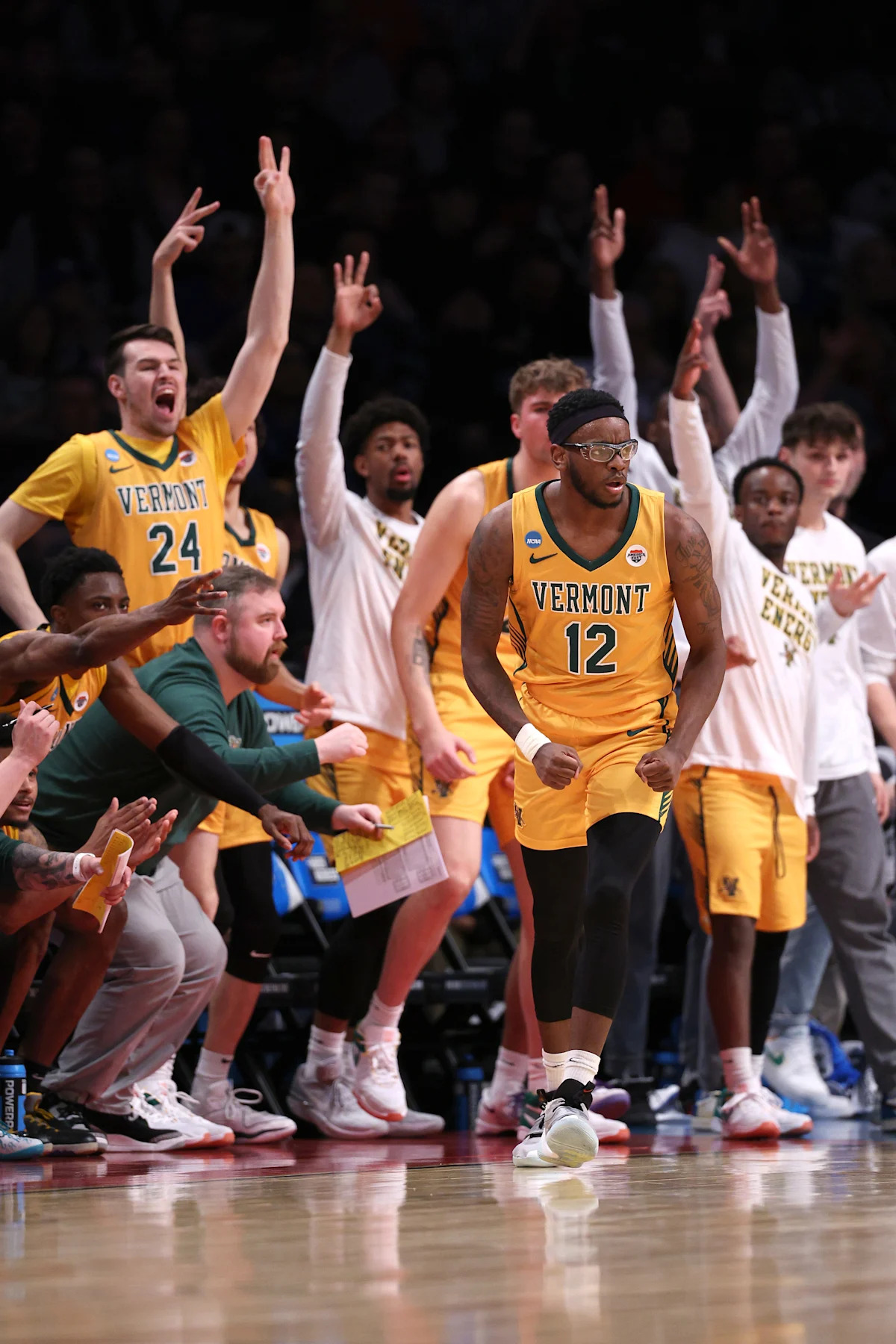
Vermont
Although Vermont has lost four of its past five — including two of three at the ESPN Events Invitational — there are still positives to take away from the past few weeks.
For starters, the Gus Yalden breakout is fully here. He’s averaging 18/4/2 on 65%/47%/67% shooting splits since making his debut against Northeastern.
His post presence (1.36 PPP on 33 possessions, 96th percentile) and passing vision provide the Catamounts with a true interior hub to play around and through. John Becker has been looking for a Ryan Davis replacement for a few seasons, and he’s finally found one.
Advertisement
Yalden’s interior presence keeps defenses honest, meaning the Cats are getting more open perimeter jumpers. However, you don’t have to sacrifice anything with Yalden on the court, as he has a surprisingly smooth 3-point shot, and he’s a willing perimeter trigger-man in DHO actions.
My favorite thing I saw this week was Vermont drawing up flex actions with TJ Hurley as the screener to get Yalden post entries down the stretch against Princeton. Defenders can’t help off of Hurley, giving the Gus Bus plenty of space to do one-on-one damage down low.
As Yalden has cooked, the Catamounts’ offense has cooked. In my power ratings, they’ve jumped up to 111th nationally in offensive efficiency. They rank in the top-50 nationally in 3-point rate (47%) and effective field goal percentage (57%). They’re shooting 38% on catch-and-shoot opportunities and 65% at the rim.
Advertisement
It’s everything you want to see out of a Becker offense. Yalden might be the new favorite for CPOY.
On the contrary, this looks nothing like a Becker defense. In my ratings, they’ve slipped to 283rd nationally in defensive efficiency.
The Cats are still getting back in transition and cleaning the glass, but the half-court defense has been a mess. They haven’t stopped anyone off the dribble or in isolation (.84 PPP allowed, 33rd percentile), have been consistently lost in ball-screen coverage (1.01 PPP allowed, 10th percentile), and there have been far too many miscommunications leading to slip cuts.
They’ve mostly been switching or playing a shallow drop, but both individual defense and team communication have consistently broken down.
Advertisement
That said, the defense looked much more buttoned up in the three-point home loss to Yale — the Bulldogs are an outstanding team, and there’s no shame in dropping a close one against James Jones’ squad.
The Cats have their annual West Coast road trip this week, with games against Oregon State and Pepperdine.
Worth mentioning that Lucas Mari suffered a concussion and should be considered doubtful for both games, albeit less doubtful for Saturday’s contest against the Waves.
Mari has flashed high potential, especially with his passing. However, he hasn’t been the downhill driving bulldozer I expected with his size and athleticism, and he’s been slumping from beyond the arc (27%). That said, we shouldn’t be too hard on him, as there’s an obvious adjustment period coming across the pond.
Advertisement
On the contrary, Sean Blake looks borderline-elite off the dribble because of an excellent first step, and he’s sporting a whopping 30% assist rate (4.4 per game). Even better, his jumper looks way better (46% on 1.6 3-point attempts per game). Unfortunately, he’s still struggling to finish (41% at the rim, 20th percentile) and with turnovers (26% rate, 2.7 per game).
Blake has been consistently targeted in ball-screen coverage (.85 PPP allowed on 27 possessions, 39th percentile), while Mari has been far better (.50 PPP allowed on 14 possessions, 86th percentile).
Safe to say I’ll be keeping a close eye on the point guard position.
UMBC
I still think the Retrievers are the second-best team in the conference.
Advertisement
Yes, they needed DJ Armstrong to pull off back-to-back miracle shots to beat Morgan State and Wagner …
… and they’ve played the conference’s most manageable schedule so far, ranking 329th nationally in SOS.
Still, UMBC has taken care of business despite dealing with several injuries, with five wins against lousy competition, a blowout loss to George Washington, and a close loss to Dayton.
Superstar Josh Odunowo missed the first three games and was only half available for the next three, finally playing a full 25 minutes against Delaware State (10 points, five rebounds, two assists, one block, one steal).
Advertisement
Old Dominion transfer Devin Ceaser hasn’t been available at all, while Paul Greene recently went down.
Overall, I’m impressed with UMBC’s effort.
Ace Valentine is sporting a 30% assist rate. Off-ball shooters Armstrong and Cougar Downing have made 20 of their combined 32 3-point attempts. Daylon Dickerson has taken a monster jump as the starting four, shooting over 60% from the field while chipping in over four rebounds per game.
Jim Ferry clearly trusts Jah’Likai King as a top scoring option, given his monster workload (12 FGA per game, by far the highest on the team). He hasn’t seen the shots fall yet (31% from the field, 17% from 3), but I assume that’ll turn in time. He’s a super explosive athlete, as shown by crashing the boards (five per game as a 6-foot-2 guard) and drawing contact (over five FTA per game).
Advertisement
Although I’d love to see more Jose Roberto Tanchyn on the court (12 minutes per game), the Retreivers are doing an excellent job running shooters off the 3-point line, defending without fouling, and rebounding — all things they didn’t do last season.
If they can get healthy, the operation in Baltimore could come together nicely. Hopefully, Valentine and Co. can clean up the turnovers (22% rate, 339th nationally; 2.5 per game from Ace).
Bryant
I don’t really know what Bryant is doing.
As a Shaka Smart disciple, I expected Jamion Christian to install a press-happy, havoc-centered defense, using turnovers to fuel an up-tempo spread pick-and-roll offense.
Advertisement
Instead, the Bulldogs have done almost the exact opposite.
On defense, Bryant is playing a fairly conservative one-through-five switch. Christian is wise to leverage his roster’s length and versatility in this fashion, but the Bulldogs aren’t attacking ball-handlers as expected.
Meanwhile, Christian has installed a plodding motion-based offense.
At this point, the defense is miles ahead of the offense. Actually, I’ve been reasonably impressed with Bryant’s defense.
The Bulldogs are the nation’s fourth-tallest team by average height, standing between 6-foot-8 and 6-foot-11 from 2-through-5. They don’t force turnovers and need to be better on the defensive glass. Still, they’ve leaned into their switchability, holding up well in ball-screen coverage (.80 PPP allowed, 72nd percentile) while forcing tough isolation sets (five per game, 79th percentile) and ruthlessly denying catch-and-shoot opportunities (15 per game, fourth percentile).
Advertisement
The defense held up excellently against Harvard, UConn, and Virginia Tech. I think it’s fair to be very bullish on that side of the court — in my power ratings, the Bulldogs rank second in the conference in defensive efficiency, right behind Maine.
The other side of the court is a mess, with far too many possessions ending in tough off-the-dribble triples from one of the lousy shooting wings — Quincy Allen, Ashley Sims, Lennart Weber, Aaron Davis, and Jakai Robinson are a combined 16-for-83 from deep (19%).
This play is a fantastic example:
This is the blocker-mover offense once run by Tony Bennett at Virginia — continuous and simultaneous flare and pin-down actions on either side of the court, with Robinson looking to pass the ball to the back-door cutter at the left block or to the spot-up opportunity at the right break.
Advertisement
I don’t think the Bulldogs are running the typical blocker-mover, as they’re running way too many DHOs. Regardless, I don’t mind the motion-based concepts, but everything seems to be running far too slow — in this case, the ball ends up in Robinson’s hands at the break with five seconds left on the shot clock, and the career 17% 3-point shooter is forced to jack up a contested step-back.
Here’s another excellent example from Bryant’s win over Stonehill:
Back-to-back BLOB sets run for Allen, who is the most athletic player in the conference. But he’s more akin to a bull in a china shop than a skilled off-the-dribble shot maker — he’s a career 23% 3-point shooter. Predictably, both of these shots end in bricks.
Advertisement
Bryant is running offense, but the Bulldogs aren’t creating the right shots. They rank in the top 50 nationally in jump shots per game (31), guarded catch-and-shoot opportunities per game (13), and in the top 100 in off-the-dribble jumpers per game (11).
However, the individual pieces are fascinating.
He hasn’t put it together as a ball-screen manipulator yet (.58 PPP, 19th percentile), but Ty Tabales is starting to make his jumpers. Keegan Harvey is a giant who can handle the ball, pass, and shoot.
Sure, Allen can’t make a jumper to save his life, but he’s a freak athlete who has made all sorts of highlight plays, especially on defense (11% hakeem rate, 99th percentile).
However, the guy with the highest upside is probably Rudovskii. Despite standing 6-foot-9, the Russian wing has shown a surprisingly versatile skillset — he’ll put the ball on the deck, make plays for others, make 35% of his six 3-point attempts per game, force steals, and rebound the ball.
Advertisement
Timo is becoming an elite do-it-all piece, and his stock is skyrocketing. I’ll be keeping a close eye on him in conference play — the ROY race could be super exciting between Timo, Tabales, NJIT’s David Bolden, and Lowell’s JJ Massaquoi.
A couple of injury situations to keep an eye on: Allen missed the Harvard game but is apparently practicing again, and Daniel Akoue will likely be out for a while.
UMass Lowell
The River Hawks are still a significant work in progress, but a couple of things pop out.
First, they are running a ton of offense through Austin Green, who is averaging nearly 13 points per game. Pat Duquette said in the preseason he didn’t plan on changing his base offense, meaning a big man would have to step up as an interior shot creator, and Green has answered the call by cutting, drawing fouls, and grabbing offensive rebounds — that’s what River Hawks do.
Advertisement
Second, Duquette is leaning fully into a two-point guard system. I thought Darrel Yepdo would be the heavy on-ball facilitator. But Carleton transfer Xavier Spencer has taken on a significant ball-handling role and responded with over four assists per game. Yepdo has shot well while Spencer hasn’t, but neither has been a solid ball-screen facilitator, and both have been sketchy as POA dribble defenders.
Third, Duquette burned Victor Okojie’s redshirt, and he’s been a very impactful two-way forward. He was fantastic against Stonehill, scoring seven, ripping 12 boards, and dropping two dimes — I thought he was pretty good on the ball.
Finally, and arguably most importantly, Massaquoi could be a stud. He’s an absolute monster at 6-foot-6, with an NFL-sized frame that he uses to bully-ball his way to the rim. He’s a non-shooter and passer, but he can pile up points in a hurry, including 26 against Wake Forest, 18 against Bradley, 18 against Saint Peter’s, and 16 against New Haven.
A few other notes:
Advertisement
-
Jared Frey needs to shoot better than 27% from the field and 21% from 3, or he’ll be out of the rotation.
-
Shawn Simmons was seen in a walking boot after missing Saturday’s game against Emerson.
-
Congrats to the River Hawks on earning a commitment from Jasiah Cannady, a four-star who is the AmEast’s highest-rated recruit ever.
Albany
I’ll try to get more information on Albany when possible, but for now, I have no clue what’s going on with the program.
Will Richardson, Tarique Foster, and Abdoulaye Fall have been MIA. Three huge incoming players that have barely played this season, which helps explain why the Danes still haven’t earned a D-I win.
Additionally, Sully Adewale still hasn’t recovered from a knee ailment he suffered last season. Ife West-Ingram has been in and out of the lineup as well.
Amir Lindsey is having a quietly excellent season, averaging 15/5 with two steals per game. I’ve also been quite impressed with Zach Matulu’s minutes, as he’s been flying around the court, contributing in every area, and scoring 1.75 PPP in transition.
Advertisement
Worth mentioning that the Danes have three players averaging over 1.5 steals per game, led by Jaden Kempson’s 2.3. Ball pressure has been a staple of Dwayne Killings’ defense over the past few seasons.
Maine
Nobody had a worse first month of the season than Maine.
The Black Bears are 0-9, one of just four winless teams nationally. They also likely have lost Killan Gribben and Darius Lopes for the season.
Lopes is replaceable in the backcourt, but Gribben was the team’s best two-way player. I don’t know how the Black Bears recover.
On the surface, the defense looks fine, but I think they’re due for some regression to the mean, as opponents have shot just 26% from deep against them. They rank 223rd nationally in 2-point shooting allowed, aren’t rebounding well, fouling too much, and not forcing enough turnovers to compensate (as they did in past years). It all paints a poor picture.
Advertisement
I’m still a big believer in TJ Biel, who’s averaging 13 points per game. Also, watch out for Bashir N’Galang, who has been a wildly impressive ball-screen orchestrator (1.26 PPP, 93rd percentile).
It also feels like we’ll be seeing a ton of Mekhi Gray minutes in the future. That’ll be a roller coaster.
New Hampshire
Belal El Shakery ranks first nationally in the percentage of his team’s shots he takes when he’s on the floor (37%). He’s a tough player who can score in the post (1.04 PPP, 66th percentile) and abuse the boards (seven per game), but he’s just 1-for-17 from beyond the arc so far.
The Wildcats have been playing heavily through their frontcourt, with him and Comeh Emuobor posting up at a super high rate — Emuobor mostly platoons with El Shakery. Emuobor is a similarly physical interior player, but he’s really struggled across the board (although he’s grabbed his share of offensive rebounds).
Advertisement
KiJan Robinson will be taking on the primary ball-handling duties, and he’s posted a sparkling 30% assist rate to just an 18% turnover rate. It seems most of those assists are going toward Davide Poser and Jack Graham, as the duo is shooting a combined 36% from deep on over 10 attempts per game.
I’ve been rather impressed with John Squire’s minutes. He’s a monster two-way rebounder who’s adding two stocks per game.
The offense has been pitiful in the early going, but I expect positive regression, as I don’t entirely hate the shot diet. But New Hampshire needs to pick up the pace, as Nathan Davis wants to play faster than their 18.7-second average possession length (320th nationally).
NJIT
All hail, David Bolden! The Highlanders have found their replacement for Tariq Francis.
The kid is a bona fide shot maker, averaging over 12 points per game while shooting 39% from deep. He’s also adding nearly two steals per game. I’d like to see a bit more from him as a ball-screen manipulator and passer, but he’s only a Freshman.
Advertisement
Surprisingly, Sebastian Robinson has been coming off the bench, but he’s still chipping in his usual share of low-efficiency points.
I’m bullish on Jeremy Clayville. Although he’s only shooting 27% from 3, he clearly has some deep range, and he’s been the team’s best spot-up player so far (1.3 PPP on 20 possessions, 87th percentile).
Head coach Grant Billmeier texted me before the season started, stating simply, “Ari Fulton is a very good player.”
So far, I can’t refute him. The efficiency hasn’t quite been there, but he had a five-game stretch of double-digit scoring. Perhaps more importantly, he’s been a menace defensively and is proving to be one of the conference’s best rebounders, with his seven per game trailing only Binghamton’s Demetrius Lilley.
Advertisement
After a 3-1 start, the Highlanders have cooled off, primarily due to natural shooting regression and a much more challenging schedule. I’m hopeful they can pick off New Haven at home next Wednesday — for what it’s worth, I project them as a three-point favorite in that game.
Binghamton
Binghamton’s been the conference’s biggest surprise in the early going.
The Bearcats have been awful. They have just one Division I win alongside three losses to absolute bottom-feeders — Niagara (67-59 at home), Maryland Eastern Shore (63-52 on a neutral), and Canisius (75-66 on the road).
All that said, I’m not selling my Bearcat stock just yet.
The offense is still mostly working as intended. Jeremiah Quigley is averaging six assists per game at a ridiculous 47% rate (fourth nationally), while the Bearcats are still cutting, rim-running, and drawing fouls at a high rate. Demetrius Lilley is averaging 17/10, while Jackson Benigni has been excellent in the early season (124 Offensive Rating).
But the Bearcats can’t make a shot to save their life.
In those three losses mentioned above, the Bearcats shot a combined 9-for-46 from 3 (19%). Meanwhile, those opponents shot 22-for-60 (37%).
That’s just bad luck.
In the lone game where they got some decent shooting luck, the Bearcats shot 7-for-21 from deep (33%) while their opponents shot 4-for-19 (21%), and Binghamton was reasonably competitive with Georgetown on the road, losing 83-70.
Binghamton is a streaky shooting team. The Bearcats ran cold for the first half of the conference season last year, starting 1-5. Then, they were flamethrowers for the second half, winning six of their final 10.
Regardless, a rim-running offense works a lot better when the team’s making shots, as it drags defenders out and opens up the cutting lanes.
Of similar importance, Wes Peterson missed some time with an injury. Given he’s arguably their most impactful two-way player, having him on the court should help immensely in the coming weeks.
The defense needs work. The Bearcats have been playing more zone early in the season, but — as so many zone defenses do — they’re getting destroyed on cuts (1.33 PPP allowed, 17th percentile) and on the boards (269th nationally in defensive rebounding rate).
Of greater importance, they’re still turning the ball over way too much (23% rate, 357th nationally) and have been horrendous in transition defense (1.27 PPP allowed, 4th percentile). That ultimately did them in last year, so they have to clean that up.
Levell Sanders has really cut his rotation — the Bearcats rank 345th in bench minutes. In their latest win over Lehigh, only six players saw the floor in an overtime win.
