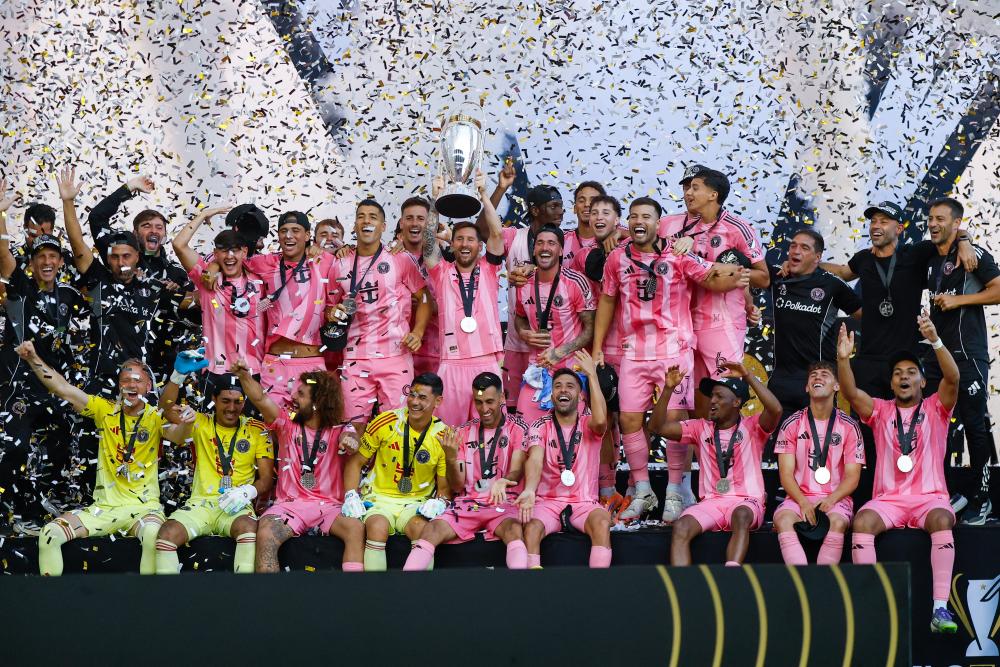
As the confetti flew, the Philip F Anschutz trophy was lifted into the air, and a player commonly thought to be the greatest ever to kick a ball celebrated the 48th title of his professional career, it was nearly impossible to believe that at several points, there were doubts. Serious doubts. Questions, large and small, about this Inter Miami squad, their manager, and nearly every player on the roster other than Lionel Messi.
Consider them answered. The Herons are MLS Cup champions after a 3-1 win over the Vancouver Whitecaps in the last game at their temporary home, Chase Stadium in Fort Lauderdale, Florida. Next year, they will open their new stadium, Miami Freedom Park, as champions, and will face a high bar to clear to top a turbulent 2025 that saw them play 58 games – an all-time MLS record for games played by a team in a calendar year – for five separate trophies.
Advertisement
Related: Inter Miami defeat Vancouver Whitecaps in MLS Cup final – as it happened
This one, though, was the one they wanted. Against a terriffic Vancouver Whitecaps side that was the better team for much of the night, this MLS Cup was won by moments of the small, everyday sublime – combined with less picturesque moments that proved decisive. And while Messi was at the genesis of all three goals, the first two were scored thanks to his larger influence on a team crafted specifically for him.
A Vancouver own goal opened the scoring off a move that was set up by one of those minor moments of Messi magic. Vancouver equalized in the second half after a botched save from a near-post effort from Ali Ahmed. And Messi’s Argentina teammate Rodrigo De Paul, a midseason arrival from Atlético Madrid, delivered the goal that won the title in the 71st minute off a poor turnover by the otherwise excellent Whitecaps midfielder Andrés Cubas.
Tadeo Allende’s goal in stoppage time, off another brilliantly lobbed assist from Messi, removed all doubt. The on-loan Celta Vigo man finished calmly past Whitecaps goalkeeper Yohei Takaoka, head coach Javier Mascherano sprinted on to the field, kissed the grass, and celebrated as if he was a player once again.
Advertisement
It was not difficult to predict that Messi would be responsible for breakthrough moments, whenever they came. But one might not have predicted that the first of those moments would come behind the midfield stripe; not in a pocket of space he had routinely manufactures in the center of chaos but as a momentarily peripheral figure, on the right touchline between the benches. The ball arrived at Messi’s feet there early on, and within seconds a trio of Vancouver defenders collapsed on his possession, sensing an opportunity to pounce on a moment of indecisiveness as they did successfully at numerous other points in the game.
It didn’t work this time. Messi took a touch around one defender, split the other two with the others, snaking out of danger and lofting a perfect ball into the stride of Mateo Silvetti, who lobbed the ball to Tadeo Allende with one touch. Allende had time and space, and a well-worked move would have been deservedly capped by a slick finish. Instead, a Vancouver disaster. Allende’s service landed in the stride of center back Ralph Priso, who was unfortunate to knock it into his own net.
Throughout the mid-afternoon kickoff in typically sweltering Florida heat and humidity, examples of this contrast – the lyrical combined with the blunt – were legion, with symbolism rife to be taken from anyone desperate enough for metaphors. Underneath temporary, erector set-like stands installed after Messi’s acquisition, one could find an old-time US stadium classic – Dippin’ Dots – there for sale alongside $45 shrimp skewers, or $55 lobster tails. Celebrities like Whitecaps minority owner and former NBA superstar Steve Nash milled about the concourse of the bare-bones venue right among the autograph and selfie-seekers. Seemingly only Messi’s family and members of Inter Miami ownership are fully insulated from the hugely passionate crowds from all walks of life that have filled this arena since Messi’s 2023 arrival.
Those crowds had some reason to despair after Miami’s opener. Vancouver dominated the vast majority of the first half – maintaining possession, picking off Miami’s buildup in key areas, and generating scoring chances that just missed or were blocked by the Miami defense. Emmanuel Sabbi in particular was effervescent, consistently finding space behind Jordi Alba, who like Sergio Busquets was playing in his last professional game. Unfortunately for the several hundred Whitecaps fans that made MLS’s longest away trip, Sabbi struggled to find end product.
Advertisement
Vancouver finally made all that work pay off in the 60th minute. Brian White did well to hold off the challenge of Maximiliano Falcón, turn, and found winger Ahmed streaking in behind Miami right back Ian Fray into the box. Ahmed’s near-post finish should have been saved by Miami goalkeeper Rocco Ríos Novo – and he did get a hand to it, but the ball slipped over that palm hung in the air for a seeming eternity, and settled into the back of the net.
The Whitecaps could have had the decisive moment just two minutes later. Sabbi broke through the heart of defense, shrugging off defenders and ignoring options to slip a through ball in favor of testing Ríos Novo. His effort beat the goalkeeper, but ricocheted off of one post then bounced across the line and hit the opposite. Falcón blocked a follow-up effort; an extraordinary moment.
Throughout this period, Messi had been engaging Vancouver midfielder Andrés Cubas – one of Vancouver’s best players throughout their own challenging year, who constantly stepped up with excellent steely defensive play and smart distribution and positioning. Cubas, a common foe of Messi through World Cup qualifying encounters with Paraguay, talked back. We had seen moments like this before – moments where the typically mild-mannered Messi is driven to anger by a slight – perceived or otherwise. Often, it ends up determining the course of the game.
Related: Double-post salvation gives Busquets and Alba a fitting farewell in MLS Cup final
Advertisement
And so it was today. Ten minutes after the equalizer, a rare indecisive moment from Cubas in midfield saw Messi steal in and take the ball off the Paraguayan’s foot. He played in De Paul, who beat Takaoka with a smart finish in the 71st minute. Ahmed had gone off with an injury just minutes before, and Vancouver was now in desperation mode without one of their more dangerous wingers and best playoff performers. Allende’s breakaway goal, itself too the product of a Messi assist, sent Chase Stadium into delirium, waving the pink towels as if to say goodbye to a new venue in an historic spot for South Florida professional soccer.
On 8 September 2001 – 24 years, three months and seemingly at least one whole world ago, the Miami Fusion won their first and only title, the MLS Supporters’ Shield, after a 3-1 win over DC United at Lockhart Stadium. It was the first trophy won by a soccer team who played at that field since the 1977 NASL title, won by the Fort Lauderdale Strikers. The match was interrupted by an epic rainstorm, soaking a field that still had football lines left over from its use as a facility for the Florida Atlantic Owls football team. Ray Hudson, still a resident nearby and now firmly established as the US-based voice of so many of Messi’s high points, was the Fusion’s coach. The 17,000-capacity venue was half-full. David Beckham was still six years away from arriving, and even farther removed from owning Inter Miami, the team that plays in the venue that Lockhart was torn down in order to house. A few months after that Shield win, the Fusion were dead – a victim of contraction in a different era of MLS.
Today, that venue said goodbye to another era of soccer – the flashiest in league history, and perhaps, the most indicative of what could come next for MLS as it embarks on a new reality of fall-to-spring schedules and, presumably, more involvement in the international transfer market that could bring more players like De Paul to the field. Chase Stadium has not seen its last action – it will remain as a home for the club’s reserve team, and will presumably have other uses as well.
For now, though, it rests with the trophy, and the confetti, and the brilliant pink towels left behind on functional, ugly steel bleachers.
