Mets fans have been left dazed and despondent by what has transpired over the last few days.
If the loss of Edwin Diaz to the Dodgers was a body blow, Pete Alonso signing with the Orioles 24 hours later was the knockout punch.
Advertisement
That those two departures came just a few weeks after Brandon Nimmo was traded to the Rangers means that in an incredibly short span, the Mets have lost not only three of their most popular players of recent vintage, but three of their most popular 15 or so players ever.
So it’s a big ask from David Stearns and Steve Cohen to expect fans to trust the process right now, especially considering the massive failure the 2025 season was.
At the same time, it’s important to look at the situations with Alonso, Diaz, and Nimmo separately.
In the case of Alonso, while it might not have been totally nuts for the Mets to extend to four or five years for him (especially if he was willing to DH a lot more), they clearly had no intention of ever doing so. You can be furious about it, but that’s the deal. Stearns stuck to his plan. As an aside, that they didn’t officially offer Alonso a contract is of no consequence. Doing so would’ve been performative once they realized his market was beyond where they were willing to go.
Advertisement
When it comes to Diaz, it seems that something went haywire. There is no indication that Diaz did not want to return to the Mets, and that he bolted over a difference of $3 million suggests the Mets botched the negotiation.
As far as Nimmo, dealing him for Gold Glove second baseman Marcus Semien was understandable — if you realize that Semien is not replacing Nimmo. Yes, Nimmo was still an above average offensive player. But he has been slipping at the plate over the last two seasons, while his defense in left field has regressed significantly. And there were five years left on his deal.
With the dust starting to settle, here are the two most important things to consider:
The first is that the Mets are much worse off right now than they were at the end of the season. And it will not be easy to replace the production they’ve lost, especially when it comes to the power Alonso provided.
Advertisement
The second is Stearns’ overall philosophy.
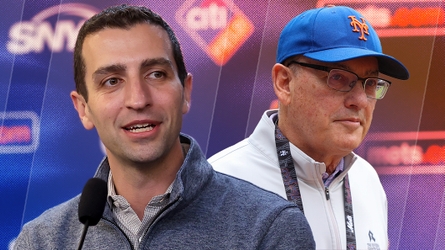
David Stearns / USA TODAY Sports/SNY Treated Image
Anger from fans who simply want Stearns to hand blank checks to players is understandable. And Stearns’ cold, calculating way of operating — especially given the resources at his disposal — is questionable.
But it’s not that Stearns won’t spend lavishly. It’s that he seemingly won’t spend big — especially in terms of years — on players whose contracts he thinks could imperil his long-term Mets vision.
With that as a backdrop, here’s how the Mets can reload without Alonso, Diaz, and Nimmo, and how they can address their other areas of need…
Advertisement
Replacing Alonso
To swipe a line from Moneyball, this will likely be about replacing Alonso in the aggregate, because there is no other first baseman or designated hitter available who has Alonso’s blend of power and on-base ability.
There were multiple reports on Wednesday night about the Mets engaging the Cardinals on a potential trade for first baseman Willson Contreras, who has two years and $36.5 million remaining on his contract — plus a club option for 2028. Contreras, who is entering his age-34 season, was a plus offensive player (123 OPS+) and above average defender (90th percentile, 6 OAA) in 2025. So he certainly fits the mold of what Stearns is looking for.
As far as what the rebuilding Cardinals would want, it’s fair to believe that they would be seeking a controllable big league player and/or prospects.
Advertisement
If not Contreras, other options New York could pursue include Japanese first baseman/third baseman Kazuma Okamoto, who is a strong defender. There’s also fellow Japanese free agent Munetaka Murakami, who has otherworldly power. But Murakami strikes out a ton and is viewed as a poor defender.
As far as internal candidates, unless the Mets go huge elsewhere on the roster, it’s hard to justify using Mark Vientos regularly at first base. He is coming off a down offensive year, and has very little experience at the position.
Beyond the “who will play first base” question is the one about where the Mets will find more right-handed power.
The best answer could be free agent Eugenio Suarez, if he’s willing to be a DH. Suarez hits bombs (he smacked 49 in 2025), but strikes out at an alarming rate and doesn’t get on base much.

New York Mets first baseman Pete Alonso (20) and relief pitcher Edwin Diaz (39) slap hands after their game against the Washington Nationals during the top of the ninth inning at Citi Field / Vincent Carchietta – Imagn Images
Replacing Diaz
The Mets already have Devin Williams, who is penciled in as the closer. And despite a relatively down 2025, Williams’ stuff remains elite. And it’s fair to believe he’ll be very good in 2026.
Advertisement
But New York’s desire to retain Diaz (and their failure to close the deal) means there’s a massive hole in the back end of the bullpen that they’re open to filling.
Pete Fairbanks is a free agents, and signing him would be the simplest way to react to losing Diaz.
There’s also the trade market, with Brewers fireballer Trevor Megill available.
Megill has been great over the last three seasons, posting a 2.88 ERA (2.62 FIP) and 1.14 WHIP while striking out 162 batters in 128 innings.
He is set to earn roughly $6.5 million in 2026, and is arbitration-eligible in 2026 and 2027 — making him incredibly valuable.
Advertisement
Replacing Nimmo
There are two obvious fits on the free agent market: Kyle Tucker and Cody Bellinger.
In the case of Tucker, it’s difficult to envision the Mets giving him a massive deal in terms of years. And while he’s a special offensive player, his defense has been slipping.
Bellinger, while an above average defender at multiple positions, is an erratic offensive performer. He also had stark home/road splits last season, with a .909 OPS in the tiny confines of Yankee Stadium and a .715 OPS on the road.
While Tucker or Bellinger could make a lot of sense if they can be had on deals that aren’t crazy in terms of years, the Mets’ best bet could be the trade market.

Boston, Massachusetts, USA; Boston Red Sox left fielder Jarren Duran (16) runs out of the dugout before the start of a game against the Atlanta Braves at Fenway Park. / Eric Canha – Imagn Images
One very intriguing option is Red Sox outfielder Jarren Duran.
Advertisement
Duran, who is entering his age-29 season and is under team control through 2028, had a .774 OPS last season for Boston while leading the AL with 13 triples, hitting 16 homers, and smacking 41 doubles. He also swiped 24 bases.
His defense has been kind of all over the place (95th percentile in 2024, 18th percentile in 2025). But he has elite speed.
In addition to left field, the Mets have a hole in center field. But it would be wise to keep one spot open for top prospect Carson Benge, who could be ready early during the 2026 season.
Addressing the rotation
Lost in the shuffle a bit in the madness of the last couple of days is that the Mets still have a ton of work to do in the rotation.
Advertisement
It was the starting staff that was most responsible for torpedoing the 2025 season, and it’s the pitching just as much as the defense that Stearns is referring to when he discusses “run prevention.”
Stearns’ apparent unwillingness to go long on the top free agent starting pitchers on the market is also understandable.
Framber Valdez is 32 years old, Ranger Suarez‘s fastball velocity is steadily declining, and Tatsuya Imai is a largely unknown entity.
If Valdez winds up taking a deal for four years or so, perhaps the Mets swoop in. If not, someone like Michael King could make a lot of sense, though New York would be taking a big risk given King’s injury history.
Advertisement
In a world where the Mets sign King, they would ideally also need to find a reliable starter with upside — possibly via trade.
As things currently stand with the Mets’ roster, it’s hard to make an argument for them trading serious assets for a one-year rental like Freddy Peralta. But if they’ve already properly addressed their other needs before swinging a trade like that (or have faith they’ll fill those needs afterward), going for it will make sense.
