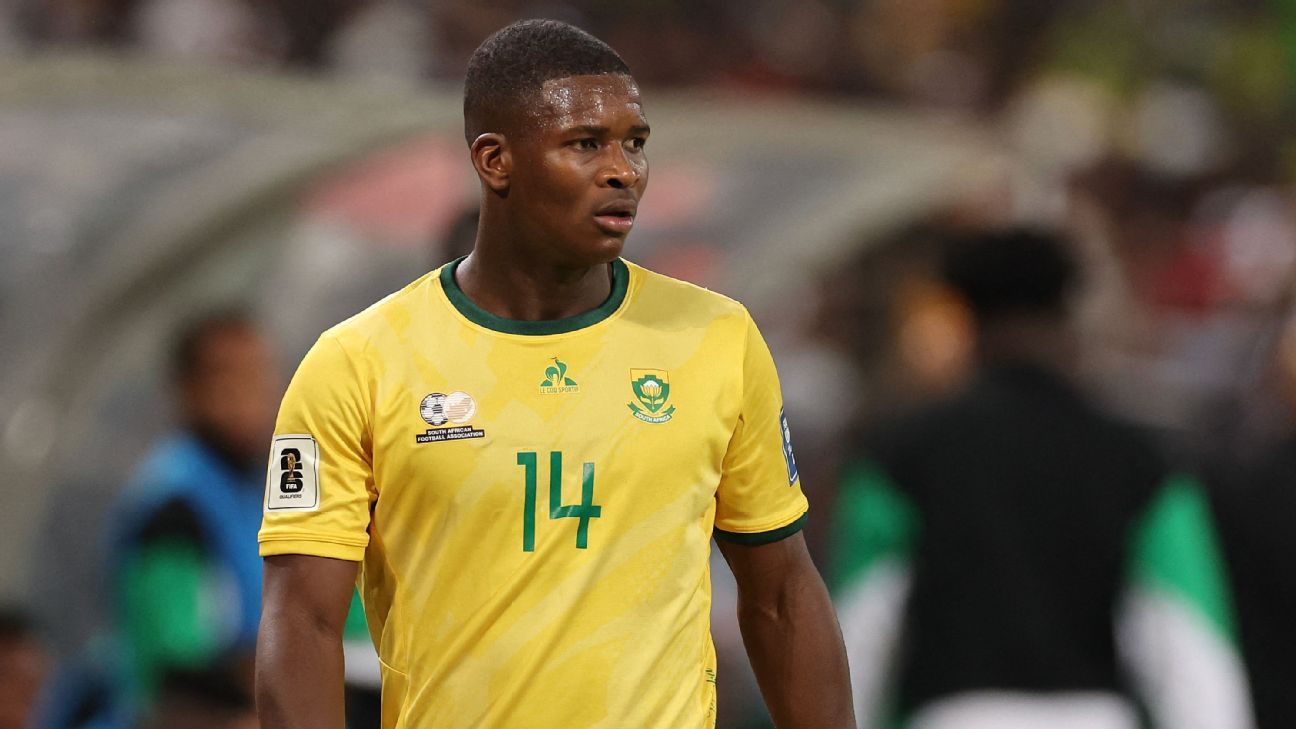
Bafana Bafana head coach Hugo Broos’ straight-talking approach has been instrumental in changing the culture of South African football for the better, but his recent comments on Mbekezeli Mbokazi were not only factually incorrect, but out of touch with the country he has generally served admirably for nearly five years.
In a Wednesday press conference, Broos lambasted 20-year-old centre-back Mbokazi for arriving late to the national team camp at the Tuks High Performance Centre in Pretoria for the looming Africa Cup of Nations in Morocco (December 21 – January 18) after missing his flight.
He also took aim at his move to Chicago Fire from Orlando Pirates – for whom he played his final game in Saturday’s Carling Knockout final win over Marumo Gallants.
“It’s not even a top team in America. If my info is right, he’s going to play in the MLS 2 at the second team of Chicago, I don’t know if it’s true, I’ll ask him when I see him. That’s even worse,” Broos said.
Although he asked not to be quoted on his understanding of Mbokazi’s Chicago Fire situation, he was facing the South African media while knowingly on the record. Therefore, he should have known better than to make a statement he had yet to verify, which turned out to be incorrect.
Why Mbokazi is a shoo-in for Chicago Fire first team
Broos is right to demand high levels of punctuality from his players, but wrong on the facts of Mbokazi’s move. A source at Chicago Fire confirmed to ESPN that he will indeed be part of the first team.
The confirmation from within the club echoed a post on X from Chicago Fire insider Alex Calabrese, an established Major League Soccer reporter and MenInRed97 editor – who wrote: “Regarding Bafana Bafana manager Hugo Broos’ claims that he was ‘told’ Mbekezeli Mbokazi would play for the Chicago Fire second team… This is completely untrue. He’s a first team player and occupies one of the valuable U-22 roster slots. He’ll play in MLS.”
Speaking to ESPN, Calabrese explained further that the reported transfer fee of around $3 million for Mbokazi is completely at odds with what Chicago Fire would have paid for a player they didn’t intend to use almost immediately.
Calabrese explained to ESPN: “In MLS, teams are effectively limited to signing six players for transfer fees over US$2.5 million.
“They are permitted three ‘Designated Players’ (guys like Lionel Messi, Thomas Müller, Son Heung-min, etc.) and three ‘U-22 Initiative’ players, which are intended to be high-profile, talented young up-and-coming stars.”
It should be noted that as per the official rules, there is some room for flexibility in terms of MLS roster composition and there is no explicit rule stating that clubs cannot sign more than six players over $2.5 million.
However, Calabrese’s explanation offers a breakdown of how the underlying intent of MLS financial restrictions on teams means that a club is highly unlikely to pay above that amount for a player that was not MLS-ready.
“Mbokazi is one of these, and the fact that the Fire have shown this much trust in making a defender one of these valuable U-22 players shows how much they believe in him and reflects that he’s going to be a valuable first team player going forward,” Calabrese continued.
Falling short on diplomacy
The politics at the top of the South African Football Association (SAFA) and the Premier Soccer League (PSL) are sensitive territory that few coaches have the courage to confront, and Broos’ straight-shooting style has worked for the best more often than not.
When Broos took over a Bafana Bafana side that had missed out on Africa Cup of Nations (AFCON) qualification in 2021, he immediately began openly criticising players, coaches and even administrators at the highest level of the local game.
Subsequent testimonies, and more importantly results, suggest it was precisely the shock to the system needed for Bafana Bafana to rally behind a common cause.
Even past critics including highly regarded MC Alger head coach Rhulani Mokwena (who traded barbs with Broos while at Mamelodi Sundowns) have acknowledged that the Belgian mentor has earned respect.
Sundowns duo Ronwen Williams and Teboho Mokoena are among senior players who have lauded the competitive culture Broos has created. Meanwhile, younger players of Mbokazi’s ilk have flourished while also being kept on their toes by his straight-shooting disciplinarian approach.
Broos’ irreverence for South Africa‘s sensitive politics has been one of his greatest strengths to date, as it has allowed him to positively disrupt a football system that previously failed in many aspects.
However, his comments on Mbokazi and his agent, Basia Michaels, were an example of how disruptive comments can be negative when not uttered with thought and respect.
“A nice little woman who is his agent and thinks she knows football is doing what many agents are doing [and thinking]: ‘How much can I get?,'” Broos said of Michaels.
This was one of two comments the Bafana boss made which got him reported to the South African Human Rights Commission (SAHRC) by the United Democratic Movement (UDM), a minority party within South Africa’s national coalition government (broadly known as the Government of National Unity), as revealed on Thursday.
The UDM accused Broos of “sexist utterances” and also claimed a comment he had made on the dressing down he planned to give Mbokazi was “racially suggestive”.
Specifically, they took issue with Broos saying, probably tongue-in-cheek: “I can assure you: he (Mbokazi) is a black guy, but he will get out of my room as a white guy.”
For context, Broos has never before in his five-year stint in charge had a public complaint against him for sexism, and it is unlikely that a racist could have handled his job as well as he has since taking charge.
South Africa is only 32 years removed from apartheid and wealth is still largely divided along racial lines. Despite the emergence of a relatively small black elite and middle class, white South Africans have a far higher quality of living on average.
Apartheid left deep psychological and physical scars on South Africans – as has its ongoing gender-based violence epidemic, which was highlighted in a nationwide campaign by activists throughout the build-up to the recent G20 summit in Johannesburg.
Football has long been an outlet for black South Africans to excel. However, women have been systemically neglected in the sport – as highlighted by the lack of a fully professional women’s league and frequent protests by Banyana Banyana players against their own association even through their most successful period ever on the pitch.
Broos – a decorated and experienced coach who gave Vincent Kompany his breakthrough at Anderlecht and won AFCON 2017 with Cameroon – has more than earned the right to his opinion that Mbokazi could have secured a more favourable move after AFCON 2025 in Morocco or the 2026 FIFA World Cup in the USA, Mexico and Canada.
The 73-year-old has also proven with his third-place finish at AFCON 2023 and successful 2026 World Cup qualifying campaign that generally speaking, he knows the best way of talking to his Bafana Bafana players.
However, when some South Africans critique his tone when speaking about Michaels – a respected agent – and young Mbokazi, it is they who are speaking from experience of a different kind which Broos ought to consider deeply.
