The NASCAR trial has ended, and when the Daytona 500 takes the green flag in two months, everything will look the same as it’s looked for many years now.
The antitrust lawsuit, filed by two of the 15 teams that field the 36 full-time Cup Series cars, ended last Thursday when a settlement was reached before a nine-person jury was asked to render a verdict.
Advertisement
After 16 months of legal sparring, ultimatums and conjecture, things ended in the familiar manner of settlements, but in a manner no one could’ve foreseen even a day earlier: Michael Jordan and Denny Hamlin, co-owners of one of the plaintiff teams, cordially flanking NASCAR chairman Jim France outside the courthouse in Charlotte, N.C.
Things were so casual, you had to wonder why all of this wasn’t simply hashed out over cocktails months ago. But for better or worse in the world of American juris prudence, that’s not how these things work.
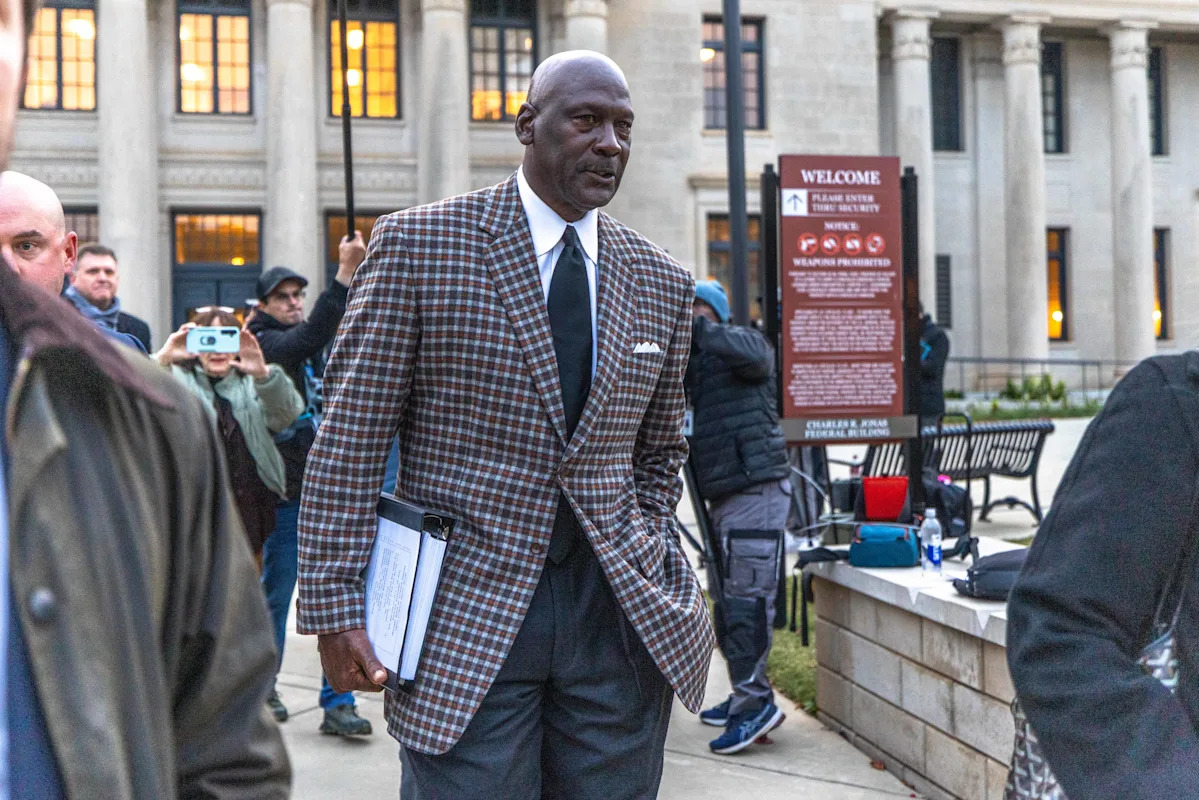
A familiar scene over the previous two weeks: Michael Jordan entering a Charlotte courthouse.
Lawyers have bills to pay, too, you know.
With the smoke still clearing, let’s skip the full recap and speed right ahead to the future, both up near Turn 1 and also way off down the backstretch.
Advertisement
1. The teams will get more money, but what about horsepower arms race?
We don’t yet know how much more money the teams will be guaranteed in these new charter terms. Hopefully, we’ll rely on an old-fashioned leak and not another trial to uncover those numbers.
But here’s the question: Will it matter?
The teams were reportedly averaging $12-13 million apiece annually per car, while Denny Hamlin and others say it costs closer to $20 million to run the entire season. My slightly educated hunch says it doesn’t cost $20 million to run, but it does cost $20 million to run near the front of the field.
The better funded teams — through added sponsorship or deep-pocketed ownership — spend the extra to compete for wins and a possible championship. Nothing, it seems, has been done to address that, and you can make the argument that nothing should be done in an open market.
For the sake of argument, let’s say the teams will now be getting that $20 million per year under the new terms (again, for the sake of argument, because we don’t know). Can’t we assume the Hendricks and Penskes of the paddock will still find ways to add another several million to the budget in order to keep the horsepower advantages they’ve always enjoyed?
Advertisement
Will the teams still be struggling for what the industry calls cubic dollars? Same game, just bigger numbers? Will they soon say, “sure, we’re getting $20 million guaranteed, but it takes $30 million to compete?” It’s worth asking.
A little over 25 years ago, NASCAR was closing a long chapter in its history and approaching the 2001 season and its new world of February-to-November, flag-to-flag network television coverage. A blanket TV deal had arrived and arrived in a Brink’s truck.
On the final weekend of the 2000 season, in Homestead, I asked Richard Childress, who’d seen a lot of things go good and bad from his earliest days on the wrong side of the tracks, if he had any concerns about all the new money coming into the sport.
“I’ve had the problems of not having enough money,” he said. “I’d rather have the problems of too much.”
Advertisement
Speaking of Richard Childress …
2. Any chance Richard Childress can forgive and forget?
Of all the dirty laundry uncovered during the lawsuit’s discovery phase, nothing was more unseemly than the internal text messages about Childress and his public airing of grievances regarding the charters and TV money.
“Stupid redneck … ass-clown … flogging …”
All made their way into the record, courtesy of new NASCAR commissioner Steve Phelps, who was still NASCAR’s president when the texts were exchanged. Childress responded through a press release we assume truly represented his mood — not too pleased, as you might imagine.
Advertisement
He even hinted at the potential for legalities, though the possible legal grounds might be tough to dig up.
Though the RCR organization isn’t exactly a championship contender these days, Childress and his team remain a big part of the NASCAR landscape — for many, the team remains synonymous with Dale Earnhardt.
Childress must further regret playing a role in the trial. He was a plaintiff’s witness, and during cross-examination, he was asked about recent negotiations to sell a percentage of his team. Those discussions, he said, were supposed to be confidential and in fact were protected by a non-disclosure agreement.
Advertisement
His regret is undoubtedly mixed with anger. You wonder how the team owner will co-exist with “management” going forward.
Now, speaking of that management …
3. Does Steve Phelps navigate the fallout?
When Phelps’ title changed from president to commissioner last spring, we assumed it either meant a lot or nothing much.
If nothing much: Create a new commissioner title, one that matches the leadership language of the NFL, MLB, NBA, etc., while simultaneously promoting Steve O’Donnell to Phelps’ former president position, a move that rewards O’Donnell and keeps him securely in the fold as part of NASCAR leadership.
Or the other thought: It was part of a short-to-medium-term plan to sunset the Phelps era and make way for newer overlords — not just O’Donnell, but the next (and fourth) generation of France family leadership, Ben Kennedy. He’s been on a steady climb through leadership positions since hanging up his own racing helmet in 2017.
Advertisement
If it’s the latter, the dust-up with Childress might’ve sped up the timeline.
4. Does this provide an exit ramp for NASCAR chairman Jim France?
Since we’re in the corner offices, we might as well speculate about the man at the head of the table.
Several years ago, Jim France never envisioned himself reaching his early 80s and sitting in that seat, let alone imagine standing alongside Michael Jordan on the steps of a Charlotte courthouse.
It’s been seven-plus years since he took on the role following the resignation of his nephew, Brian France. In an odd twist of fate, it seems NASCAR went from its third generation of family leadership back to the second, and will likely jump to the fourth sometime down the road.
Advertisement
How far down the road?
Jim France is a steady and clear-headed 81. His appearance outside the courthouse Thursday, addressing the media, was quintessential Jim — a mix of graciousness and understatement, and almost surely some relief just below the surface.
Back before he assumed this role in 2018, to whatever extent he thought about the mid-2020s, he likely assumed he’d be largely focused on his other (favorite?) racing interests — sports-cars and motorcycles.
As he shepherds the family business through this transition, maybe he’ll use the opportunity to pass the gavel.
5. Will Michael Jordan spend as much time on the pit box?
And since we mentioned Michael Jordan, what’s his NASCAR future?
Advertisement
At different times during his previous life — that of international sporting icon — he occasionally mentioned how he grew up a fan of NASCAR and remained a fan into adulthood.
He officially joined the sport as co-owner of 23XI Racing in 2020, and since then, he’s legitimized his credentials as a guy who knows the sport, enjoys the sport, and better yet, is up to speed on stock-car racing history.
Following the settlement with NASCAR, he sounded like a guy ready to practice what he’s been preaching about a new way of doing business.
He’s become a rather familiar figure on his team’s pit box over the past few years. Will that now increase, decrease or remain about the same?
Advertisement
Needless to say, NASCAR was thrilled to see him enter the sport, especially at the ownership level. Leadership probably had other opinions over the past 16 months of litigation. But now that it’s largely settled and a new path will soon emerge, Jordan’s presence can only help the effort to blaze that new trail.
∎ Email Ken Willis at ken.willis@news-jrnl.com
This article originally appeared on The Daytona Beach News-Journal: NASCAR, Michael Jordan lawsuit ends in settlement but questions remain
