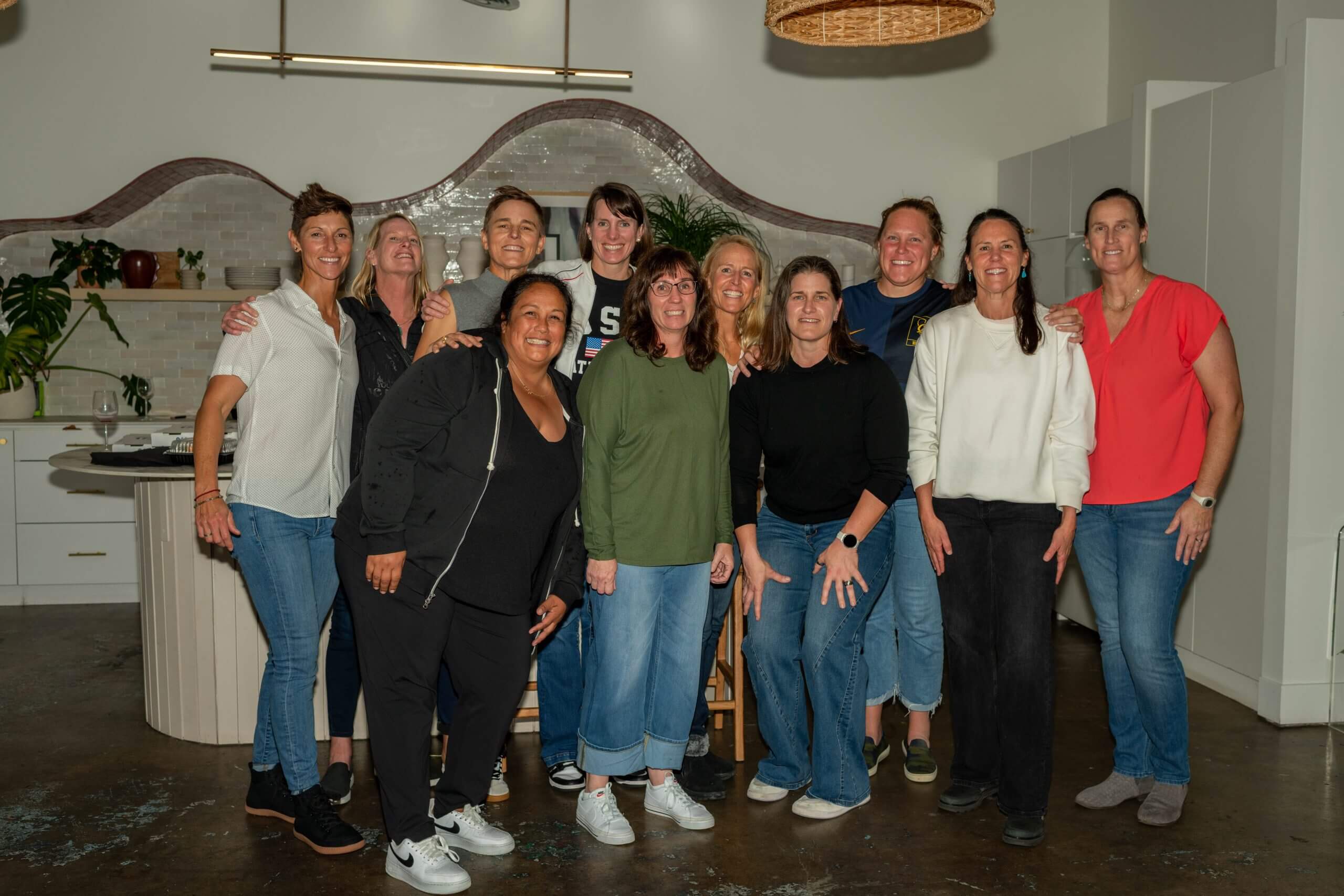
U.S. Women’s Water Polo Celebrates 25 Years of Olympic Inclusion (Plus: Where Are They Now?)
By Aimee Berg
In 2000, women’s water polo finally made its official Olympic debut – a century after the men’s game.
“We thought for sure (the International Olympic Committee) would add it to the Olympics in ’88, and they didn’t. In ‘92, they didn’t. And in 1996, they didn’t. I retired in ’94 because I didn’t think it was ever gonna be added,” said Maureen O’Toole, who was widely regarded as the greatest female water polo player of all time.
Yet on October 29, 1997, O’Toole was reading The San Francisco Chronicle in her kitchen and recalled seeing “a one-sentence thing in the paper” that women’s water polo would finally be contested at the 2000 Sydney Games. When O’Toole arrived at her office at Cal-Berkeley, where she was the head women’s coach, her old coach Sandy Nitta called.
“Mo, did you hear? Do you want to come out of retirement?” Nitta asked.
O’Toole, then 36, said: “I remember thinking for a hot second, ‘Oh man, I got a 5-year-old daughter. I don’t know.”
When the news reached USC goalie Bernice Orwig, she immediately thought: “Oh, this is amazing! But I still hadn’t made the U.S. National Team. I was on the B team, so I’m like: ‘Oh well. There’s already other goalies ahead of me. I’ll just continue with college and maybe one day, it’d be really cool if I could get there.’”
Meanwhile, 17-year-old Brenda Villa was training with the U.S. National Team on weekends to prepare for the 1998 World Championships in Perth. But October 29 was a Wednesday and she was in high school. Cell phones were rare, and only 18 percent of U.S. homes had internet access. “Maybe someone called my house line?” she guessed.
Eventually, all three women made that inaugural U.S. Olympic team that had been the second-to-last nation to qualify for the tournament, finished eighth at the previous World Championship and, somehow, in Game One in Sydney, defeated powerhouse Netherlands, 6-4. Next, it tied Canada, 8-8, to earn a crucial point in the round-robin tally and, five days later, went on to defeat the Netherlands again in the semifinal, 6-5, to earn a berth in the gold-medal game against host nation Australia.
U.S. driver Julie Swail remembered walking into an arena filled with the largest crowd ever to watch a women’s water polo game.
“It was so loud, you could feel it in your chest cavity,” Swail said. “Of the 17,000 in attendance, I’d say 16,000 were cheering for Australia. You could be two feet away from your teammate, shouting at the top of your lungs, and they could not hear.”
The plan was to stay calm and “just play Los Al style,” Orwig said, as if they were at practice at Los Alamitos, the team’s training base in California.
Villa recalled assistant coach Chris Duplanty telling the US team to “listen for the silence. If we’re doing well, scoring, making big saves, the place will be quiet. Aim for that quiet – and be okay in that quiet (because) it means we’re doing a good job.”
The final turned into a remarkably low scoring game, tied 2-2 at the end of the third period. Australia broke the tie with 1:50 to go. In the final 13 seconds, Villa tied it, 3-3, and overtime seemed inevitable – until the final second when the Australian lefty Yvette Higgins caught the ball, cranked her shoulder, and fired. The ball whizzed past U.S. goalie Orwig’s outstretched arm and slammed into the upper left corner of the net.
“I still remember how it went off my hand,” said Orwig. “But there was so much confusion on the play. All of a sudden, the game was over. Like, ‘What? What just happened? We lost? Are you sure we lost?’”
U.S. coach Guy Baker disputed the call, but it was done.
“It was shock, just absolute shock that that’s how it ended,” said defender Heather Moody. “We all came to the side (of the pool), almost blank.”
But the crowd was rapturous.
“Aussie-Aussie-Aussie Oi-Oi-Oi haunted me for decades,” Villa said.
Moments later, while the ecstatic champions from Australia accepted their gold medals, Team Russia stood on the far right of the podium, jubilant after defeating the Netherlands, 4-3, earlier that night to claim the bronze. On the far left was the only team that had lost that day, the U.S., draped in the inaugural silvers.
Orwig blew past the press and was later summoned to do a gutting post-match press conference with the gleeful Aussies. A full year later, the final point was still on her mind. In 2001, she met with coach Baker and broke down crying, telling him: “Any time there’s a player at that position, all I see is that moment in the gold-medal game,” Orwig said. “I ended up retiring in 2003 because I just… I was never able to get back to that level of play.”
By then, Orwig had already completed her college career, but younger players like Villa, 19-year-old Ericka Lorenz, and 21-year-old Ellen Estes returned from the Olympics to face another new opportunity. Women’s water polo suddenly had NCAA championship status. The NCAA had decided even before Sydney to hold the first NCAA women’s water polo championship in 2001.
Thanks to Olympic and NCAA inclusion, participation grew, as did funding, but perhaps the greatest and longest-lasting impact of the 2000 silver medal was the development pipeline.
After Sydney, coach Baker left UCLA to work full-time for USA Water Polo. “That’s where the P.A.C.E. clinic started, all the education, under-20 teams, under-18s, all that,” Baker said.
Future Olympians like “Maddie Musselman, Rachel Fattal – all those kids were identified while we were running that stuff,” said Baker, who would coach two more U.S. women’s Olympic teams. In 2004 in Athens, he guided the squad to bronze (with seven Sydney veterans on the team). In 2008 in Beijing, the U.S. earned another silver.
The development push didn’t only affect youth, however. Baker had infused it into the culture of the 2000 Olympic team – partly out of necessity (to raise money), but by emphasizing its importance. Nearly every single member of that team later became a coach.
“Before we were an Olympic sport, we used to run camps and clinics as a way to fundraise for the women’s national team,” recalled Rachel (Scott) Ruano, the 2000 Olympic alternate. “The coaching staff would do coaching seminars and we (players) would travel around the country doing clinics for kids. We did a whole Eastern tour. I think I went to one in like Louisiana, Chicago, all over, as well as in California.”
“Guy felt it was really, really important to give back,” Moody added. “So the 2000 team was actively taking the lead in teaching younger athletes our skills, and in the 2000 to 2004 window we were really active. We made videos so kids and coaches could see: here’s what the national team does.”
As a result, Moody said: “I had to learn to use my words to teach kids what I did, so now when I’m coaching, I have an idea of how to break down passing, shooting, center work, defense. It helped me develop as a coach. It gave us the groundwork and the platform to grow into who I am today.”
Where Are The Now?
- Robin Beauregard, 46, a physical therapist in Orange County, is raising 11-year-old twins in Tustin,
California. - Ellen (Estes) Lee, 47, lives in Belmont, California, has two water-polo playing children, and works at
Genentech, where she leads a group that develops pricing strategies to help patients access medicine. - Courtney Johnson, 51, lives in Dallas, Texas, has four children, and is both the director of girls’ water
polo and the executive director of operations at Pegasus Water Polo Academy. - Ericka Lorenz, 44, lives in Redondo Beach, California, and is an ocean lifeguard for the Los Angeles
County Fire Department. - Heather Moody, 52, lives near Sacramento and is the high-performance director of the American River
Water Polo Club. She also coaches a community college women’s team and a high school boys’ team. - Bernice Orwig, 49, is a mother of two in Colleyville, Texas, and teaches pre-kindergarten to 3-year-olds.
- Maureen O’Toole, 64, lives in Australia, three hours south of Sydney, where she is a lifeguard and
outrigger canoe coach. - Nicolle Payne, 49, lives in the North Lake Tahoe area and coaches goalkeepers for the USA Water
Polo’s Olympic Development Program. - Heather Petri, 47, lives in Moraga, California, and is an assistant women’s water polo coach at her alma
mater, Cal-Berkeley, with Coralie Simmons. - Kathy Sheehy, 55, placed second in the women’s 50+ division at the 2025 World Aquatics Masters
Championships in Singapore, and is based in South Lake Tahoe. - Coralie Simmons, 48, has been head coach of women’s water polo at Cal-Berkeley since 2015 and is
raising two soccer-playing children in the Bay Area. - Julie Swail, 51, lives in Irvine, California, and does NBC Olympic commentary for women’s water polo
and triathlon (her 2008 Olympic sport). - Brenda Villa, 45, is the new associate head coach of women’s water polo at her alma mater, Stanford.
- Coach: Guy Baker, 64, is the executive director of Lamorinda Water Polo Club in Lafayette, California,
where he coaches the U18 boys’ and girls’ teams. - Alternate: Rachel (Scott) Ruano, 49, lives in Sacramento where she is the programs director and Boys’
U14 coach at the same club as Heather Moody. All four of her sons play water polo, including Lucas, who
competed for the US at the U16 world championships in 2024.
