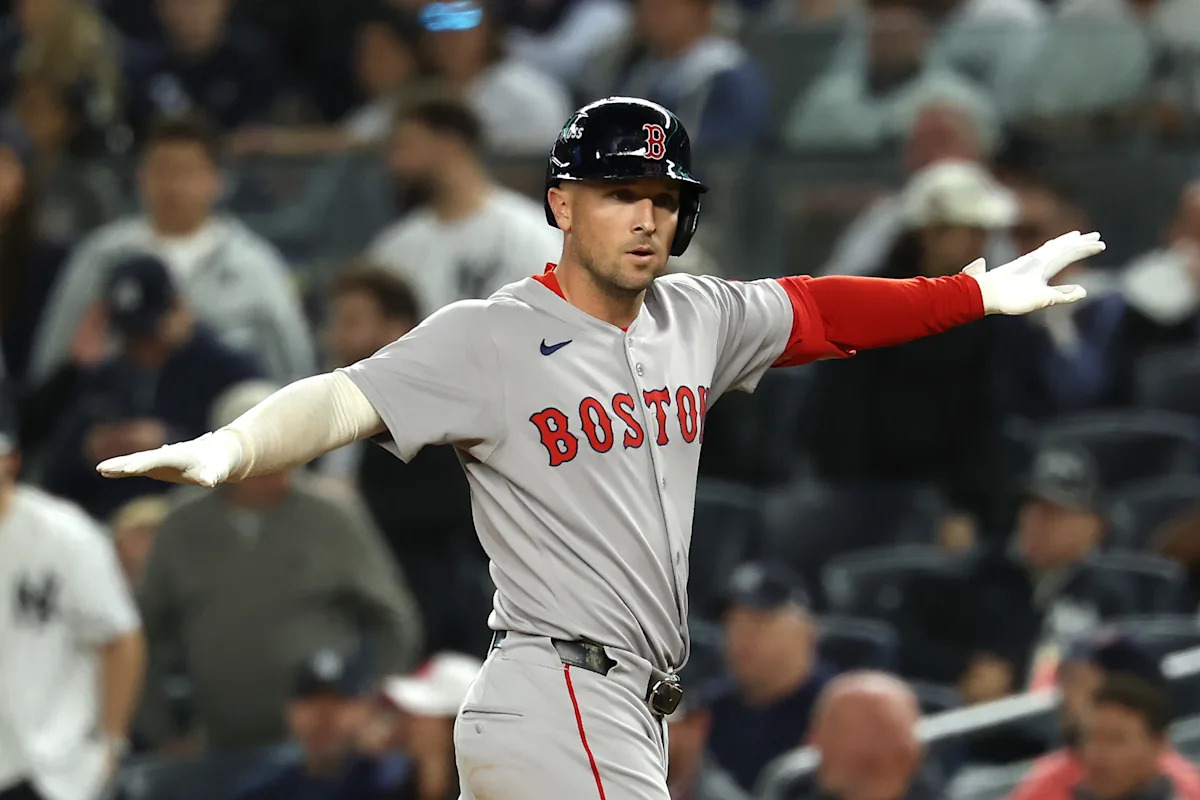
Christmas is a week away, and the Boston Red Sox have yet to sign a free agent to an MLB deal. Only one other club, the Colorado Rockies (and their brand-spanking-new front office), has been similarly passive on the open market. But even though chief baseball officer Craig Breslow hasn’t handed out any contracts, he has still been quite a busy man.
The Sox have conducted six trades, bringing 11 new players into the organization. Not all the transactions have been of the blockbuster variety, but Boston has boosted its pitching corps with two big NL Central swaps, acquiring hurlers Sonny Gray and Johan Oviedo.
Advertisement
But have the Red Sox actually gotten any better? Is the 2026 club positioned to win more games and journey deeper into October than the 2025 version?
That’s a big question, one impossible to answer until we can assess the roster on Opening Day. Instead, here are five other questions that will define the remainder of Boston’s winter.
1. Alex Bregman?
No, that’s not technically a question, grammatically speaking, but you catch my drift. Come Opening Day, Boston’s entire offseason will be defined by whether or not Bregman is back in the fold. In one season with the Sox, the three-time All-Star became that important to the entire operation.
Advertisement
He missed two months due to a quad injury but otherwise delivered a Bregman-esque statline. The man rarely chases or whiffs, and pulls the ball with authority often enough to produce sufficient power. Off the field, the 31-year-old continued to reinforce his reputation as one of the sport’s most influential clubhouse characters. It was, for both parties, a perfect match.
But Bregman earned the opt-out in his contract, and now 29 other clubs have a shot. That includes the Detroit Tigers, who made a serious play for the third baseman last winter, and the Arizona Diamondbacks, who were recently linked to Bregman.
In the end, though, Bregman ending up back in Boston makes too much sense. The Sox have the budget, the need and a core that, if properly supplemented, could make a real playoff push. How many years and how much dough it will take become the key questions. Fellow Scott Boras client Pete Alonso just parlayed a one-year opt-out into that evasive long-term deal. Bregman is surely hoping for something similar, and the Red Sox can’t afford to miss out.
Advertisement
2. If they don’t get Bregman, then what?
The only infielder on the open market with a comparable offensive pedigree to Bregman’s is former (and future?) Jays shortstop Bo Bichette. But the suave-swinging 27-year-old is four years younger than Bregman and likely to necessitate a bigger commitment as a result. That’s not a clean fit for a Sox franchise penny-pinching its way through life. Past Bichette, it’s a pair of third basemen in veteran slugger Eugenio Suárez and Japanese import Kazuma Okamoto before things drop off into the gulp Isiah Kiner-Falefa realm.
It’s reasonable to expect youngster Marcelo Mayer to be the Sox’s Opening Day option at either second or third. His flexibility gives Breslow some of his own, but Boston has to make an external infield upgrade of some sort — and if not through free agency, then through trade. The Sox have been rumored around D-backs All-Star Ketel Marte, and Cards second baseman Brendan Donovan would also make sense. But entering the year with Marcelo at third and Ceddanne Rafaela at second (more on him momentarily) would send a message that the Sox are an unserious outfit. This is why it feels like all roads lead back to Bregman.
[Get more Boston news: Red Sox team feed]
3. How do they simplify the outfield mix?
Boston’s outfield group has firmly entered too-many-cooks territory. Between the grass and the DH spot, the Sox have Rafaela, Jarren Duran, Wilyer Abreu, Roman Anthony and Masataka Yoshida. All but Rafaela are left-handed swingers. Yoshida can’t really play defense. Abreu and Duran struggled mightily against lefties last year. Anthony, one of the game’s most talented young hitters, has to be playing every day. And Rafaela — one of the best outfield gloves in the sport who, because of Boston’s roster realities, spent far too much time at second base last year — has to be the regular center fielder. Forcing him to the keystone is like putting Jimi Hendrix on bass guitar.
Advertisement
That means somebody has to go, probably Duran or Abreu. Duran is a tricky figure because rival teams are valuing him much lower than the Sox do. Boston sees him as the 8.7 bWAR/132 OPS+ player he was in 2024; everyone else is treating him according to the 4.7bWAR/114 OPS+ season he just posted. That means either somebody will blink on Duran, the Sox will deal Abreu instead, or Boston will enter 2026 with a bunch of puzzle pieces that don’t really fit together.
Yoshida, meanwhile, is moving toward albatross territory. He’s under contract for two more seasons, doesn’t really hit for power and has the defensive chops of someone stumbling out of the bar at last call. Boston probably gives him one last shot, but there’s a strong argument to cut bait if a better option shows up.
4. Have they done enough to solidify the rotation?
At the offseason’s outset, Breslow was forthcoming about his intention to acquire a viable No. 2 starter behind über-ace Garrett Crochet. That proclamation sent fans into a frenzy, soul-deep into the Paul Skenes fake-trade abyss. Back in the real world, Breslow swung a deal to acquire veteran righty Sonny Gray from the St Louis Cardinals.
Advertisement
Gray, 36, is still a good pitcher, but he’s far from a surefire, frontline force at this point in his career. Perhaps going from an old-school pitching apparatus in STL to a very progressive one in Boston unlocks something for Gray. Even if that happens, he looks less like a co-ace and more like Crochet’s soft-tossing sidekick.
The other major deal of Boston’s winter, a five-player swap that sent 27-year-old righty Johan Oviedo to Fenway, has much more upside but also much less certainty. Oviedo flashes tantalizing stuff but has had a start-and-stop career.
Those upgrades might be enough, particularly if talented southpaw Payton Tolle delivers on the immense promise he flashed during his 2025 debut. The depth is pretty good, too, with names such as Brayan Bello, Connelly Early, Patrick Sandoval and Kutter Crawford rounding out the rotation. Barring a trade that sends arms elsewhere, it’s hard to see there being room for another pitcher, which means Breslow and Co. are probably rolling into Opening Day with this group.
Advertisement
5. How much are they willing to spend?
Recent history suggests the Sox are comfortable surpassing the first luxury-tax threshold ($244 million for 2026) but not by much. Last season, according to Spotrac’s very detailed accounting, Boston went less than $1 million into the tax. There’s little reason to expect that to change, based on how the Sox have conducted business over the past half-decade. At this point, despite their mammoth brand recognition and real estate clout, this organization clearly prefers to run a payroll that is firmly in MLB’s third tier (behind Dodgers and Mets in tier 1 and Yankees, Jays and Phillies in tier 2).
Advertisement
Does that mean they’d balk if Bregman’s asking price gets too high? What if they sign Bregman and have the window for a Ketel Marte deal? Is ownership willing to push the envelope if the right opportunity comes along? Or is there a cement financial ceiling? The answers to those questions could dictate how this winter plays out and, in turn, the immediate future of Red Sox baseball.
