Maryland women’s basketball built its 2025 roster differently than it had in the past.
Throughout the offseason, the Terps had spots to fill on their roster with little time to do so. Would-be transfer Gracie Merkle rescinded her commitment to Maryland in May, leaving the roster with three holes, including one that was previously unexpected.
Advertisement
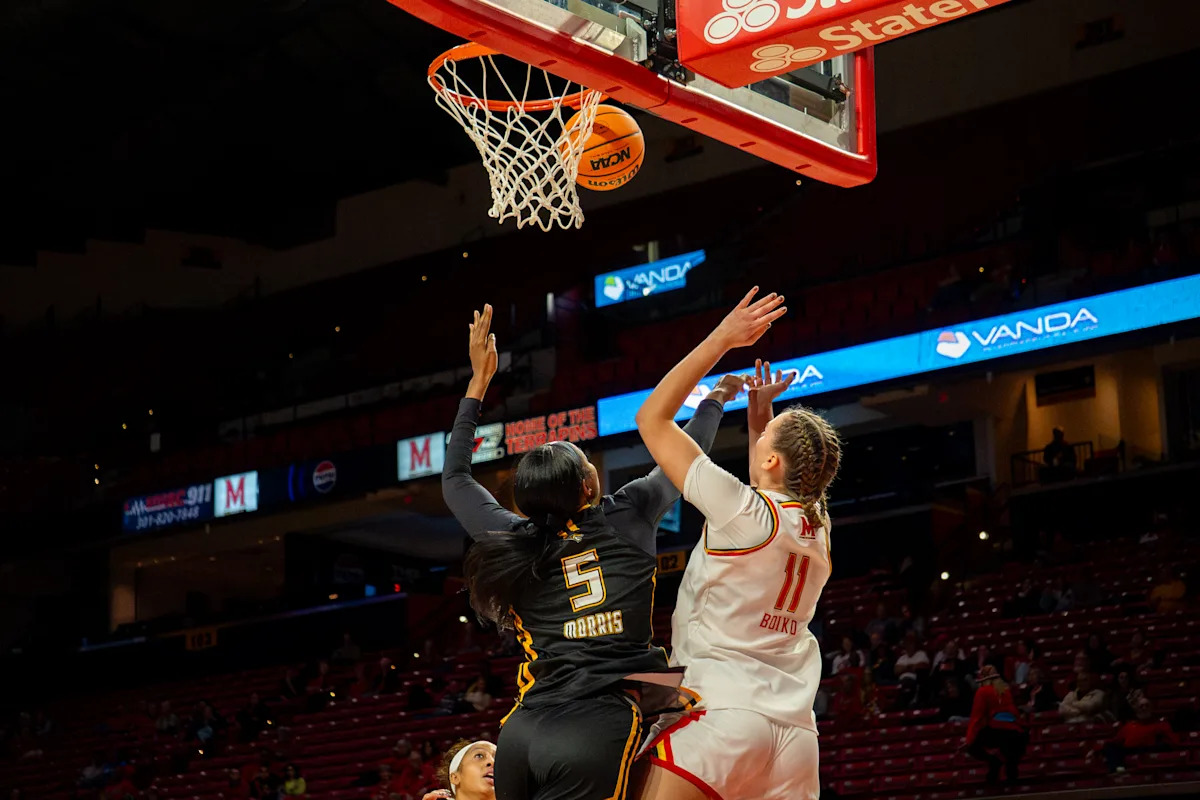
Those holes were filled by three international freshmen in Lea Bartelme, Marya Boiko and Nicole Fritea. Maryland has five international players on its 2025-26 roster — its most in program history.
Alongside the three freshmen, Isimenme Ozzy-Momodu — from England — and Yarden Garzon — from Israel — spent time at other programs before transferring to Maryland.
“We don’t limit ourselves,” assistant coach and recruiting coordinator Lindsey Spann said. “Trying to find the best kids that fit our program.”
Maryland’s willingness to use alternative methods to fill its roster has allowed the program to develop a unique dynamic. The vast diversity of experience on the roster helped integrate the three international freshmen.
Advertisement
“I’ve also had experience playing for my country’s team and also playing here for two years in [junior college],” Ozzy-Momodu said. “Playing in [junior college] made me get a sense of how American basketball is played.”
Ozzy-Momodu was once in similar shoes to Boiko and Fritea, albeit at a different type of program. She’s taking responsibility to guide them through their first season in the United States.
Bartelme, Boiko and Fritea were brought in as a necessity, making their recruitments anything but typical.
NIL makes college basketball more attractive for international recruits
Changes to the college basketball landscape have made the NCAA a more desirable option for international players.
Advertisement
Before 2021, collegiate athletes couldn’t make money. An international player can enter the WNBA at 20 years old, whether they have played as an amateur or professional, as long as they have withdrawn their college eligibility.
“Where it has changed is the climate overseas. They now come over here and get degrees as well as be a part of NIL and rev-share,” Frese said.
Those who do decide to play in the NCAA can’t enter the WNBA until they are 22 years old or graduate from college. But the ability to make money has opened the floodgates for international recruiting.
“Everybody’s journey is a little different. It’s definitely more appealing for some now to come over and play the four years in the States and take advantage of what they can,” Spann said.
Advertisement
Bartelme, Boiko and Fritea’s journey to Maryland
Maryland’s three international freshmen were all added during the summer as the transfer portal period wound down.
Boiko is from Belarus, Fritea is from Romania and Bartelme is from Slovenia. None had met with Maryland’s coaching staff in person before committing.
“We did not have to go over and visit them in person, but after we did some initial Zoom conversations,” Spann said about Boiko and Fritea. “You want to meet them and their family, and what are their goals and what do they want for their daughter.”
The most important aspect was to build some type of connection while overcoming clear barriers. Spann described the process of recruiting Bartelme, Boiko and Fritea as “speed dating.”
Advertisement
The Terps were looking at players beyond the freshmen trio. The final decisions came down to scouting and conversations over who best fit the team.
“You never want to pressure a kid or their family,” Spann said. “We’re very upfront and just very forward with how they fit, how we see them in our program, what we think where they can add value.”
Spann explained that every process is different regarding a recruit’s priorities and timetable to make their decision. That was the case in this cycle.
For Bartelme, college basketball was not always the obvious choice. She didn’t watch it growing up, and she didn’t know the landscape, but she saw the growth of the college game.
Advertisement
“First, I was more focused on Europe. But then, once everything started changing, we heard more of college. I could get a degree and also play really good basketball,” Bartelme said.
The increased media coverage of women’s college basketball in recent years gained Bartelme’s attention as she decided on her future.
She did her research, speaking to players who had played at Maryland — those who were in a similar situation.
“That was the right moment, the right timing. They called me. This is the option. You cannot miss that kind of option. Not a lot of people get it, and especially overseas, that’s rare,” Bartelme said.
Advertisement
The call from Maryland was an offer she couldn’t refuse.
“It’s getting more often, but it’s still rare. I just need to take that. It’s a really good decision. You just need to take it. There’s no other chance,” Bartelme said.
Maryland’s international recruiting process
Frese revealed that despite the change in college basketball’s climate, the nature of recruiting hasn’t changed. But new recruiting methods have opened up.
The international recruiting process is bolstered by strong connections and gathering information to help construct a roster. But the recruits’ journeys are different presently.
Shay Doron, a member of the 2006 national title squad, moved with her family from Israel to New York for high school so she could get recruited. Now, a similar move isn’t necessary.
Advertisement
“Before, it would have been different people working through, different scouting services that just assist with getting some kids in Europe, their name out just so they’re known,” Spann said.
Spann explained the strategy behind international recruiting is “the connections that you’ve already made over time.” Thus, agents have become an integral part of the process.
Previously, collegiate athletes didn’t have agents because they weren’t allowed to make money. But given contemporary NIL rules, agents have connected international players with college coaches.
“Once you have a lead, which was the case with all three of them, then you’re able to do your homework, and that’s where our staff does a really good job,” Frese said.
Advertisement
Maryland’s international freshmen are still finding their footing in the U.S. Bartelme began the season as the starting point guard, but suffered an ACL tear on Nov. 13 against Towson. Boiko has been in and out of the rotation, and Fritea just had a season high in minutes in the Terps’ 70-point blowout of Delaware State.
With these players on the roster, and likely more to follow in coming seasons, the future of international recruiting — for Maryland, and in college basketball as a whole — is bright.
