
Viktor Gyökeres was billed as the elite striker who would finally end Arsenal‘s 22-year wait for a Premier League title. The €63 million summer signing from Sporting CP arrived after scoring a remarkable 97 goals in 102 games across two prolific seasons in Portugal, and the Gunners finally had their “win now” acquisition that was heralded as the final missing piece of the puzzle.
Before Gyökeres had even kicked a ball in the club’s preseason tour of Asia, fans in Singapore and Hong Kong queued up to pose with hands interlocked across their faces in his signature celebration. And manager Mikel Arteta willingly played along, speaking of a player walking into his dressing room with the aura and presence associated with the very best.
But fast forward to the week before Christmas and Gyökeres faces accusations that the mask has slipped; that the robust defenses of English football’s top flight have found him out.
Arsenal still sit two points clear at the top of the table and are the bookmakers’ favorites to win the league, but Gyökeres has not played the central role he was signed for.
ESPN looks at the reasons behind this and whether it will matter in the end.
The “win now” option
The equation for Arsenal this summer seemed simple: sign a striker to win the title. A team that had drawn 14 league games and scored 17 fewer goals than champions Liverpool had come close in 2024-25, as they finished second yet again, but needed more firepower to get over the line.
The club enquired about RB Leipzig‘s Benjamin Sesko prior to him signing a new contract in the summer of 2024; then they asked again in January 2025 when injuries struck their frontline, the same month a failed move for Aston Villa‘s Ollie Watkins enhanced their desire to sign a forward at the next opportunity.
Sources have told ESPN that Arsenal believed Newcastle United‘s Alexander Isak was not going to be allowed to leave that summer (he later left in a protracted and acrimonious exit to join Liverpool for a British-record £125 million fee).
The Gunners were not entirely convinced by Sesko, who later joined Man United for €85 million, given he was just 22 and clearly still learning his trade. Gyökeres was available for higher fee but his devastating goal-scoring record for Sporting, plus a prior knowledge of English football from his time at Coventry City and Swansea, led Arsenal to pursue a deal.
Gyökeres’ willingness to join (he went on strike and refused to train at Sporting) and his agent’s desire to facilitate the deal — forgoing a fee in the region of £6 million to help bridge a gap in transfer valuations between the clubs — reinforced the feeling they had landed on the right target.
Speculation over the move — which sources say was still being worked on even the night before it was publicly announced on July 26 — had dominated the club’s Far East tour. Such was the desire to get Gyökeres involved, he was flown out to Singapore to be unveiled before the crowd at Singapore National Stadium as Arsenal took on Newcastle. He did not take any part in the game and the club had just one light training session the next day before making the four-hour flight to Hong Kong.
Then, on his first morning, Gyökeres sat down with a few reporters for his first interview at the Rosewood Hong Kong hotel, which was besieged by fans night and day for Arsenal’s brief stay as they lost 1-0 to Tottenham before flying back.
He came across as a perfectly pleasant, diligent and focused professional, but perhaps bereft of the “aura” Arteta had talked up. Though he could be forgiven for needing time to gather himself. It was a whirlwind introduction in an unrelentingly vibrant city and in some ways an extension of the truncated preparation he had already endured, as he trained alone at Sporting while negotiations with Arsenal dragged on.
Arteta reflected on the level of scrutiny Gyökeres has faced since his arrival when speaking to reporters on Friday ahead of the game against Everton.
“At the end, you have to experience it — you can imagine the global impact that you are going to have to deal with when you come to a big club and the expectation is as it is,” he said. “But after you have to live it. Living it is always slightly different to your imagination.”
But privately, Gyökeres was being hailed as the “win now” option. He was a player whose transfer fee, age and experience demanded he hit the ground running.
How Arsenal have adapted
Sources have told ESPN that some at the club believed Gyökeres was slow to hit his stride in his first week of training; again, perhaps a consequence of the lack of consistency in his preparation to that point.
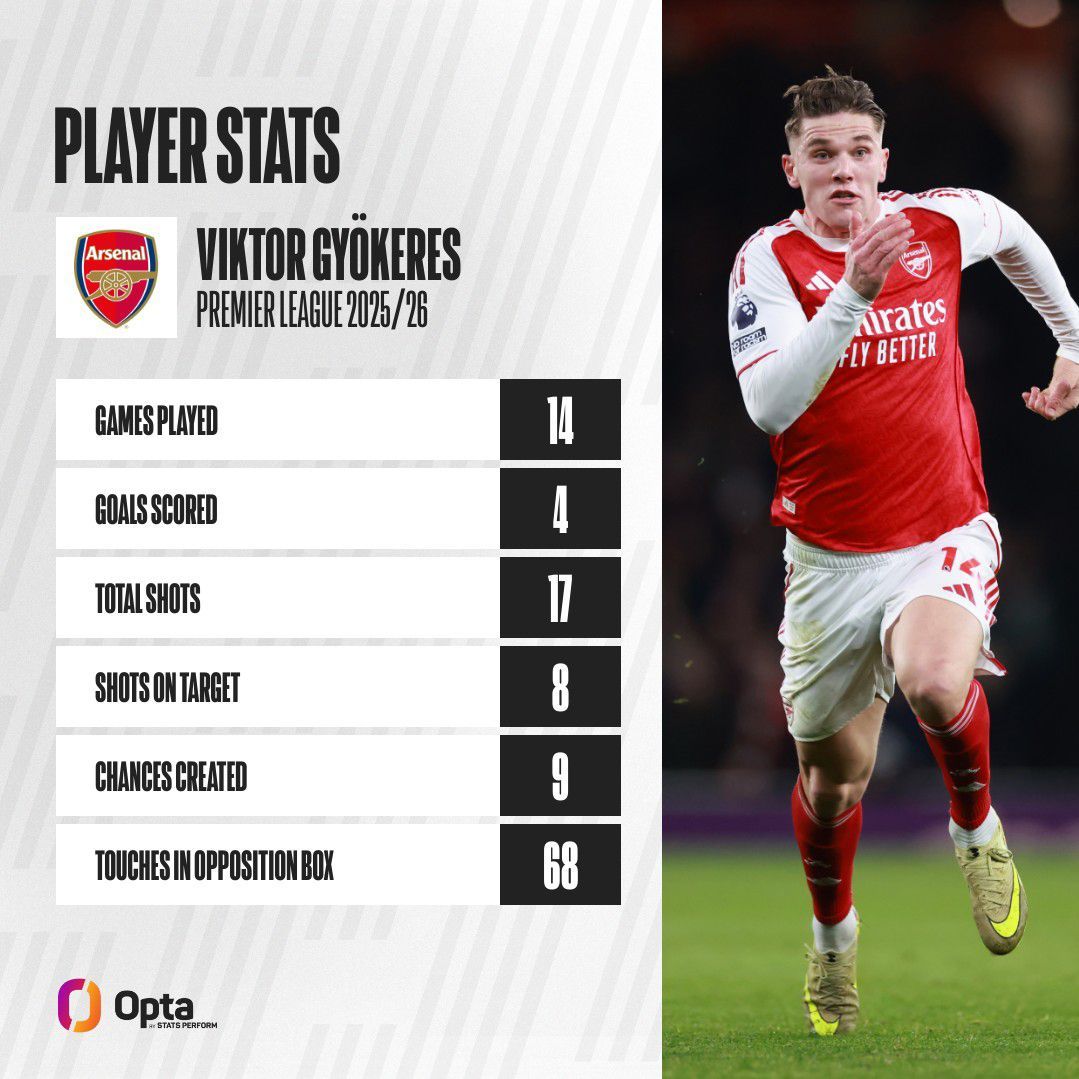
A brace on his home debut against Leeds United and a goal against Nottingham Forest in early September staved off any immediate concerns — as did Arsenal’s ascent to the top of the table — but his only league goal since came at Burnley and the Gunners have objectively looked at their best this season when playing with midfielder Mikel Merino leading the attack amid Kai Havertz‘s injury woes.
And perhaps this comes to the crux of the issue: Arsenal appear caught between the team they were last season and the team they planned to be now.
Sources told ESPN that there was a recognition upon signing Gyökeres that the team would have to change to play to his strengths. Gyökeres is not at his best linking the play in the manner of Merino or Havertz, he is most effective running in behind, occupying and turning center backs within the width of the penalty box.
Arsenal consequently planned to become a more direct team, but the early statistics are mixed on that front.
They averaged 59.2 progressive passes last season; this season that figure is 55.6. Their average passes in creating a chance is up to 42 from 38; their number of long balls completed is up to 18.4 from 16.4; and amount of through-balls per game is now 1.2, up from 0.9. Meanwhile, their “fast breaks” (defined as an attempt created after quickly turn defense into attack having won the ball in their own half) stand at 0.9, precisely the same as last season.
Part of the jumbled picture here is Gyökeres’ absence for most of November through injury, and the different skillset that central midfielder Merino brings to the role. Merino’s ability to adapt as a No. 9 striker, helping the attacking players around him while contributing at the business end himself, almost took them to the title last year and his three goals and three assists this season have been key.
In fact, since the start of last season, Merino averages a Premier League goal involvement every 135 minutes. That figure is better than Gyökeres (221), Havertz (169) and Gabriel Jesus (142).
Struggles against Wolves
Arsenal’s early reliance on set-pieces and a resilient defense has been well documented, as is the reemergence of their effective right-wing combinations with Jurriën Timber, Ben White (now unfortunately injured again) and Bukayo Saka proving particularly dynamic of late.
Saka was the key figure in Saturday’s 2-1 win over Wolves, a game in which Gyökeres’ peripheral performance against the worst team in the division — possibly the worst team in Premier League history — rang alarm bells. The Sweden international managed just 15 touches on the night, completing three of his six passes and was nowhere to be found when Saka delivered a brilliant first-half cross of the type many thought should be his staple diet as a potent close-range finisher.
Substitute Jesus completed as many passes in his nine minutes on the field as Gyökeres managed in his 81 minutes on the pitch, and amassed nine touches. The Brazilian then ran to meet Saka’s stoppage-time cross, which Wolves defender Yerson Mosquera headed into his own net to give Arsenal a dramatic victory.
Of course, the focus on Gyökeres’ form comes at a time when the Gunners’ main title challengers, Manchester City, are being spearheaded by the deadliest finisher in world football right now: Erling Haaland. It makes for an awkward comparison.
“He [Gyökeres] is doing it with a lot of desire,” said Arteta. “His energy level, his commitment is absolutely top and we are all here to help him because we have all been here, we all need time, there are always moments where the strikers score more goals or less goals. We need to be there for him.
“The first few weeks were difficult because physically he wasn’t in his best state, and he is a player who needs that like any other player in this league almost to perform at that level.
“Then he kicked on, he had a really good period, and he got injured. Now, I saw a lot of positive things in the last two games that he’s done. We need to continue to tweak and understand him a little bit better in certain situations and he needs to do the same. But that’s about time and we have full support for him.”
Arteta is rarely a manager prone to criticizing his players but he knew they got away with it against Wolves and effectively confirmed on Friday that the players would need to be reminded of their defensive and attacking principles in training this week.
What does the future hold?
1:02
Robson: Arsenal still need to use Gyökeres more
Stewart Robson praises Viktor Gyökeres’ performance vs. Atletico Madrid but believes Arsenal are still adapting to his style.
The question remains: do Arsenal continue to try to evolve into the team they had planned to be, or keep the more familiar, patient approach which has moved them into top spot after 15 games? Can Arsenal be as effective playing to the strengths of one man — as City do so often with Haaland — or is their route to glory better served by another approach?
Arteta’s choice of starting striker at Everton will in many ways hint at the answer. He opted to start Merino over Gyökeres in the 2-1 defeat at Villa Park, which was an eye-raising choice, albeit one partly informed by Gyökeres’ recent return from injury. But if the No. 14 really is the game-changing center forward Arsenal targeted, he surely has to start,
The decision will be made harder by Jesus’ return from long-term injury, with Havertz also expected to follow in the next fortnight. It may the case that all four have a role to play and Gyökeres is entered into rotation rather than operating as the clear first-choice.
“The whole summer I was thinking, ‘if we bring a No. 9, what was going to happen with Gabi Jesus and Kai?” Arteta said at the start of the month. “And I had a lot of No. 9s. I just think that I like them so much as well. Okay, what are we going to do?
“How are we going to handle it? And so far we haven’t had a problem because they’ve been injured. So, live the present, live the moment, and deal with the situation when it comes.”
That situation is now here.
