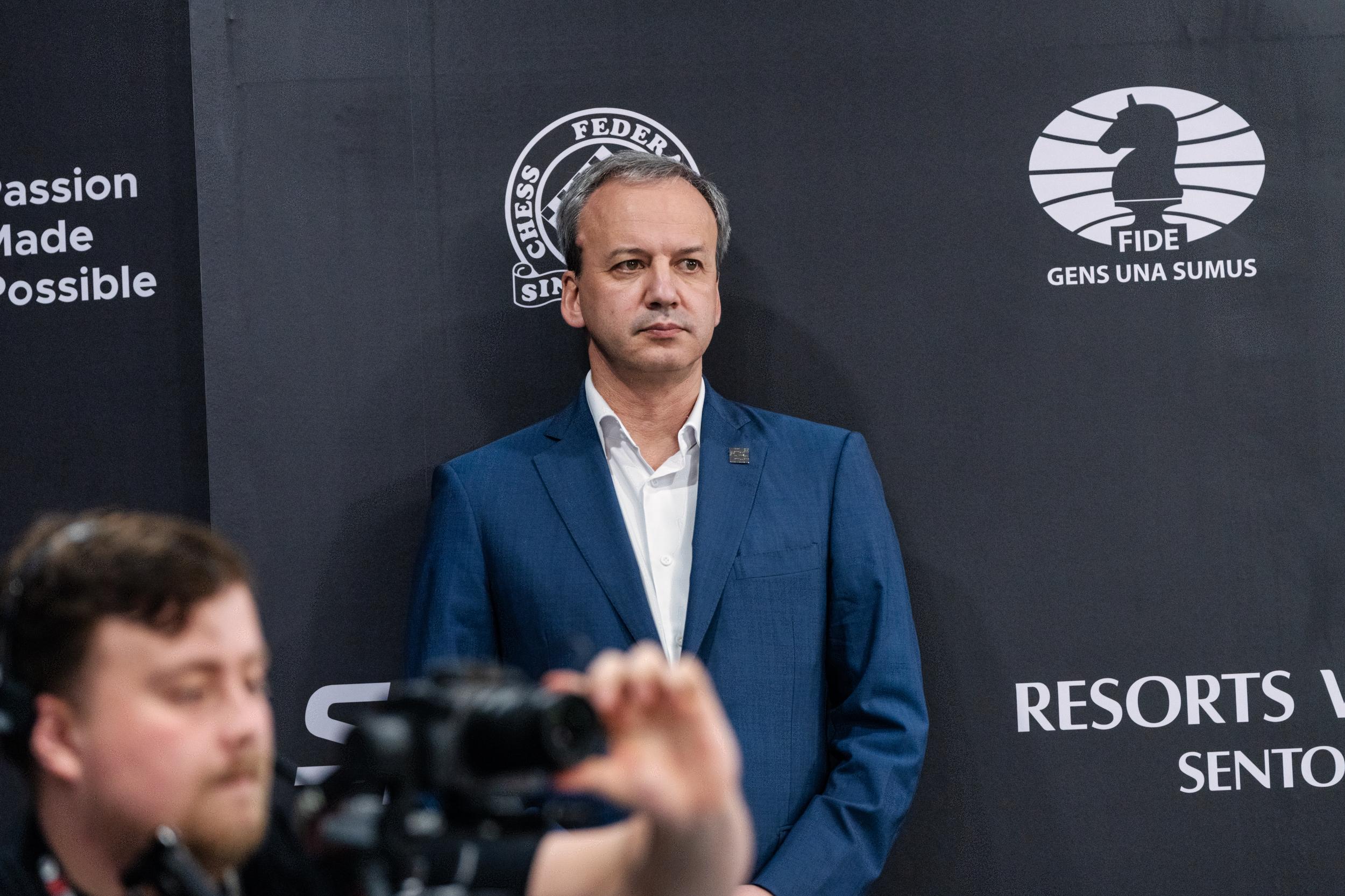
The International Chess Federation (FIDE) approved the lifting of sanctions on Russia and Belarus following an online General Assembly, but the proceedings have been criticized by several federations, and the world governing chess body could face legal challenges.
The six-hour General Assembly on Sunday decided to allow Russian and Belarusian teams to return to official FIDE competitions for the first time since Russia’s full-scale invasion of Ukraine in 2022.
However, the manner in which the vote was conducted, including the approval of two resolutions, has raised questions about the legality, governance, and potential political influence within the world governing chess body.
The full broadcast is available below. The discussions begin at around the one-hour and 55-minute mark.
Before we get to the latest developments, it’s worth sharing some background. Russian and Belarusian teams have been suspended from international chess events since the full-scale invasion of Ukraine on February 24, 2022. Individual athletes have been allowed to play, but only under the neutral FIDE flag.
Since then, the restrictions have been gradually relaxed. At the 2024 FIDE General Assembly in Budapest, motions to lift them were dismissed, but a last-minute proposal approved the return of “vulnerable groups.” In January, Russian and Belarusian youth and disabled teams were allowed back and now play under the FIDE flag.
In November, an all-Russian team was also allowed to compete at the 2025 Women’s World Team Championship, sparking protests by the Ukrainian Chess Federation labelling it a “blatant disregard for 600 Ukrainian athletes and coaches being killed by Russian occupies.” The European Chess Union (ECU) also protested and argued it was in conflict with the policy agreed upon at the General Assembly.
In October, the Russian FIDE President Arkady Dvorkovich confirmed to Chess.com that a proposal to reinstate Russian teams had been put on the agenda for the online General Assembly, reiterating that “decisions will have to be based on IOC (International Olympic Committee) recommendations.”
On Sunday delegates voted on two separate, contradictory resolutions:
- A resolution from the Russian Chess Federation, calling for the immediate removal of all restrictions, including the restoration of national flags and anthems, was approved with 61-51 votes. (29 delegates abstained or did not participate.)
- A resolution from the FIDE Council, which allows the return of teams but keeps restrictions on national symbols in adult competitions pending consultation with the IOC, was approved with 69 votes in favor, 40 against. (32 delegates abstained.)
“I would like to ask anyone if they have an opinion on how to proceed here,” Dvorkovich said after declaring both votes valid. The Council would implement the “points of consensus” between the two, he later added.
I would like to ask anyone if they have an opinion on how to proceed here.
—Arkady Dvorkovich
Both motions were voted on by secret balloting, which appears to violate the FIDE statutes Article 17.15, as they require an open vote:
Votes on elections for the President and the members of the Council must be made by secret ballot. The elections for Zonal Presidents and for elected Commissions shall be made by secret ballot, except when there are no more candidates than positions to be filled. A secret ballot is held for the award for hosting the Olympiad and for decisions on motions of no confidence. All other decisions will be taken by open vote.
Ahead of the vote, the Russian spent 16 minutes showing three slides presenting the proposal, which included an email from an IOC representative stating that FIDE would be responsible for applying the participation criteria for the competitions it organizes.
He also showed a slide listing the sports that currently allow Russian team participation.

Dmitry Oleinikov of the Russian Chess Federation and Russian sports lawyer Mikhail Prokopets spoke on the federation’s behalf, and each addressed the Assembly for six minutes urging full reinstatement.
“It’s absolutely clear that athletes cannot influence or stop any geopolitical problems or conflicts,” Prokopets said. “There are no links between banning athletes and stopping the war… stopping the conflict.”
There were several delegates agreeing with that sentiment. One was the delegate from the Kyrgyz Chess Federation, Babur Tolbaev, who previously filed a motion to lift restrictions ahead of the General Assembly in the 2024 Chess Olympiad in Budapest.
“Peaceful sports federations like chess should stay away from politics. There were a lot of examples of conflicts in the past, before the tragic Russia-Ukraine conflict. We are the ones that bring peace,” he said.

Sri Lanka’s delegate, Wjesuriya G. Luxman, said: “When we were playing in the 80s, these three countries were playing as one team. Now, due to some political reasons, they have some problems, and they are accusing each other. I don’t know why our young players like Nepo are punished because some politicians are doing a war. My idea is to let politicians do their politics, and we’ll play chess.”
The Ukrainian Chess Federation, with its president Oleksandr Kamyshin, eventually hit back: “It is surprising to hear how some people call an unprovoked, full-scale invasion a geopolitical issue,” urging delegates to maintain sanctions, noting that only six out of 108 international sports federations currently allow Russian team participation.
“Allowing this would send a deeply troubling political signal and compromise the moral integrity of FIDE,” he added.
IM Malcolm Pein, Director of International Chess and External Relations and an outspoken critic of FIDE over the years, pointed out that the official IOC recommendations remain explicit and unchanged since 2022, stating:
- Russian and Belarusian athletes may only compete as Individual Neutral Athletes
- Teams from Russia and Belarus cannot be considered
- No flags, anthems, or national symbols may be displayed
- Sanctions against the Russian and Belarusian states must remain in place
He called it scandalous. “It is potentially dangerous for the future of the organization if we go against the views of the IOC.”

After six hours, several of the delegates from Asian federations pointed that it was past midnight. Dvorkovich admitted the legal questions had not been resolved, but recommended not to have a vote on the two contradictory resolutions.
Pein told Chess.com after the General Assembly this week: “This is the logical culmination of allowing FIDE to be completely dominated by one country, both in terms of personnel and policy. The result of this vote is to isolate the game of chess,” he said.
Pein warned that several federations could face problems with funding, or not being able to host FIDE events, if there’s a stipulation that Russian teams must be allowed to compete under their national symbols.

“We will continue to fight this issue and support Ukraine. I am hopeful there will be a challenge to Dvorkovich at the forthcoming FIDE congress. It is noticeable that one of the things he fought on was the introduction of term limits, but now that he still seems to be useful to his masters in the Kremlin, he decided to throw that pledge out of the window.”
We will continue to fight this issue and support Ukraine. I am hopeful there will be a challenge to Dvorkovich at the forthcoming FIDE congress.
—Malcolm Pein, English Chess Federation
The English Chess Federation (ECF) also issued a statement on Wednesday, condemning both the procedure and the outcome.
The FIDE President, Arkady Dvorkovich, a former Deputy Prime Minister of Russia, who chaired the meeting, effectively acted as a tool of the Russian state. Mr Dvorkovich refused to allow a debate or a vote on the motion proposed by the ECF.
It reaffirmed it will not host FIDE events involving Russian teams and will not permit Russian flags at English events until IOC policy changes. It also noted that chess now stands among just five sports—out of 108—to ease sanctions on Russian teams.
The Nordic Chess Federations (Norway, Sweden, Denmark, Finland, Iceland, Faeroe Islands and Greenland) also issued a statement ahead of the General Assembly, urging delegates to vote against the proposal arguing it was not consistent with the recommendations or principles by the IOC.
Following the vote, the president of the Norwegian Chess Federation, IM Lasse Ostebo Lovik, has been particularly critical of how the General Assembly was conducted. Lovik confirmed to Chess.com that they consider legal action, which includes a complaint to the Court of Arbitration for Sports (CAS).
“The entire process surrounding and during the congress was tragicomic. The FIDE Council engaged in outright propaganda ahead of the case, and it seems that this continued during the congress itself. Western input and criticism fell on deaf ears and empty heads,” he said.
The entire process surrounding and during the congress was tragicomic.
—Lasse Ostebo Lovik, President of the Norwegian Chess Federation
On Tuesday, the federation confirmed to NRK that they have decided to create a working group to potentially take FIDE to CAS, even if the costs may be significant. They are also considering a complaint to the FIDE Ethics & Disciplinary Commission, the independent juridical body that investigates and rules on ethical violations and disciplinary offenses within the chess world
The statement reads:
The Board condemns the process during and leading up to FIDE’s General Assembly, and believes it has not been in line with fundamental principles of transparency, trust, and good governance. The Board considers the decisions made at the FIDE Congress to be invalid.
The reaction from the Ukrainian Chess Federation has also been clear. On Wednesday, they said in a statement published on Facebook that they are preparing an appeal to CAS.
The events leading up to the adoption of this shameful decision show signs of serious violations taking place, including during the illegal secret voting not provided for in such cases by the FIDE Statute, and in the process of vote counting. In addition, the heads of FIDE – President Arkady Dvorkovych and his team – during the General Assembly systematically violated the procedures and conditions of the FIDE Statute, neglected the principles of openness and transparency and ignored the recommendations of the IOC.
IM George Mastrokoukos, a Greek chess organizer who served as FIDE’s Events Coordinator between 2003 and 2018 and was part of FIDE’s legal team in CAS proceedings, described the General Assembly as unprecedentedly flawed.
#chess #FIDE This was the most shameful FIDE General Assembly ever. Numerous statutes violations, delegates were not allowed to speak and the floor was given to law firms representing Russian interests for full-blown propaganda. And still, despite the (illegal) secret vote, the…
— George Mastrokoukos (@GMastrokoukos) December 14, 2025
Ahead of the General Assembly, Mastrokoukos warned delegates that the memorandum shared by the FIDE office, labeled as an independent legal opinion and defending the reinstatement of Russian teams, was actually authored by Swiss lawyer Claude Ramoni. He has previously represented the suspended Russian Olympic Committee in several cases since 2019.
The criticism doesn’t come only from the outside, but also from members of the FIDE Council itself. FM Joran Aulin-Jansson, one of FIDE’s vice presidents, told NRK:
“Personally, I am skeptical about how the process was carried out and, to be honest, I’m a bit confused about what is going to happen next. I assume there will be further discussions about it in the board.”
In a statement published on Sunday, FIDE described the outcome as being “in line with IOC recommendations”:
- Russian and Belarusian teams are admitted to official FIDE competitions
- Youth and junior teams may compete under national flags and anthems, citing Olympic Summit guidance on youth access to sport
- Restrictions on hosting FIDE events in Belarus are lifted
- Adult teams will initially compete under neutral symbols, with flags and anthems to be decided after IOC consultation
Since Sunday, the lifting of restrictions has been widely celebrated in Russian media. Dmitry Peskov, press secretary of Russian president Vladimir Putin, who also serves as the chairman of the board of trustees of the Russian Chess Federation, said:
“We believe this is the most appropriate step toward depoliticizing sports, especially in a field like chess. And we hope that this decision by the international federation was precisely that. Any other interpretation of the fair vote can only cause us disappointment,” he told Russian state-news.
Asked by Chess.com how the secret balloting was justified, a spokesperson for FIDE responded:
The procedure for applying secret voting was approved by a majority of the Assembly delegates through an open vote. Immediately during the Assembly, FIDE’s Constitutional Commission Chair confirmed that the Assembly, as the organisation’s supreme body, has the authority to determine its own voting procedures for specific items to ensure that delegates can express their will without external pressure. This practice is consistent with maintaining the integrity of the vote in sensitive matters.
Regarding a potential case in CAS, FIDE said:
FIDE recognises the right of any member federation to seek review through the Court of Arbitration for Sport (CAS). We believe the Charter and the principles of democratic governance. We are confident that the legal validity of the resolutions will be upheld if challenged.
Answering a question about the English Chess Federation’s statement on not allowing Russian teams, flags or national symbols, FIDE said:
At this time, the English Chess Federation is not scheduled to host any FIDE team events where these specific participation rules would apply. Any federation organising FIDE competition whether team or individual, is obliged to comply with the relevant FIDE regulations.
