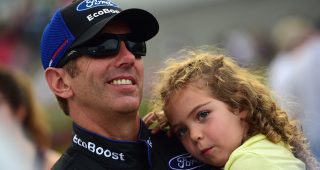
For Greg Biffle, the incessant dedication to his work was all play.
That‘s what possessed a future champion and NASCAR Hall of Fame nominee to start a chassis shop as a teenager — four years before he even raced a Late Model, much less won a race.
Advertisement
“I thought, ‘If I can build race cars all day and not have to work, I’m going to be in heaven,‘ ” he said. “So that‘s what I did.”
Biffle‘s vision of heaven was a workaholic‘s dream.
For the better part of a decade, he toiled nonstop straight out of high school — starting as a fabricator, working six-day, 60-hour weeks at a pipe welding company. After socking away $20,000, he switched to a job at his parents‘ steel company and slightly reduced his working hours.
But he never took a day off from racing.
Biffle slept four hours a night while spending five months (and a large chunk of his savings) on a Street Stock whose gorgeous precision handiwork caught everyone‘s eye in its debut among a 70-car field at Portland Speedway in Oregon.
Advertisement
“People said, ‘Who the hell are you and where‘d you get this car?‘ ” Biffle recalled. “I said, ‘I built it.‘ It wasn‘t a big deal to me, but suddenly, everyone wanted me to build them cars. You didn‘t have to tell me that twice. So I took all my money and started building race cars.”
After his death Thursday at 55 in a plane crash, Biffle, the only driver ever to win NASCAR Truck and Xfinity championships and finish second in the Cup Series, was memorialized in many ways.
He was prodigiously talented with a loose race car, outdueling the best of his generation by racing on the absolute limit. He was a selfless teammate and doting father. He had a remarkable second act as a renowned humanitarian and philanthropist who made national headlines by flying countless helicopter sorties to western North Carolina regions ravaged by Hurricane Helene (and his foundation also had rescued thousands of dogs long before that).
All of the accomplishments were rooted in the simple tenet that his hard work could overcome any obstacles.
Advertisement
“I’m kind of a self-made guy,” he once said. “I like to do things on my own.”
Biffle will be remembered as one of the last of the true blue-collar racers in NASCAR.
It‘s a line of stars perhaps best embodied by homebuilder-turned-driver Harry Gant, another late bloomer who once won a Cup race on a Sunday and celebrated by constructing an addition on his garage Monday.
The same sense of purpose drove Biffle, who would think nothing of tinkering with a home improvement project the day after taking a checkered flag.
“Some people call me the last driver’s driver,” Biffle told USA TODAY Sports in 2006. “I’ve heard that. The David Pearsons, the Dale Earnhardts. That’s how all these Cup drivers got here, like Sterling Marlin, Ricky Rudd and whoever. I came up like a normal driver. I do take a lot of pride in that, but I wouldn’t have minded getting (to the Cup Series) at 20, either.”
Advertisement
Generational and societal shifts have erased the path to Cup that was taken by Biffle, who started his racing career as an adult and caught a big break in his mid-20s.
The racing phenoms of the 21st century are in go-karts by 5 years old. A superstar emerging from obscurity in post-adolescence now would be considered a remarkable story.
But such a narrative still would have a hard time topping the force of will and self-determination in Biffle, whose early life was singularly guided by a manifest destiny in motorsports.
At 19, he started J&S Racing (named after his parents, Jack and Sally Biffle) with longtime friend Rodger Ueltschi. Their chassis business made good money — generating a few dozen cars and more than $150,000 annually during the mid-1990s — but Biffle plowed it all back into his Late Model while living in a double-wide trailer in Vancouver, Washington, and driving a battered old Ford pickup truck.
Advertisement
He and Ueltschi worked weekdays from 7 a.m. to 7 p.m. on their chassis shop‘s customer cars. Then they‘d wrench on Biffle‘s race car until midnight.
Their weekends were spent racing at two tracks four hours apart — Friday at Portland Speedway and Saturday at Tri-City Raceway. They‘d arrive home from Portland at 1 a.m., wake up at 6 a.m. Saturday morning to work on the race car until noon, drive to Tri City and return at 5 a.m. Sunday. They were up by 11 a.m. to repair customer cars.
Sleep deprivation had little effect on Biffle, who once won 57 of 60 races at Tri-City and 30 of 37 at Portland.
“There were some nights we didn’t have enough gas to get back and forth to Tri-City,” Ueltschi once said. “But it paid $800 to win, and that would get us home.”
Advertisement
Yet it still wasn‘t enough to fund Biffle‘s long-term career aspirations. With J&S Racing serving as his car‘s sponsor and parts supplier, he searched for other revenue streams.
A friend convinced him to chip in $50,000 and partner on a revamped bar and grill that specialized in microbrews. It meant shouldering a half-million in debt, but there was enough growth potential to provide a touring series budget for Biffle.
“It made business sense and sounded fun,” he said.
But six months to the day after Biffle became a quasi-restaurateur, he received a cold call from Geoff Smith on the recommendation of 1973 champion and analyst Benny Parsons, who raved about watching Biffle dominate a 1997 winter series in Tucson, Arizona.
Advertisement
Roush Racing was offering a golden opportunity in NASCAR virtually sight-unseen.
Ever the “Prove It” guy, Biffle hung up on Smith, looked up the Roush Racing president‘s phone number and then called him back to verify authenticity.
1998: Greg Biffle (C) with car owner Jack Roush (L) at a NASCAR Truck Series race. This was Biffle‘s first season racing Fords for Roush in the series and, although he would go winless in his first year, Biffle would go on to score 16 Truck victories before moving full-time to the NASCAR Busch Grand National Series in 2002. (Photo by ISC Images & Archives via Getty Images)
That started a nearly three-decade career with Roush and ended his time as a driver-owner-sponsor whose entrepreneurial spirit and boundless work ethic were well-suited for grassroots racing but had limited prospects for high-dollar advancement.
“The more money I could make, the more racing I could do,” Biffle said. “I was supporting my habit. It was easier to work hard and make money than it was to put on a polo shirt and knock on doors to solicit money from (sponsors) because I didn‘t know how. I had no marketing background. I can tell you how to put a motor in a car, but I couldn’t put a presentation together to save my life.
Advertisement
“And I have a hard time bullshitting people. I couldn‘t do that part of the business.”
As noted in the endless tributes after Thursday‘s tragedy, Biffle‘s complete lack of pretense was adored by fans, media and his peers.
In the no-nonsense style of someone who had spent a lifetime in manual labor with tight deadlines, he was one of NASCAR‘s most unvarnished straight shooters and often was candid to a fault.
After his fourth and final win at Michigan International Speedway in 2013, Biffle apologized for a radio transmission in which he celebrated a crash by Jimmie Johnson (who was trying to catch the leader).
Advertisement
During a late 2000s interview in his No. 16 hauler with longtime racing journalist Brant James, Biffle was grumbling about his Ford‘s lack of performance and his frustration with contract extension negotiations. Team owner Jack Roush entered the lounge mid-interview, but Biffle never stopped airing his grievances during the stream of consciousness.
“He is very transparent in a positive way,” Smith once said of Biffle‘s blunt manner. “If something’s not working right, he talks about it.”
Well, naturally, he would.
Because working is ultimately what mattered most to Greg Biffle.
