The German brand Deuter has been around for well over 100 years, and offers a huge portfolio of hiking, camping and outdoor products. Here in the UK, though, they are best known for their rucksacks.
They have specific packs for almost every sport and occasion, and so, of course, have a variety of bags for use on a bike. The Compact 14+3 sits roughly in the middle of the range in terms of size and is aimed at mountain bikers, gravel riders and commuters, with enough capacity for a decent day out but probably not quite enough room for overnight trips.

Plenty of space for long days out
(Image credit: Andy Jones)
The question as to whether a backpack or on-bike luggage is better is a personal one, and depends very much on the type of riding and specific use case. A backpack might be preferred for more technical riding, where weight on the bike (especially a large, ponderous saddlebag) can have a detrimental effect on the bike’s handling, whereas bikepacking-style bags are probably better for longer rides on easier terrain when a pack might become uncomfortable. Smaller riders might also need to use a backpack if their frame doesn’t have room for a frame bag, and some commuters will value the versatility and convenience of a backpack, especially if their journey involves some walking or public transport as well.
Construction
As you’d hope with their long history, the Compact 14+3 is clearly well-made and carefully thought out, with plenty of useful touches.
Firstly, as the name implies, the bag has a capacity of 14 litres, with the potential to expand the main compartment by an additional 3 litres by undoing the 360° zip. This means that smaller loads can be carried close to the back for better stability, whilst there is still the potential to add extra kit should the need arise.
The Deuter Airstripes back system is comprised of soft, open mesh over firm foam with ventilation grooves on either side of the spine and a large, open channel down the centre for airflow. The inside of the straps also uses the same soft, padded mesh, whilst the outside of the straps features a small tab for holding a pair of sunglasses. As well as a chest strap with a built-in whistle, there is a padded waist belt with a zipped pocket on either side.

The soft, open mesh is comfy and breathable
(Image credit: Tim Russon)
The outside of the bag is pretty simple. There are two reasonably deep stretch mesh water bottle pockets, a zipped lumbar pocket and two compression straps. These straps can be used to attach a helmet (full-face or normal) as well as for stabilising the load. There is also a hi-viz rain cover stashed in a zipped pocket at the bottom of the backpack.

The straps can be used to carry a helmet
(Image credit: Andy Jones)
A long, U-shaped zip gives access to the main compartment, which has a water bladder sleeve inside it (and is the compartment that can be expanded by 3 litres). There is a printed panel inside this section that details a few safety and first aid procedures, which is quite a nice idea, although I’d probably rather not be relying on my bag for medical advice!

(Image credit: Tim Russon)
The smaller compartment contains a zipped pocket with a key clip, two wallet or phone-sized pockets and two deeper mesh pockets.
All very nicely executed with good build quality.
The claimed weight is 860g, although my scales registered 915g, and there is only one back length available, which is normal with packs of this size. It is available in three colours: Ink-Ashrose, Graphite-Shale and Savanna-Dune.
The ride
Carrying kit on a bike is always a bit of a compromise, and I’ve seen fashions cycle through rucksacks, bum bags, saddlebags and back to backpacks again. At 13 / 17 litres, the Deuter Compact is aimed at adventurous day trips rather than quick local loops or multi-day epics, although clearly that depends on whether you pack light or heavy.
I used it on a few gravel and mountain bike rides in the Peak District as well as some urban errands; it was pretty faultless throughout. I guess deuter doesn’t market it as a commuter pack because it doesn’t have a laptop sleeve, but other than that, it would be fine for carrying a few tools, spares, work clothes and a sandwich to the office as well.

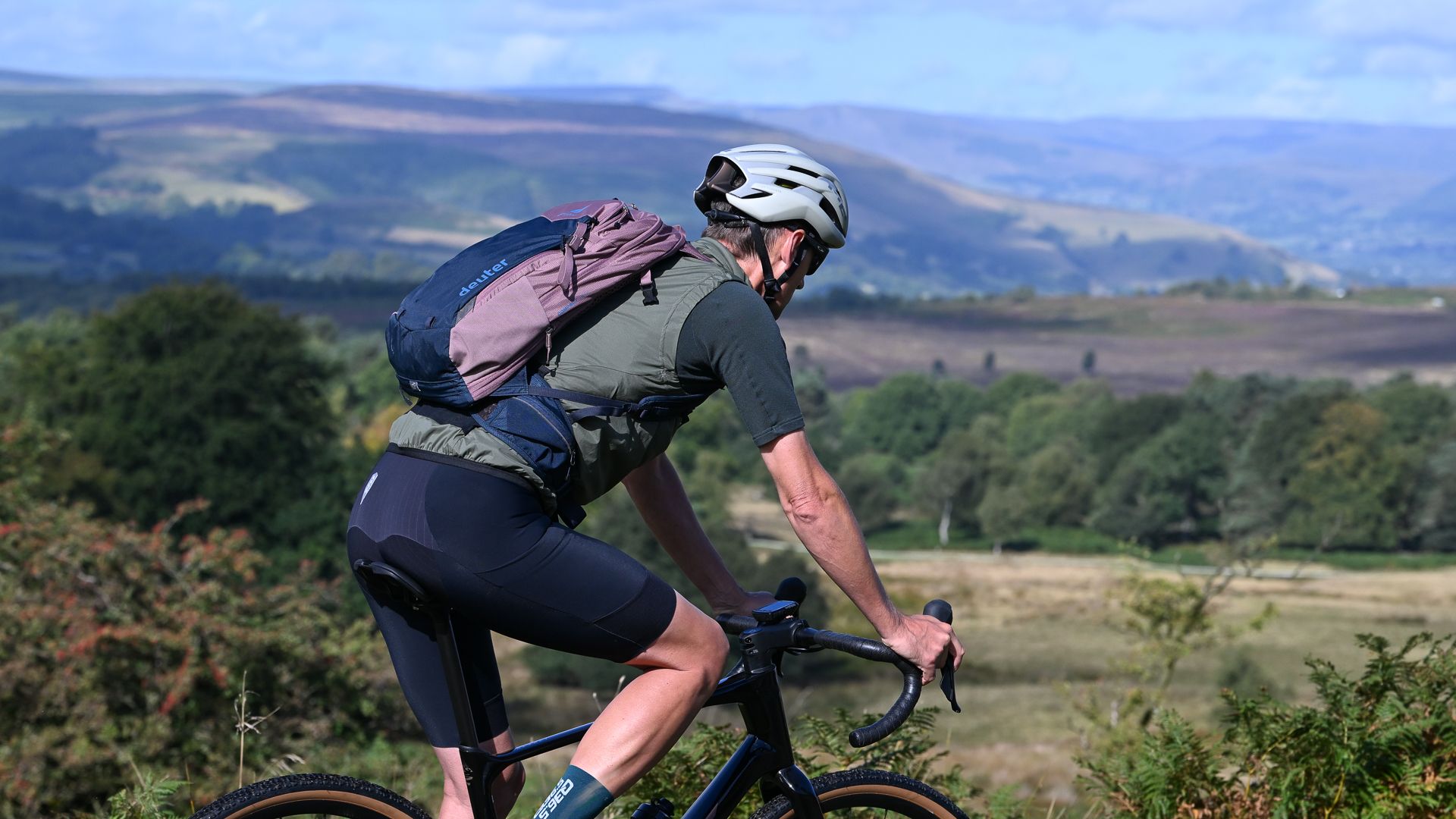
The pack sat low enough down not to be obtrusive
(Image credit: Andy Jones)
In use, it was pretty unobtrusive, comfortable and close-fitting (unlike the Thule Paramount). The straps did a decent job of keeping it stable and preventing it from banging into the back of my helmet on steeper descents, whilst the back panel was as breathable as could be expected. Which is to say, nowhere near as good as not wearing a pack, but reasonable enough that it wasn’t unpleasantly sweaty.
It was nice not to ration the amount of gear I was taking with me, especially on changeable days when getting wet or cold was a concern, and the internal pockets did a good job of allowing me to organise my kit and keep the grubby tools away from my clean extra layers. I didn’t need to use the expansion zip at all, but the potential for extra capacity was nice to have.

Comfy on and off the bike
(Image credit: Andy Jones)
I also used the pack as a more general bag for travelling, and the design and carrying system were versatile enough that it was still very comfortable and didn’t look out of place on the train or in a city centre.
Value and conclusion
In fact, it is this versatility that is the Compact 14+3’s strongest point; many bike bags look and feel a bit strange off the bike, but the deuter is perfectly good to use anywhere. Its RRP is £110, so it’s very reasonable when you consider that many similarly sized bikepacking bags cost more for less versatility.

Quality construction and versatility make the Compact 14+3 a good option
(Image credit: Andy Jones)
For me, though, a rucksack of this size is not something I’d want to ride with regularly, but it is a great option when you need to carry a few more layers or extra provisions on rides and a jersey pocket or small saddlebag just won’t cut it. Whether it’s better to use a rucksack or a large bikepacking bag on these occasions is up to you, but you won’t be able to pop to the gym carrying the bikepacking bag!
I’m giving it full marks because it does what it says on the tin very well and at a sensible price. Whether you should have one for your gravel riding is up to you.
