The new Studies Database
By Martin Minski
Fellow students, whether composers or solvers, have appreciated it for years, but it is far less known to the wider chess community: since 1991, there has been a database containing exclusively studies. It is the result of the tireless work of Harold van der Heijden, a Dutch collector of endgames and studies, editor, chess organizer, and chess composer.
After completing his education at a polytechnic school in 1980 and his military service, Harold began working as a research and development technician at a veterinary company in 1982. He worked there for over 40 years until his (early) retirement in July 2025. After receiving his doctorate from Utrecht University in 2008, he became head of the company’s R&D laboratory, where he was active in both management and research. He is married and has two sons.
Harold van der Heijden has been editor-in-chief of the English-language chess studies journal EG since 2007. In 2001, he was appointed an International Arbiter for Chess Composition, and in 2012, he was awarded the title of FIDE Master of Chess Composition. Ten of his best studies have been included in the FIDE Albums to date. In the coming years, he intends to compose more studies and aims to achieve the title of International Master of Chess Composition.
 Over the past few decades, Harold van der Heijden has amassed the largest collection of chess studies in existence. It is accessible to a wide circle of experts and amateurs worldwide and contributes significantly to the further popularization of chess studies. The data is in PGN format, so the moves can be easily replayed with virtually any chess program. It can be ordered here.
His study collection is an indispensable tool for both composing and judging tournaments, particularly for researching predecessors. On the other hand, it’s simply wonderful to browse through it, replay and enjoy the many small and large masterpieces, or improve one’s endgame skills by solving the studies. Every study enthusiast should definitely acquire this collection! The 7th edition of the database, known in technical jargon as “HHdbVII,” has been released in December 2025.
The number of studies has increased fairly consistently since the completion of each version (HHdbI-HHdbVI). Approximately 1,000 new studies are published annually in journals, books, or online, all of which are included in his study collection. Now for the first time it contains over 100,000 studies. In addition to new studies, Harold also adds older studies and many information updates on works already in the database. Harold estimates that a total of approximately 4,000 endgame study tournaments have been organized over time.
The database also contains incorrect studies that have been published. Harold is occasionally asked why he doesn’t omit these studies. The point is that a study is initially published, and only later does it turn out to be incorrect. If such a study is omitted, it will later reappear (perhaps in a secondary source), and the inaccuracy will remain unknown.
Another question he is regularly asked is whether all the studies are computer-tested. This is not the case. Due to the increasing power of chess software, this would largely have to be repeated with each new generation of hardware, software, and Syzygys.
It also happens that studies previously deemed incorrect ultimately turn out to be correct. A famous example is the Behting study, which we will describe in a separate article. About ten years ago, this study posed a challenge for most computers. Today, Harold’s new computer (with many 7-EGTBS available for calculating the variations) analyzes it in an acceptable time and arrives at a draw.
So why doesn’t Harold analyze all the studies with his new update? Well, if he only needed 5 minutes per study, it would take him years! This also shows us that 100,000 studies is a truly massive number.
When Harold imports “new” studies, he always enters the moves himself. He doesn’t import PGN files created by others because he has strict “rules.” For example, a sub-variant with a white deviation should always end with a black move or a white move that stalemates Black.
A future edition could include cross-references between studies (e.g., corrections/versions, anticipations, etc.) and lists of secondary sources (books, journals). Harold experimented with this and implemented it in 9,000 studies. However, this took him a whole year, and it was too complex to implement in HHdbVII.
Building and maintaining the database represents a huge time commitment. “Over the past 37 years, I’ve certainly worked on the collection for an average of three hours a day, about 300 days a year. That adds up to 33,000 hours. As a commercial project, this would be a hopeless undertaking—no one would pay for this work. But it’s my hobby.”
The Dutchman remembers as if it were yesterday how he began collecting his first studies in a computer file. In his booklet “Pawn Promotion” (1996), he wrote: “I collected studies with underpromotions on index cards. I drew the diagrams with pen and pencil and pasted in the pieces, which I cut out from boring over-the-board chess games in chess magazines. The advent of home computers in the 1980s represented a huge leap forward. I programmed my own software to save the positions and made the first rudimentary attempts to digitize my underpromotion index. On October 15, 1988, the very day the ARVES study association was founded, Bas de Heer gave an impressive lecture on computer databases for endgame studies, which at that time were still in the realm of fantasy. The following morning, I began building a database of ALL endgame studies, and since then I have spent several hours a day working on it.”
Harold van der Heijden was able to publish the first version of this database three years later, in December 1991. It contained exactly 23,358 studies.
The goal, of course, is for this database to unite together all endgame studies ever published. The hero of our report estimates that it is currently at about 90 percent. He suspects gaps exist in the countless daily and weekly magazines of the Soviet Union, which often included a chess column and also ran study tournaments.
An important free tool for working not only with this database is the Chess Query Language by Lewis Stiller and Gady Costeff. This is an extremely powerful scripting language that allows one to search Harold’s database of 100,000 studies for specific positions or maneuvers in just a few seconds.
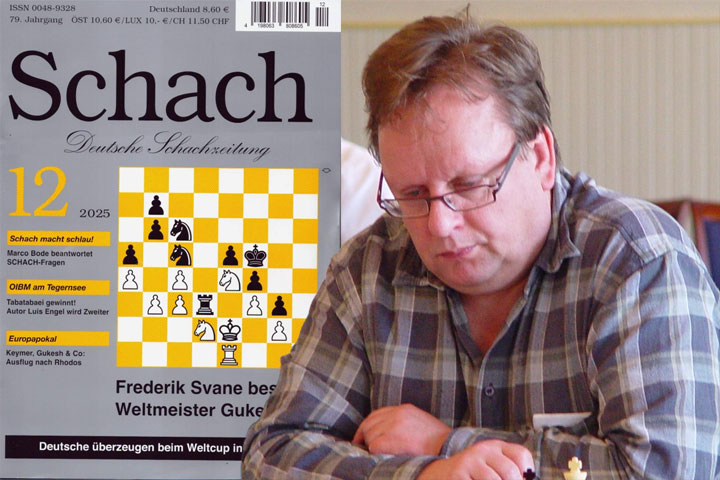
 The above article was translated from a two-page story in the German chess magazine SCHACH and reproduced with kind permission of the publishers and the author:
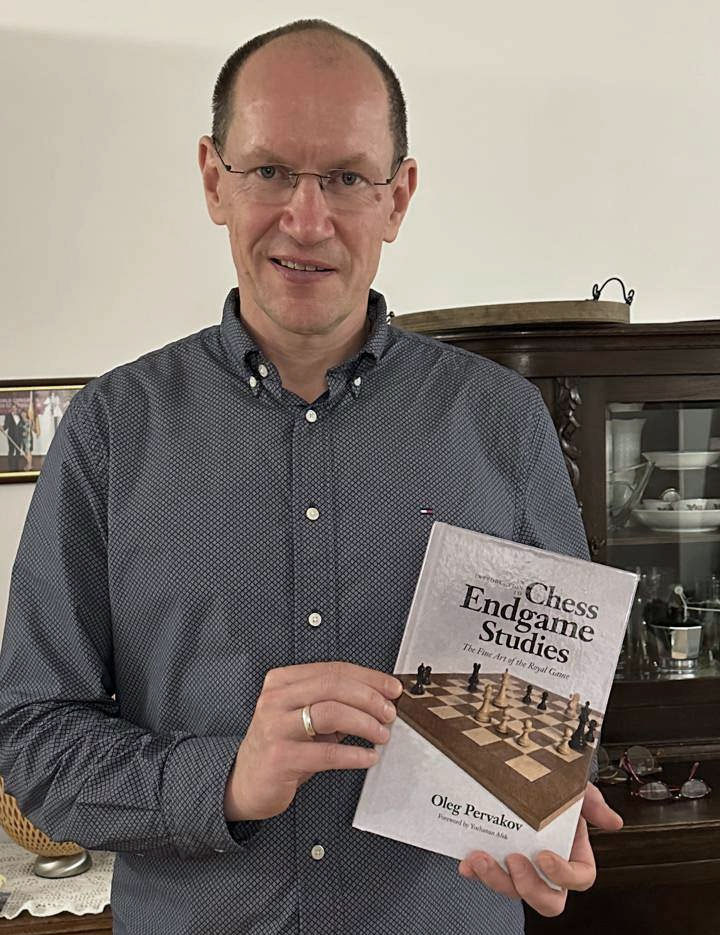
Martin Minski, a German composer of chess endgame studies, known for highly tactical and artistic positions. He is also a mathematics teacher, combining his teaching career with composing chess studies.
Minski has composed hundreds of endgame studies, many of which are published and prize‑winning. He holds the title Grandmaster of the FIDE for Chess Compositions (since 2020) and is an International Judge for study composition (since 2013).
