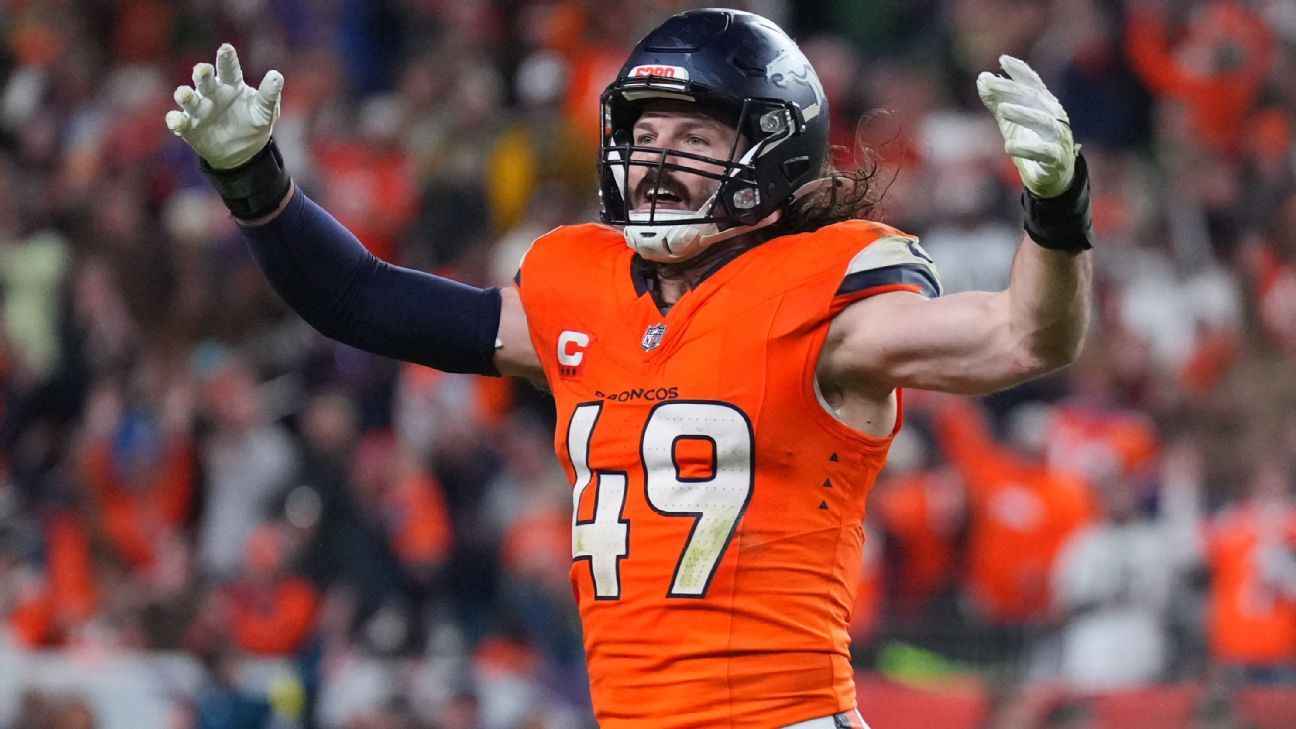
ENGLEWOOD, Colo. — “Cancer … the word still freaks me out a little bit,” Denver Broncos linebacker Alex Singleton said. “And then you hear it … and your mind just goes.”
On Monday, Nov. 3, Singleton and his wife, Sam, listened intently as a doctor explained that Alex almost certainly had testicular cancer. The cancer was discovered when a random NFL drug test flagged an abnormally high level of a hormone (hCG) in Singleton’s sample.
The ensuing surgery was scheduled four days later on Nov. 7. Scenarios unfolded: worst cases, best cases, the forks in all the roads that might be on the horizon as they hoped the cancer hadn’t spread to other parts of the body.
“You do hear the word cancer, it is shocking, so shocking,” Sam Singleton said. “… You go from not even thinking about something like that, living and working and everything in your day, and then you’re listening to [doctors] tell you about cancer.”
Alex Singleton is in his fourth season with the Broncos. And for the 15th time this season, he will line up at his customary middle linebacker spot on the Denver defense on Christmas night against the Kansas City Chiefs at Arrowhead Stadium (8:15 p.m. ET, Prime Video).
Singleton leads the Broncos — who continue to chase the AFC’s No. 1 seed — with 124 tackles. If that holds, it will be the third time he has led them in the category in the past four seasons. But he now does it as a member of a club he never imagined he would be in. Singleton is now a cancer survivor, part of a legion who know the shock, anger, fear and lingering emotions from the moment the word is spoken.
“Sounds weird, maybe, but I see my daughter laughing, sit and talk with my wife, and there is a little more, a different, like texture to it,” Singleton said. “I had surgery, I’ll do all the checkups and bloodwork for as long as I need to, but it opens your eyes to what you should think about and worry about. It really just opens your eyes.”
THE FIRST DOMINO fell Oct. 31, when Singleton — as part of the NFL’s random drug testing program — was notified his urine test had shown elevated levels of the hormone hCG.
“He’s not taking, injecting anything that would do that, so we’re confused. It’s late, so we start Googling everything,” Sam Singleton said. “If you’re a woman, hCG levels likely mean you’re pregnant, but if you’re a guy … and you’re not injecting it, everything said, ‘Well, then you have testicular cancer.’ That’s it, the only two options we can find.”
What followed was what both Singletons call “the whirlwind.” Alex visited a urologist the Monday after the Broncos had beaten the Texans 18-15 on the road in Week 9 and was told cancer is a possibility — “basically 95%,” Alex said. He was immediately sent to an oncologist, and the Singletons scrambled to their car to make that next appointment, with Alex already on the phone.
“We had like 15 minutes together, in the car on the way to the next doctor to talk about me having cancer, and I was mostly on the phone with the other doctor’s office while we drove there,” Alex said.
Added Sam: “We were just running around and didn’t really, really sit and talk about it together for a few days.”
They were told by the oncologist that the tumor was cancerous and that surgery will be scheduled for Friday, Nov. 7, the day after the Broncos were scheduled to play the Las Vegas Raiders in Empower Field at Mile High.
“The football player in me is asking, right then, to the doctors, to my wife … ‘Can I play maybe what will be my last game?'” Singleton said. “I think if they had told me that Wednesday night cancer was in my entire body, I still would have played [against the Raiders]. … If they had been like Friday morning you’re having surgery and you’re starting chemo Saturday [two days after the game], I would have been like ‘I’m playing.’ Just to finish it on my terms if that was really it for football.”
Surgeons removed the tumor the day after the Broncos beat the Raiders 10-7. Singleton finished with nine tackles that night, smiling through postgame interviews and giving no indication of what awaited him the following morning. Only a smattering of teammates and Broncos officials knew Singleton was set for surgery. Broncos inside linebackers coach Jeff Schmedding said Singleton told him during halftime of the Raiders game after “somebody said something that hinted at it.”
Both Alex and Sam Singleton said one of the most difficult things at that point was that so few people around them knew what was happening. As Alex put it, “We’re just kind of going through our days, trying to look like everything was OK, doing what we normally do.”
Sam said she attended an event for the Special Olympics — one of Alex’s primary off-field endeavors — and was trying “to hold it together” while people asked her about holiday plans in the weeks ahead.
Three days after the surgery, Alex officially told Broncos players, coaches and staff members about the cancer diagnosis, surgery and what was ahead for him in an emotional team meeting. Shortly after the meeting, he also posted a message on his social media accounts, which made his cancer diagnosis and surgery public.
Still, even as Singleton said he was set to go back to work post-surgery, he and his wife didn’t have the answer they were waiting to hear — that the cancer had not spread to other parts of his body. Finally, after a CT scan, doctors told Singleton that they believed it was contained. But Sam Singleton said she wanted the information in her hand, “to see it with my own eyes.”
“That was the worst part about it for me,” she said. “You’re just thinking, ‘Did we catch it soon enough, did it spread, what happens if it did?’ You’re hearing how if it spread, it likely went up the spinal cord and can go all over. That if it spreads, that’s a whole different conversation for all of us.
“That week was so horrifying. We didn’t find out totally, for sure, until after surgery that following Wednesday [that] the cancer had not spread. I just needed to see the lab results. All of them.”
SINGLETON STARTED IN the Broncos’ 34-20 loss to the Jacksonville Jaguars this past Sunday, finishing with a season-high 13 tackles. He played every one of the Broncos’ 70 defensive snaps and remains a huge part of one of the NFL’s top defenses.
“It’s kind of crazy to think about, but you’re thinking he had cancer,” Broncos linebacker Justin Strnad said recently. “We’re around him every day, and he had surgery for cancer, you just think how many people out there deal with all of those things, but he’s right here in front of us.”
Singleton said in recent days, even as he moves through his usual routines in and around the team complex, he still reflects that he missed only one game — the Broncos’ Nov. 16 win over the Chiefs. He said those weeks felt like months in some ways and “that whirlwind” in others.
“I call him Jon Snow (a “Game of Thrones” character who shares Singleton’s distinctive locks), but Alex, man … think about it, had cancer and played. Cancer,” Broncos defensive tackle Malcolm Roach said. “We all want him to be healthy and do what he needs to do with the doctors, but when he told everybody he had surgery … I think everybody was blown away, but also like ‘Oh, it’s Alex.'”
Since his announcement, Singleton said his social media accounts, phone and face-to-face interactions with people he has never met before have been filled with the commonality of cancer. Battalions of people who either have or had cancer themselves or know somebody who does/did — Singleton said it feels like cancer has one degree of separation from so many in a way he had not seen before or understood.
“Eye-opening into that part of life, of the world,” Singleton said. “Just how many people out there, so much worse, so many situations, but out there fighting.”
His first game back on the field was Nov. 30 against the Washington Commanders. After the game, Singleton said an array of coaches and players from the Commanders he had not met made it a point to find him. It’s a scene that has repeated over the Broncos’ past three games.
“People he’s never met before — coaches, players, fans, people in all kinds of jerseys just saying they were thinking about him,” Sam Singleton said. “But I think I was the most nervous about the Commanders game … because I just didn’t want anything to happen with his incision where they had done the surgery; 13, 14 days post-surgery he’s playing, and maybe it all just kind of sunk in.”
THIS PAST THURSDAY, Singleton was announced as Denver’s Ed Block Courage Award winner, awarded to players who are deemed role models for inspiration, sportsmanship and courage. The award is chosen by the players. It honors character and effort in players who have overcome injuries or other challenges in their lives.
And now Singleton wants to continue to inspire. He plans to “be a voice” on cancer, and testicular cancer in particular, in the months and years ahead. He hopes to use his circumstances to help encourage people to go to the doctor or ask for help.
“It’s the rest of your life, you know?” Singleton said. “So, it’s hard to talk about it, about that part of your body or whatever, you don’t want to talk about it. So, don’t talk about it — just go get checked. You’ve got people around you who need you to go get checked for anything. … I hated going to doctors until I needed to go to one. So, skip the hating part and go.”
Singleton, 32, knows that he has already beaten most of the actuarial tables on the football front. But in a season when the Broncos will have the opportunity to chase a coveted Super Bowl ring, it all now fits a little differently.
“I could have been done with football forever, so I’ve felt those emotions already, I know what they are,” Singleton said. “I’ve been given a perspective on the game that, at 32, was tough to hear right then, and a tough way to get it, but it’s still nice to get.
“A lot of us say the game feels like a job at some point, but I can say, without a doubt now, it’s the opposite of that. I still love football so much, and before this I’ve always said I’ll appreciate every second of it, but I guess what that appreciation was even two months ago compared to now is no comparison.”
Singleton hopes by answering questions when asked and simply talking about how an NFL linebacker had cancer tossed on to his doorstep will help others also talk about it. He, and those around him, know he has a unique platform to make an impact.
“You know, I’ve been blown away [by] how he’s handled it. Obviously people see the competitor, but he’s one of the best people you’ll ever meet,” Schmedding said. “His vibe is contagious. He truly lifts people up just how he goes about his day, maybe even a little more now.”
