Symmetry and symmetry breaking
by Christian Hesse
Symmetry is one of the universal principles in the cosmos. It describes the phenomenon whereby an object or system remains unchanged under certain transformations, such as reflections, rotations or translations. Symmetry lends beauty, stability and comprehensibility to many structures.
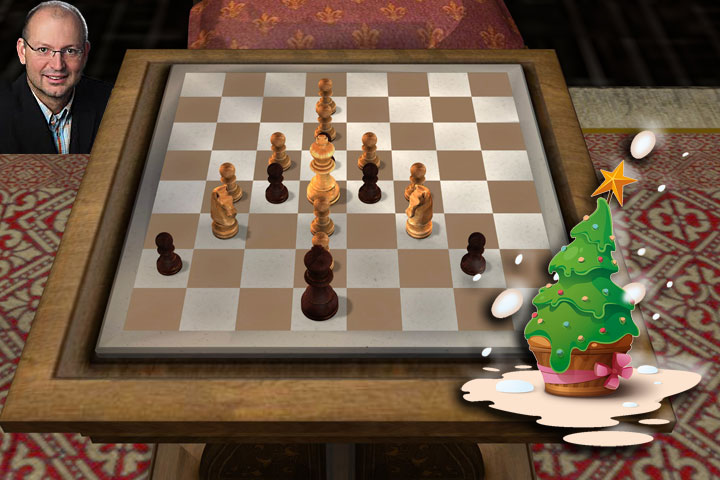
The following chess problem by Thomas Dawson from 1924 also contains an axis of symmetry. It is the e-line, relative to which the arrangement of the pieces is mirror-symmetrical. Because of this bilateral symmetry, one might think that for every solution there is also a mirror-image solution. However, this is not the case.
2025 Christmas puzzle 1
Thomas Rayner Dawson, Falkirk Herald 1924
White to play and mate in two
If a problem had multiple solutions, it would be artistically devalued. Composers of chess problems of this type value the uniqueness of the solution.
The uniqueness of the solution is based here on a tiny symmetry break. To discover it, I recommend looking at the past of the position and asking yourself what Black’s last move must have been. The answer to this question is related to which white pieces captured the black pieces that are no longer on the board. Yes, seriously!
Hint: Looking for Black’s last move, we see that it obviously cannot have been made by the pawns on b7 or h7. The e4 pawn is completely blocked and cannot be considered for the last move either. Nor can the black king have made the last move. This is because it would have had to come from either d8 or f8, but there it would have been in check by the pawn on e7, when a knight delivered check, or by a knight when the e7 pawn captured with check.
The king could not have come to e8 from d7 or f7 either, as it would have been in check on these squares, but there was no way for the white pawn on e6 to deliver this check in the preceding move.
Therefore, the only possible last moves for Black are d7-d5 and f7-f5. And indeed, after …d7-d5 follows cxd6 (en passant), followed by d6-d7, a flawless checkmate (variant 1, which is on the board). But similarly, after …f7-f5 and gxf6 (en passant), the move f6-f7 also results in checkmate (variant 2).
But don’t the above considerations destroy the required uniqueness of the solution? No, they don’t. In fact, the problem has only one unique solution. We ask you to find out why.
2025 Christmas puzzle 2
Pal Benko, Christmas Tree Puzzles 2010

White to play and mate in two
Above is the famous Christmas puzzle that Pal Benko sent us fifteen years ago. Beautiful crafted with a surprising key move. Try solving it with a chess board and pieces, only that way you will enjoy the solution.
Or move the pieces on our live chess board. Black will defend, thwarting any moves that do not result in a mate in two.
Please do not post any solutions in our feedback section below. Let other readers enjoy them. Please submit your solution feedback here. We will reveal the solutions to all Christmas Puzzle in the first week of January 2026.
 Prof. Christian Hesse is the author of a number of chess books, most recently, (together with Frederic Friedel), Chess Stories, where he has created some amazingly deep and entertaining connections between chess and mathematics, spanning the range from the first appearance of Fermat’s last problem in chess to a magic trick on the chessboard based on Fibonacci numbers. He has also created an entirely new genre of chess problems, the “Zen Chess Logicals”, that have been described by Garry Kasparov as adding a whole new dimension to chess studies and logic.
Purchase options
