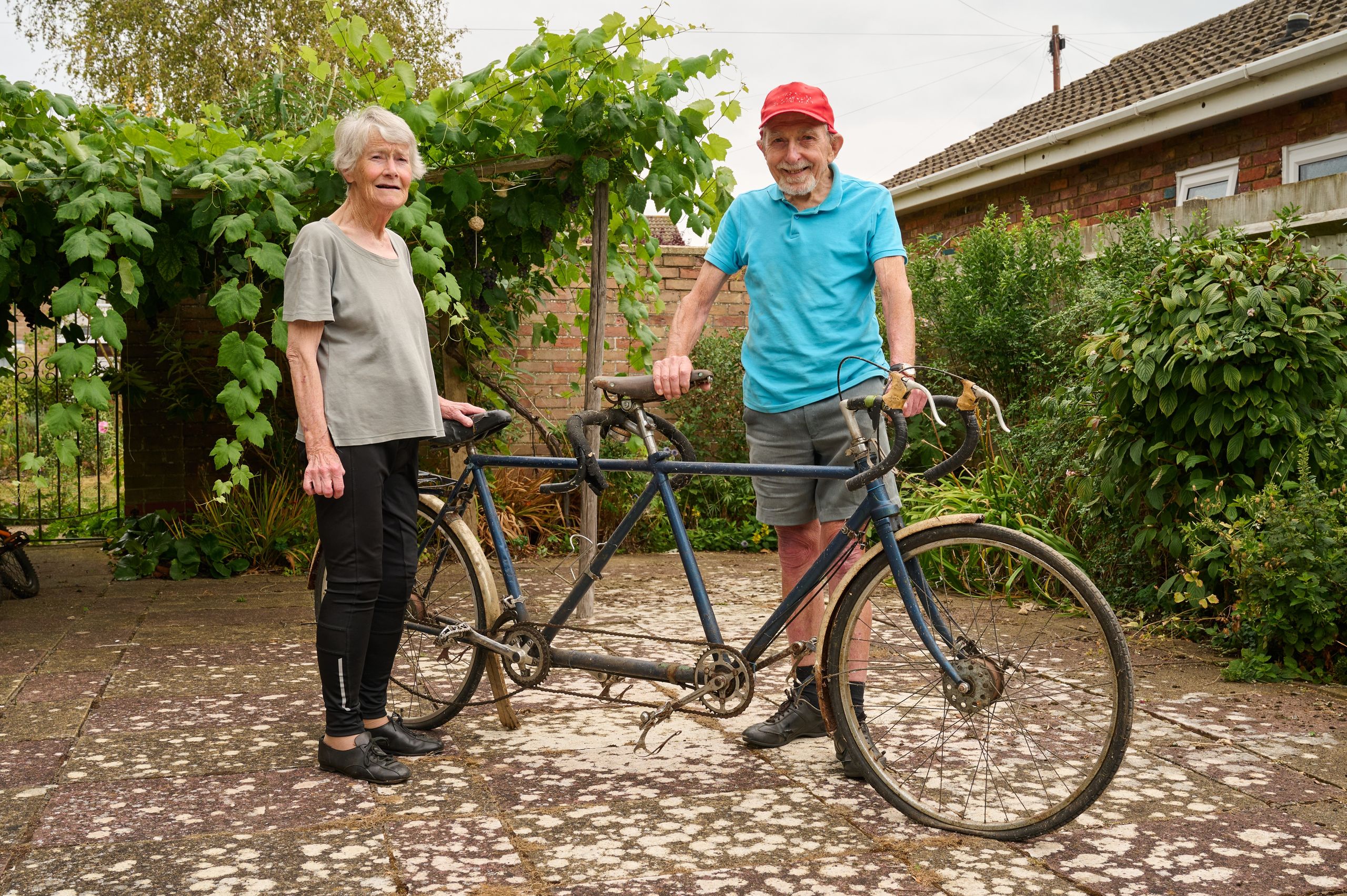
The story of the first couple to ride a tandem around the world begins with a car crash on the banks of Loch Lomond in 1970. Colin and Veronica Scargill had married the previous year, and were on holiday when a car ploughed into their van. Veronica, who was 25, suffered a broken femur, which left her leg in traction for 12 weeks. “She couldn’t bend her knee at all during that time,” says Colin, who was 29. “One of the things recommended for getting it working again, once the plaster was off, was cycling.”
As a member of Stevenage Cycling Club, Colin had previously raced time trials on a Hetchins fixed-wheel track bike, but his wife had barely done any cycling. “I happened to be out riding one day when I was overtaken by the Pendletons [Max and Pauline, later parents to Olympic gold medal-winning track cyclist Victoria] on their new tandem,” recalls Colin. “They told me the boy who’d bought their old one was now selling it, and that’s where I got the idea of how to get Veronica’s knee working again. I bought the tandem for £18.”
Shortly after becoming the owners of the 1934 Selbach machine, they attended a slideshow about a father and daughter’s tandem trip to Yugoslavia and were inspired to take their own cycling holiday to that country the following year. “We’d also read Dervla Murphy’s book Full Tilt [about her 1963 bike ride from Ireland to India] and decided we’d like to do something similar but longer – a ride around the world,” Colin says. “We had no idea whether it had been done before, we just wanted to do it. To get some more practice with camping and cycling we went to France, and by the next year we were ready.”
In early 1974, a miner’s strike had reduced Britain to a three-day working week, power cuts were the norm and the internet was just a mad scientist’s dream. Colin lost his job as an engineer and the couple decided to use his redundancy pay, plus the compensation from the 1970 car crash, to fund the trip. “We made a rough guess that £1 a day each would be enough for our budget,” says Colin. (They later calculated that the actual cost of their 18-month trip, including two flights and two ocean voyages, had been £2,300.) On 25 February, they boarded a cargo ship leaving for New York City.
Now aged 84 and 80, Colin and Veronica are relating their extraordinary story from their cottage in a village just outside Bedford. Veronica has been tending their brood of chickens, while Colin has just returned from one of his regular solo rides. More than half a century after their adventure began, they have no trouble remembering it. “We decided to start on the other side of the Atlantic rather than the English Channel, to make it harder for us to consider giving up,” says Colin.
From New York they headed to Canada where Veronica had a list of names of friends and “friends of friends” who they planned to stay with during their journey across the continent. With no internet or smartphones, they had no idea if they’d find passage across the Pacific until they reached the west coast. There were no ships leaving from Vancouver, so they continued south to San Francisco and found a P&O passenger liner sailing to Sydney.
In Australia, they soon realised they’d have to ride up to 120 miles at a stretch without passing any settlements or sources of water – “we’re not big distance cyclists, we averaged 55 miles a day,” says Colin – so opted for the train most of the way to Darwin, from where they had a flight to Singapore booked. “We planned to ride the last 200 miles but then Cyclone Tracy intervened,” he adds. The Christmas Day tropical storm destroyed most of the city and killed 66 people. The Scargills and their tandem were among those evacuated by Hercules military transporter plane. They ended up back in Sydney where they had to reorganise their flight.
Before leaving Australia, they bought a book called Across Asia On The Cheap, the first in what turned into the Lonely Planet series of travel guides. It quickly became their 1974 equivalent of Google. “It covered all the places we’d be going and was our source of information about hotels and local conditions,” says Colin.
From Singapore they cycled to Thailand. They arrived at Bangkok Airport for their flight to Calcutta several hours early and were resting under some shade when a group of youths approached them brandishing a pistol. “They managed to find my wallet which had the equivalent of £23 in it and got away,” says Colin. Fortunately, the policeman who arrived gave them the money they needed to pay their airport departure tax. “He was typical of pretty much everyone we met during our trip – friendly and hospitable. I think it was down to the novelty of us riding a tandem.”

In Calcutta they visited the central post office to collect their mail from the Poste Restante counter. “I’d worked out roughly where we’d be and when so that our friends and family could write to us along the way,” says Colin. “It didn’t always go to plan. In Calcutta they just handed us a big box of letters, some dating back years, and we had to search through it to find any addressed to us.”
Riding across India they relied on the network of “dak bungalows” – cheap, often free, accommodation that had previously been used by government officials. Each night Veronica would write up her diary – which would eventually total 149 A4-size pages to complement the 18 rolls of slide film they shot on their Olympus compact 35mm camera – while Colin bought food from the nearest market.
It was the division of tasks, they believe, that ensured their relationship survived the challenges of the trip. “We split jobs,” explains Colin. “On a tandem, you’ve both got the same objective but one can’t ride without the other. That’s why we never really got homesick – we had each other.”
Veronica adds: “The other thing about riding a tandem is communication. It encourages you to talk. Colin was steering and so had to keep his eyes on the road most of the time, but at the back I could look around and see things and share this information. As the Tandem Club says, ‘riding a tandem is twice the fun!’”
The couple still own the tandem they rode 50 years ago – it lies neglected in their garage, next to the much newer model they still use today.

Back in 1975, at the top of a 2,500m mountain pass in the Himalayas, they stayed in the home of a school teacher who was also a shepherd. “He pointed out Everest to us,” says Colin. Later, in Pakistan, they arrived at the foot of the Khyber Pass and had to sign a waiver declaring they were taking the route at their own risk. During the ascent they noted every labourer at the roadside was carrying a rifle or revolver. “It would have been lovely to take some photographs but we didn’t dare stop,” says Veronica.
They covered much of Afghanistan by bus. “Our guidebook warned us about the security situation. Dervla Murphy had stayed in yurts when she was there but we weren’t quite prepared to take that risk.” When they arrived in Iran, it was a very different place to the hard-line Islamic Republic it would become five years later and remains today. “The people were so friendly and so proud of their culture that they would thank you for coming,” recalls Veronica. “It’s the one country we visited I’d most like to return to.”
From Iran, their route took them through Turkey, Greece, what was then Yugoslavia, Italy and France. “We didn’t realise how keen we were to get home until we passed within five kilometres of Venice and decided we’d skip it and keep going as we could return there any time we wanted,” says Colin. “That was 50 years ago and we’ve still never been.”
It was 14 August 1975, five years on from the car crash, when the couple arrived back in England and disembarked from the Dieppe-Newhaven ferry. There, they were met by a low-key welcome from Veronica’s sister and new husband – completely unaware of how historic their achievement had been. “We were more concerned with apologising to my sister for missing her wedding,” smiles Veronica. “If we told anyone we’d cycled around the world, they’d just ask, ‘Did you have a nice time?’” says Colin. “And we’d reply, ‘Well, that’s 20 years of holidays done.’”
What happened next: how the Scargills secured their place in history

In 1975, Britain had three TV channels, ‘social media’ was the pub, and the ‘internet’ was your nearest library, so it was little wonder that the Scargills’ historic ride went largely unnoticed.
It wasn’t until 1980, when Colin was idly thumbing through a copy of the Guinness Book of Records in his local library, that he realised they might have achieved something special. “Under the cycling records there wasn’t a tandem ride around the world listed, so I thought I might as well apply and see what they said,” he recalls. He’d kept a meticulous record of their journey on P&O headed notepaper (from the ship on which they crossed the Pacific), including where they stayed and their daily mileage, which totalled 18,020. The following year their ride was officially recognised in the 1981 edition of the book.
Today, Colin and Veronica are grandparents of six and still riding a tandem at the ages of 84 and 80. Following a crash on a bridleway near their Bedfordshire home in 2021, which left Veronica with a broken leg, their rides aren’t as long or frequent as previously. Colin, however, still manages solo rides of up to 65 miles on his 1961 Uppadine road bike.
Neither of them has ever owned a mobile phone and they still use paper maps. Their last cycling holiday abroad was to France in 2011, when their only concession to modernity was to let local tourist offices book their accommodation a day in advance.
Reflecting on their place in history, Colin says: “It was nice to be acknowledged, but we hadn’t done it to break a record. We did it because we wanted to. I suppose you could say we learned a big life lesson from our car crash in 1970 – if you have the opportunity to do something, do it, because you might not get the chance again.”
This feature originally appeared in Cycling Weekly magazine on 11th December 2025. Subscribe now and never miss an issue.
