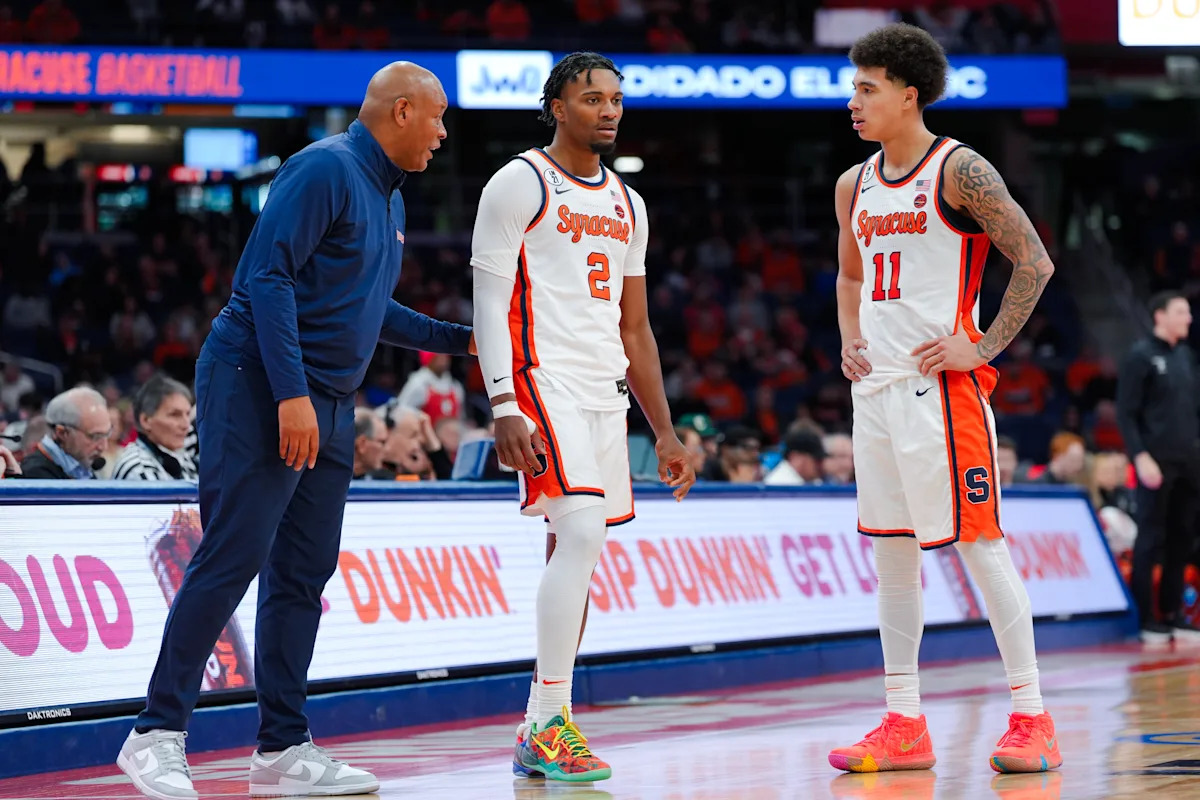
Following the Syracuse Orange’s 76-62 win over Mercyhurst on December 17, head coach Adrian Autry took a defensive tone at the podium. He was adamant that the Orange’s offense is not the problem.
“Nothing is wrong with our offense,” Autry proclaimed.
While Syracuse has followed that up with its two best offensive performances of the season in wins over Northeastern and Stonehill, there are still plenty of Orange fans concerned about the offense.
They’re right to be concerned. It’s a unit that ranks 105th in the country in efficiency at the moment, and in four games against Top 100 opponents, it ranks 135th.
In the half court, Syracuse is 15th in the ACC in points per possession and 11th in scoring percentage (percentage of possessions that end in a score). That discrepancy could be because SU is one of the worst three-point shooting teams in the conference.
In SU’s four high-major games, the team *did* face defenses that all rank in the top 12 nationally, but the Orange faltered, with just .776 half-court points per possession.
The elephant in the room is obviously Donnie Freeman’s absence. It’s not really possible to know how much him not playing is holding the team back. I do believe that he solves certain problems, he’s not a magic potion that will automatically turn Syracuse into a potent offense. If he was, he’d probably be in the NBA by now. It’s also hard to rely on him, considering he’s now had multiple different injuries over his two years of college basketball hold him out for most of the games that he could’ve suited up for.
Now that that’s out of the way, let’s get into a few of the things that popped out on the stats, and a few of the things that popped out on the film.
-
Look how they’re guarded
When coaches are putting together their scouting reports, they’ll deem a ball-handler an “under” if they’re not afraid of that player attempting a pull-up three-pointer. That tells their defenders to go under ball screens when they are set for that player. Going under a ball screen means that the defense has the leverage in a potential downhill drive situation.
Advertisement
Both Nait George and JJ Starling are unders. These are players who are more potent offensively when moving toward the basket downhill than when pulling up for threes. However, both of them have a green enough light to attempt a pull-up three or two when they can. George has attempted the third most three-pointers off the dribble in the ACC so far this season, and the fifth most jump shots off the dribble.
While this shot does go in, it’s an example of how going under ball screens impacts the rest of the action. It looks like Syracuse may be trying to initiate a Spain action between Starling and Kyle, but the defense is just sitting right back, and daring George to take the three by going under the screen.
Off-the-dribble jump shots for non-elite shooters are winning possessions for the defense. Especially with how far beyond the arc George often attempts them from. Looking at the rest of the top six highest-volume off-the-dribble three-point shooters in the ACC, George attempts a significantly higher share of his threes from more than 25 feet.
Important to note that this data is based on all three-pointers attempted, not just off-the-dribble threes. But also interesting to see that 33 of George’s 41 three-point attempts have come off the dribble, many of them thanks to defenders going under, and him having the green light to shoot it.
Advertisement
Obviously, going under ball screens isn’t just a tactic to bait bad shooters into taking threes. It has the additional benefit of making it harder to get to roll man action. Which brings me to my second point.
2. How can you use Kyle?
Syracuse’s most efficient offensive player is William Kyle III. His offensive rating of 120.4 is the highest on the team (aside from Freeman), and his 63.3 true shooting percentage is also tops on the club despite his poor foul shooting.
Is Kyle SU’s most talented offensive player? Absolutely not. He’s not the type of big that you can throw the ball into the post and expect him to work his way through a defender. He gets pushed off his spot a decent amount when he is trying to post up and he doesn’t have a bag of post moves and finishes. Kyle’s game is very much “Run Around, Catch Ball, Dunk Ball,” and that’s okay. But how can Syracuse leverage that?
Advertisement
The idea of Kyle as a roll man catching the ball and not needing to even dribble to slam it home in an empty lane is enticing, but he’s only scored 14 points as a roll man this season. That’s because the Orange have trouble creating those situations where he can catch the ball with a head of steam in an open lane. Because George and Starling are unders, it’s harder for Syracuse to create the traditional pick-and-roll two-on-one that you’re left with when a defender goes over a screen and allows the ball handler to get downhill.
To combat that, Syracuse uses a ton of rescreen actions, which are typically good against unders, because you can readjust where you’re hitting the defender, trying to force him to go over the screen instead. Defenders are more than willing to continue going under screens until they can no longer do so physically.
Maybe even more importantly than the unders though is that when Syracuse can get into the two-man game, the floor isn’t spaced well enough for the lane to be open. Kyle often runs into a bottom help defender in the paint when he collects the ball. It’s why you so often see him stuck around 6 feet from the basket turning toward it as he catches the ball, instead of being able to go straight up. He’ll get fouled in these spots plenty, which wouldn’t be a big issue if he didn’t shoot 48% from the line.
You can see how the rescreen makes it more difficult to go under the second screen, and George is able to get to his downhill drive, but White’s defender is in the paint already, and Kingz’s defender isn’t giving him a ton of respect on the weak side. A great short roll decision maker could throw this lob up to White or kick to Kingz in the corner, but Kyle isn’t a great short roll decision maker. He had one total assist in December.
Advertisement
But why is Syracuse often spaced in a way that this is a problem?
3. Auxiliary shooters + the corner
For as talented as Sadiq White is as a defender and athlete, he has limited Syracuse’s offense while on the floor this season. In Syracuse’s six games against top 200 opponents, the Orange are scoring 15 points per 100 possessions fewer with White on the floor than off the floor. It’s 12.9 points per 100 possessions when you look at the season as a whole.
That makes sense when you consider the types of lineups on the floor with White. He’s typically not the five man, and neither of SU’s fives are spacers, so you have a non-shooting frontcourt with two players that aren’t great ball handlers either. Sure, White has attempted 10 threes this season, making three of them, but the defense is more than okay with a White three-pointer being the result of an SU possession.
Advertisement
Syracuse often puts White in the dunker spot or on the baseline, which is sensible. However, putting a player on the baseline automatically means that his defender can be the low man in help on the roll man situations. It’s also potentially restricting the wings from diving to the corners.
So much of the offense is concentrated above the break, and even when the ball is passed to the wing, you see early shots, passes back to the top, or a drive through the top or straight in. Syracuse has taken just 23 corner threes in the half-court all year, 3.7% of their total field goal attempts, which is good for 363rd out of 365 teams in the country. (It is worth noting that Syracuse has allowed the lowest percentage of corner threes of any team in the country this season defensively.)
Is it possible to have a solid offense without generating corner threes? Yea. Syracuse was 318th in corner 3% when it had the No. 24 offense in the sport the last time it made the NCAA Tournament. But this offense isn’t built like that offense.
It hurts that Nate Kingz and Tyler Betsey, Syracuse’s top two shooters by volume, are shooting 32% and 34%, respectively. Those guys are supposed to be your two main spacers, and neither is shooting at a level where they’re respected as such. When both are on the floor together, Syracuse is able to get better looks in the paint, but the quality of three-point looks being generated still isn’t excellent.
Advertisement
4. What does Donnie Freeman add when he gets back?
This is a question on many of your minds, and mine as well. While Freeman isn’t a great shooter, he’s another potential offensive hub to run through, and perhaps more importantly, a short roll playmaker that can score in multiple ways. Unlike Kyle, you can throw him the ball and expect him to get you a chance at a bucket in the paint. He’s also a 79% career foul shooter, which is important.
Freeman being on the floor allows Syracuse to have an additional layer of decisions on the floor in the ball screen offense. He’s not as startled by that low man help defender that gives Kyle trouble. He’s a pick-and-pop threat that forces you to at least respect his ability to take a long jump shot, or attack your closeout. He’s also shown some improving passing chops from the mid-post.
He’s a massage for Syracuse’s problems, but he doesn’t solve all of them. Even with Freeman, the Orange will not space the floor extremely effectively. Teams will continue to go under ball screens for George and Starling, making it harder for them to get downhill, and you’ll have to live with the highs and lows.
Advertisement
Kiyan Anthony has had his fair share of highs and lows this season. While he’s polished as a tough shotmaker and plays with his own pace, his handle isn’t especially tight, and he’s taking a ton of deep threes just like George.
5. So what should Syracuse do?
I’m much better at telling you what I am seeing than telling you how to fix it. But I can offer an attempt. The Orange do try a lot of dribble handoffs with Kyle, which provides a type of screen that is harder for the defender to go under. However, it pulls Kyle further away from the rim, where he generates most of his offense, and allows defenses to adjust their shape.
I’d love to see Kyle slip some more screens, but slips work best against aggressive ball screen coverage, and Syracuse’s offense doesn’t demand sending two to the ball. In fact, of the Orange’s four high-major games, the game against Houston — the most aggressive team in the sport in terms of ball screen coverage — was the one where SU had the highest offensive efficiency. That was also Tyler Betsey’s best shooting game of the year, for what it’s worth.
Advertisement
Could Syracuse benefit from more of the screening action coming off the ball and trying to find cuts and timing? SU’s most efficient offensive play type per Synergy is a cut, but much of that comes for White or Kyle down low anyway. Regardless, the Orange are too reliant at the moment on the ball handlers to create the advantages. But does Syracuse have the decision makers, top-to-bottom, to effectively use their cuts and movement to create advantages off the ball?
And at the end of the day, there still isn’t enough spacing. It works for Arizona because they have dominant post-up players, multiple decision makers, and they’re an elite offensive rebounding team.
The good news for Syracuse is that it has already played against four of the five best defensive teams on its schedule. It was a uniquely difficult four game stretch in terms of facing four elite defenses. But SU has also faced the bottom eight defenses on its schedule already. The next opponent, Clemson, is 34th in the country in defense.
I don’t expect Syracuse to change the ball screen-heavy approach. Perhaps Nait George has turned a corner with his back-to-back 20-point performances against Northeastern and Stonehill. But the limitations of this roster when it comes to spacing the floor and finding different avenues with which to score are clear. There’s not a ton of creativity with the Orange offense either. Easy baskets in the half-court are hard to come by, which was the case last year as well.
Advertisement
As pressure around the program builds with each game, Autry and the staff need to dial up some answers. And also get Freeman back.
