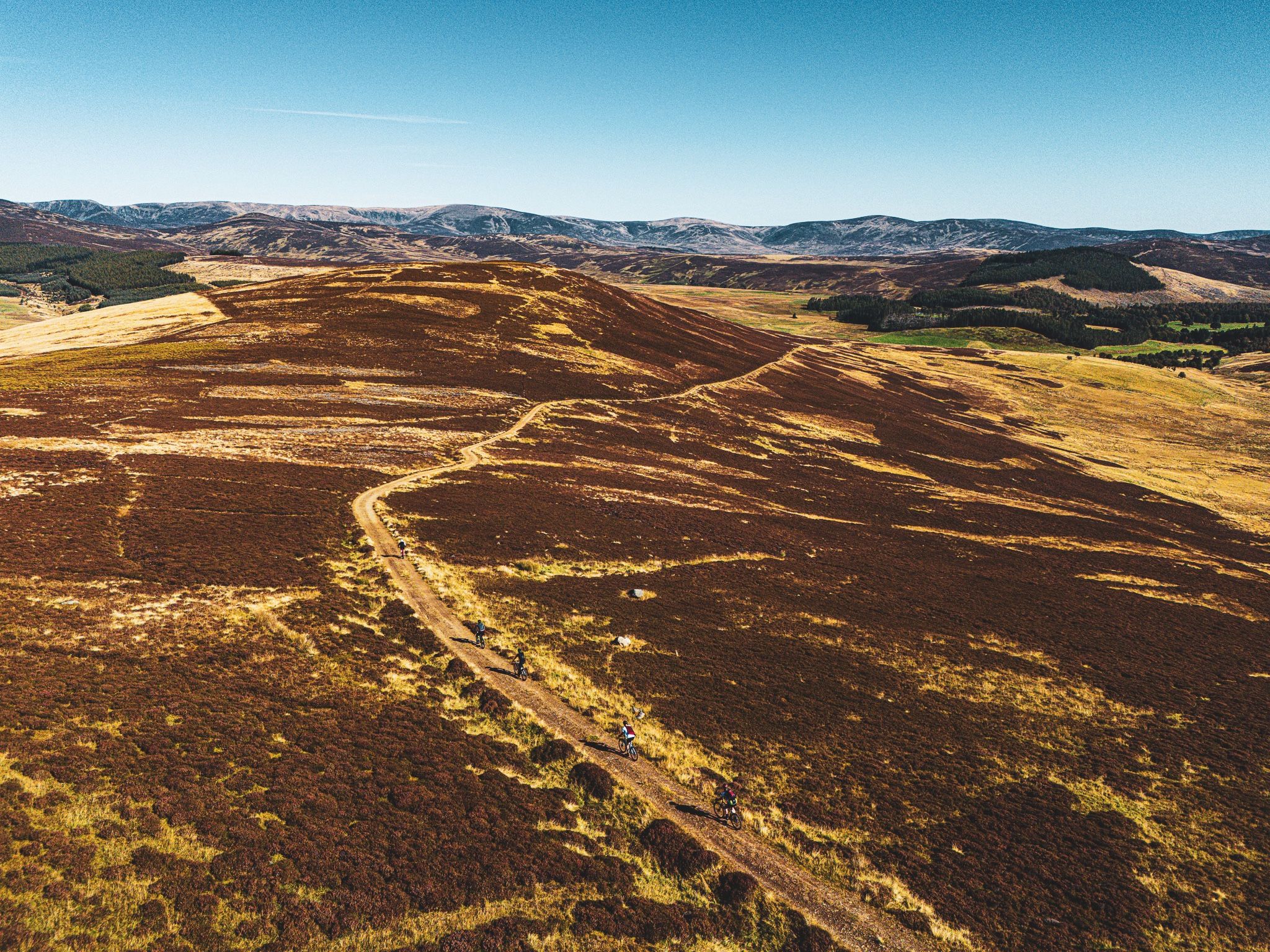
When people talk of the best gravel riding destinations, they often cast their minds to the wide, dusty tracks of North America. They think of sun-soaked vistas, trees speckled across the foreground and mountains towering in the distance. It’s an image of serenity and the joy that comes from being at one with the great outdoors. But having travelled widely in the US and Canada, let me tell you a secret: you don’t need to take a long-haul flight to enjoy such soul-soothing scenery.
North of my home in Scotland, in the expanse of the Cairngorms National Park, the smooth, flowing gravel roads are a close match for the coveted stateside ones. It’s an area laced with centuries-old tracks, sharp ascents, and routes that cross the mountains, a place that always lures me back.
When friends come to visit me, their trips sometimes coincide with my book research. In 2023, I was gathering material for Bikepacking Scotland; this time it’s Gravel Rides: Cairngorms & Perthshire. The benefits are mutual: I get riders to model for my photos, while my friends enjoy a free guided tour far off the beaten track, on some of the finest gravel roads in the country, if not the world.
Known as Britain’s ‘last great wilderness’, the Cairngorms are the UK’s largest national park, and home to some of its highest mountains. I love the history and the people, and though these days I live in Edinburgh, I’m drawn back to the changing landscapes. Unlike the rugged ranges in the west of the country, the Cairngorms feature wide, high-altitude plateaus, perfect for gravel cycling.
(Image credit: Markus Stitz)
There are also deep glens, ancient Caledonian pine forests and fast-flowing rivers. It’s a cycling paradise, split into six regions: Strathspey and Aviemore form the busy gateway, while Royal Deeside blends mountain scenery with royal heritage; Strathdon and Upper Donside showcase castles and Highland games; Tomintoul and Glenlivet bring whisky, moors and hidden glens; Atholl and the southern Cairngorms mix farmland, forests and high peaks. The latter area is where I take my friends.
We base ourselves for a week in the down-to-earth town of Alyth, home to around 3,000 people. Our lodgings are a house I bought two years ago and have since converted into bike-friendly accommodation for six. It has a big kitchen, lounge, a library of route-planning books, three bedrooms, and all the Scottish essentials: a drying rack, washing machine, tumble dryer and two mud-proof bathrooms.

(Image credit: Markus Stitz)
Luckily, today we don’t need to don our best waterproof cycling jackets. Our ride begins on a warm September morning on the Highland Boundary Fault. We start with coffee at Alyth Cyclery, a former church turned bike shop and cafe, before lathering ourselves in sun cream and leaving town. Ahead lies a long day in the saddle: wall-to-wall sunshine and over 1,110m of climbing in around 73km on a mix of quiet roads, gravel paths and short sections of singletrack.
Though my friends cycle almost daily, off-road riding in this remote region can be a challenge. We may not have any mountains to scale, but the route I’ve plotted is undulating, a constant up and down through the valleys.
A short but sharp kicker just after leaving the bike shop offers a taste of what’s ahead. Years ago, the village herdsman would slowly climb this road to Alyth Hill, tooting the horn to tell the animals to return to pasture. Like the herdsman’s livestock, we find ourselves panting towards the top, but there’s little time to catch our breath – the next climb is always around the corner.
“The landscape becomes more dramatic as we climb steadily into Glenisla and reach the Blackwater Reservoir.”
Markus Stitz
We stop in Reekie Linn at the foot of Glenisla, an impressive waterfall and ideal picnic spot. The small path that follows the Isla is too narrow and covered with roots to cycle, so we leave the bikes in the car park and enjoy the short walk to the lookout point. It’s a nice break from the pedal-turning. Bike rides, I’ve always believed, invite us to explore our landscapes at a slower pace. We mustn’t forget to stop and soak it all in.
The landscape becomes more dramatic as we climb steadily into Glenisla and reach the Blackwater Reservoir. Opened in 1969 and linked with nearby Lintrathen Reservoir, it supplies drinking water to around 300,000 people in Dundee and eastern Perthshire. We ride above it, staring down at the deep blue water, before leaving the tarmac road after a few hundred metres and turning onto a wide gravel track signposted to Glen Prosen. This is where the real adventure begins.
Our route is marked by a fingerpost of white letters on green, one of over 4,000 signs put up by ScotWays. Since the 2003 Land Reform Act, formal rights of way matter less here. The Scottish access legislation allows us to cycle almost anywhere, but these posts remain valuable, telling the history and heritage of each path.

(Image credit: Markus Stitz)
We climb steadily up the eastern flanks of Cuilt Hill beside a small stream, or as the Scots would call it, a burn. The wide and smooth track takes us through fields of tussock and heather.
The gradient of the path steepens after we ford the small river and reach the highest point of the route, 513m above sea level, on the Hill of Strone. Not all of us make it to the top without grounding a foot, but we all reunite with a smile when we spot the views across the Angus Glens.

(Image credit: Markus Stitz)
An affinity with exploration
The southern Cairngorms have a close connection with the explorer Captain Robert Scott, who spent time at Burnside Lodge to plan his ill-fated 1910 Terra Nova expedition to Antarctica with Dr Edward Wilson.
The two men reached the South Pole on 17 January 1912 but were beaten by Norwegian Roald Amundsen, and died together on the Great Ice Barrier the following March. To honour their legacy, a granite memorial sculpture was erected on the road close by.
At the time, Burnside Lodge was owned by the explorers’ friend Reginald Smith, the publisher of books by local author J.M. Barrie, who lived in Kirriemuir and is best known for Peter Pan. The small Angus town is known for two more famous men: Sir Hugh Munro, who mapped all of Scotland’s highest peaks over 3,000ft, and AC/DC’s Bon Scott.
The descent into Glen Prosen is fast and flowing. After two and a half very quick kilometres, we grind to a halt at a towering tree that provides enough shade for our lunch break. Kirriemuir is the only town with services along the route, 51km in, so packing enough food for the ride is essential. We feast on baguettes, hummus, cheese and olives before we hit the road again at Cormuir, which takes us further into Glen Prosen.
Before long, we pass the remains of Balnaboth Chapel. Built in 1693 and abandoned in the 1860s, it sits hidden behind ancient yews, and is easily missed. We continue to Prosen village – a few scattered houses along the glen with no one around. I recall a previous visit a few years back and wince at the memory of the unrideable sections.

(Image credit: Markus Stitz)
We leave the gravel and continue alongside the Prosen Water river on tarmac. I can tell that my friends, still relatively new to gravel riding, appreciate the respite. After around six kilometres, we climb up a steep forestry road, and then an even steeper singletrack to the top of Tulloch Hill.
The reward for this short, tricky section is the Airlie Monument, a splendid tower that dominates the skyline. What is even better is the descent that follows, through larch woodland.
We regroup at the Scott Wilson Memorial and follow another fabulous gravel track before we reach Kirriemuir. The town is our only opportunity to pause for coffee, but we decide to crack on to Alyth instead. After seven hours of riding, our minds are already fixed on dinner, and the chanterelles I had collected in the morning to stir into a risotto.

(Image credit: Markus Stitz)
The final pictures I take on the gravel track out of Kirriemuir remind me of the great American gravel routes – scenes of people riding through the expanse into the setting sun. Our legs are tired, stomachs rumbling, and our adventure reaches its finale when we roll through the Den of Airlie, a beautiful, wooded gorge, and back to our base in Alyth.
Out of all the routes I’ve explored in the Cairngorms, this is my favourite – but there’s no shortage of options to choose from. The region’s southern glens offer an abundance of cycling tracks suitable for gravel bikes.
Our base location of Alyth isn’t in the National Park itself, but it is very close to the quieter glens, and is at the heart of the Cateran Ecomuseum – a collection of outdoor cultural sites. You could easily spend a week or longer riding around here. To the north, the Monega Pass is Scotland’s highest rideable mountain pass, and right next to it is the Cairnwell Pass, the country’s highest road.
To the west lies Dunkeld, in the heart of Perthshire’s Big Tree Country, and to the east the landscape falls away towards the coast. From Alyth, every direction holds another adventure – which is why I keep returning, and why the Cairngorms remain Britain’s last great wilderness.
Explore More
