A few days ago, we tackled one key stat from the 2025 season for each National League team — and how that number might make or break the 2026 season for each team.
Let’s do the same for all 15 American League squads.

The number: 12.7
That was the combined WAR for Nick Kurtz (5.4), Tyler Soderstrom (4.3) and Jacob Wilson (3.0), each in their age-23 (Soderstrom and Wilson) or age-22 (Kurtz) season. The A’s became just the sixth team in the divisional era to have three 23-and-under position players post at least 3.0 WAR in the same season. Does this mean a bright future for the A’s? Let’s see what happened to the other five:
• 2013 Braves (Freddie Freeman, Jason Heyward, Andrelton Simmons): Missed the playoffs the next four seasons.
• 1978 Tigers (Jason Thompson, Lou Whitaker, Steve Kemp): Also had 20-year-old Alan Trammell (2.8 WAR), 22-year-old Lance Parrish (1.0 WAR), 21-year-old pitcher Dave Rozema (4.0 WAR) and 23-year-old pitcher Jack Morris (0.1 WAR), one of the greatest collections of young talent ever assembled (plus 1976 Rookie of the Year Mark Fidrych, who got injured). Didn’t break through until winning the 1984 World Series.
• 1977 Expos (Gary Carter, Andre Dawson, Ellis Valentine): Won 95 games in 1979 and made the playoffs in 1981, but that was the peak.
• 1975 Red Sox (Fred Lynn, Dwight Evans, Jim Rice): Reached the World Series in ’75 but didn’t win the division again until 1986 (Evans and Rice were still around).
• 1974 Astros (Cesar Cedeno, Greg Gross, Milt May): Gross and May ended up being just role players, and the Astros didn’t crack .500 until 1979.
The Atlanta Braves are the only 21st century example, and it didn’t work out with that group, although Freeman was still around for the 2021 World Series title. The one difference: Heyward and Simmons were defense-first players while this trio of A’s are all offense-first players, which perhaps bodes well for them as foundational players. It’s an enviable young core, but the A’s still have to build a playoff-caliber pitching staff around them.

The number: minus-43
Everyone keeps saying the Orioles need pitching, and that’s correct: They allowed 68 more runs than the MLB average. But the offense scored 43 runs fewer than the MLB average, so that was also part of the problem. Enter Pete Alonso and Taylor Ward, who combined for 74 home runs in 2025. What might they mean to the offense in 2026?
Let’s start with Alonso. Orioles first basemen were among the worst in the majors, creating about an estimated 68 runs. Alonso, having one of his best seasons, created about 116 runs while playing all 162 games for the New York Mets — an impressive 48-run improvement. Let’s slot Ward into left field. Orioles left fielders were also among the worst, creating about 69 runs. Ward, playing 157 games for the Los Angeles Angels this past season, created about 92 runs — a 23-run improvement. Do the math and it shows that if Alonso and Ward produce like they did in 2025, the Orioles could see 71 more runs. That would take them 24th in the majors in runs to 12th.
To turn into an elite offense, however, they’ll still need improvement from others on the roster who struggled last season.

The number: 13.2%
That’s Roman Anthony‘s walk rate as a 21-year-old rookie, as he hit an impressive .292/.396/.463 in 71 games in 2025 before going down with an oblique strain in early September — right as he was figuring things out in the power department, hitting six home runs in 26 games in August after hitting just two in 43 games prior to that. It’s that walk rate that stands out, though, as Anthony’s keen eye at the plate bodes well for his future.
Since 2000, only four players have had a better walk rate at age 21 or younger — Juan Soto, Mike Trout, Jason Heyward and Adam Dunn. Just behind Anthony on that list are Justin Upton, Bryce Harper, Cody Bellinger and Giancarlo Stanton. Four of those players have won MVP awards and the fifth — Soto — is one of the best hitters in the game. If that list isn’t enough to get Boston fans pumped up, Anthony’s hard-hit rate — balls hit at 95-plus mph — was 60.3%, which ranked as the highest percentage in the majors among players with at least 100 batted balls, just ahead of Kyle Schwarber, Shohei Ohtani and Aaron Judge. That’s pretty good company also.
Once Anthony learns to hit the ball in the air more often, which he appeared to be doing in August before his season-ending injury, watch out. He should be even better as a sophomore — and that means the Red Sox should be better.

The number: plus-140
The White Sox scored 140 more runs this past season than they did in 2024. OK, considering the 2024 squad scored the fewest runs per game of any team since 1972, that isn’t saying a whole lot. The White Sox still ranked just 27th in the majors in runs scored in 2025 Nonetheless, it was a huge increase. Can they improve again in 2026? Consecutive increases in runs scored isn’t easy to pull it off — only five teams did it from 2023 to 2024 and again from 2024 to 2025 (Yankees plus-142, plus-34; Brewers plus-49, plus-29; Giants plus-19, plus-12; Tigers plus-21, plus-76; A’s plus-58, plus-90).
Of course, considering where the White Sox started in 2024 makes it easier. And despite the lack of runs in 2025, the White Sox did some things better on offense: 17th in walk rate, 19th in strikeout rate, 17th in average exit velocity, 12th in chase rate. No, those aren’t great rankings, but they’re not bottom of the barrel either. At least there’s a potential foundation for offensive success with some of the young players such as Colson Montgomery, Kyle Teel, Edgar Quero and Miguel Vargas. Let’s see if that group can improve in 2026. And while power has been the big problem, the White Sox addressed that in free agency with the signing of Japanese slugger Munetaka Murakami. Now they’ll have to see how he adjusts to MLB.

The number: .629
This is probably the same stat we used a year ago: The combined OPS from Guardians outfielders, which ranked last in the majors. Well actually, the Guardians ranked 17th in the majors in outfield OPS in 2024 (.703), so maybe not … but they were last in 2023 (.653) when their outfielders somehow hit just 18 home runs. Their inability to fix center and right field is reflected in giving Nolan Jones, reacquired from the Colorado Rockies ahead of the 2025 season in March, the second-most starts in center and the most in right, even though he hit just .211/.296/.304 with five home runs in 355 at-bats.
The hope for 2026 will be Chase DeLauter, a first-round pick in 2022 who made his major league debut during the 2025 postseason after spending much of the season in the minors on the IL. Injuries have been a recurring problem for DeLauter as the most games he has played in as a professional were 57 in 2023. When healthy in 2025, he hit .278/.383/.476 in 34 games in Triple-A, so he projects as an upgrade … if he can stay on the field. The Guardians also went outside their usual draft strategy in the first round in 2025, taking Texas A&M slugger Jace LaViolette despite a .258 average. It’s an acknowledgment that the team needs to take some risks in finding some much-needed outfield power. They’ve proven they can make the playoffs with their pitching-and-defense philosophy. But to reach a World Series, they’ll need more pop in the outfield.

The number: 23.9%
That was the Tigers’ strikeout rate, ranking 27th in the majors. Only the Orioles, Rockies and Angels struck out a higher clip. This manifested itself when the Tigers blew numerous scoring opportunities in their 3-2, 15-inning loss to the Seattle Mariners in Game 5 of the ALDS because Detroit was unable to get the ball in play at key moments.
In his end-of-season news conference, president of baseball operations Scott Harris admitted, “We need to make more contact as an organization. We need to move the baseball more in the big leagues than we are. This has been a theme for the last two years.”
Riley Greene led the AL with 201 strikeouts and saw his strikeout rate increase 4% from 2024. Spencer Torkelson had his best season, but his strikeout rate was still 26.0%, higher than it was as a rookie. Parker Meadows, Javier Baez, Dillon Dingler, Kerry Carpenter and Wenceel Perez all struck out more than the MLB average. And those are the projected regulars. The offseason hinges on what the Tigers do with Tarik Skubal, but figuring out how to put more balls in play in 2026 might be the key to the Tigers getting back to the postseason.

The number: 88.4
The Astros ranked last in the majors in average exit velocity. In related news, the Astros averaged just 4.23 runs per game, their fewest since 2014, the last of their “tanking” seasons. In other related news, the Astros missed the playoffs for the first time since 2016. While much of the focus was on injuries to the rotation — only Framber Valdez and Hunter Brown made more than 14 starts — the offense just didn’t hit the ball hard enough often enough, and that’s the name of the game in this era of baseball.
Jose Altuve has been a productive offensive player throughout his career despite below-average exit velocities, so he drags down the Astros’ number. But other than the shortened 2020 season, he’s also coming off his worst season at the plate since 2013. And Yordan Alvarez, who obviously does hit the ball hard, played just 48 games. They’ll also have Carlos Correa for a full season, although his offense has been all over the place in recent seasons. Cam Smith showed promise early on as a rookie but then hit .154 in the second half. His average exit velocity was just 87.9 mph.
Yes, the Astros can hope for a healthier rotation, but they’ll need more than just a healthy Alvarez to boost the offense.

The number: 7.2%
The Royals were 29th in the majors in walk rate — only the Rockies walked less often. As a result, the Royals posted a .309 on-base percentage, ranking 22nd in the majors. Worth noting: None of the 12 lowest teams in on-base percentage made the playoffs. Yes, OBP is life. The biggest culprit: The outfield, which ranked last in the majors with a .285 OBP (and also next to last in home runs and near the bottom in batting average and stolen bases).
The Royals have made a couple of offseason additions to the outfield so far, trading for Isaac Collins and signing Lane Thomas. Collins had a .368 OBP for the Brewers, so that would be a nice boost — if he can replicate that performance (he was a 27-year-old rookie, which screams “fluke,” and he doesn’t have much power). Thomas missed most of 2025 with an injury but owns a .309 career OBP. He’s an improvement only because of whom he’s replacing. And neither new addition is really a center fielder, so we’ll likely still see a lot of Kyle Isbel. The key here isn’t Collins or Thomas but rather Jac Caglianone, who hit .157/.237/.295 after getting rushed to the majors as K.C.’s top prospect. He’ll be better — but will he be a star?

The number: 6.4
That’s the FanGraphs WAR from the pitching staff. Since 2000, only three times have the Angels had a lower WAR — and one of those was the shortened season of 2020. So that really leaves only 2000 and 2024. In fact, the last time the Angels ranked in the top 10 in fWAR came in 2008, when they had a stellar rotation featuring Ervin Santana, Joe Saunders, Jered Weaver and John Lackey, plus Francisco Rodriguez setting the still-standing MLB record with 62 saves.
What about 2026? Kyle Hendricks has retired and Tyler Anderson is a free agent and while they weren’t great, they did combine for 57 starts. They traded for Grayson Rodriguez, who missed the entire 2025 season. Drew Pomeranz and Jordan Romano have been signed for bullpen depth. They drafted Tyler Bremner with the second overall pick in the 2025 draft, a bit of a surprise, and hopefully he’ll fare better than some of their recent pitching first-rounders. Let’s hope they don’t do anything weird with him like what they did with Ryan Johnson, a second-round pick in 2024 who inexplicably started the season in the majors without any minor league experience (he eventually went back to A ball, where he pitched well in 12 starts).
The pitching staff ranks 29th in strikeout rate over the past two seasons. Until that improves, the Angels will still be looking up at .500.

The number: minus-2.72
The Twins ranked 28th in the majors in bullpen win probability added — better only than the Arizona Diamondbacks and White Sox and an explanation of why the Twins went 4-11 in extra-inning games. Overall, the Twins ranked 27th in bullpen ERA, 23rd in strikeout rate and 28th in batting average allowed. Now for the bigger issue concerning 2026: Jhoan Duran (2.01 ERA), Louis Varland (2.02 ERA), Brock Stewart (2.38 ERA) and Griffin Jax (72 strikeouts in 46 innings) were all traded in the deadline dump, leaving Justin Topa, Cole Sands and Kody Funderburk as the top holdovers.
Successful bullpens can often materialize out of nowhere and in a winnable AL Central, that’s what will have to be the case with the Twins. Maybe some of the pitchers who don’t make the rotation — David Festa, Taj Bradley, Mick Abel, Marco Raya — end up as relievers. Sands has a five-pitch mix, including a plus splitter and curveball, that could make him an effective closer, but the Twins lack guys who throw in the upper 90s. The Twins have a potentially good rotation and a sleeper lineup with some top prospects on the way. The bullpen might tell the story of where the 2026 team ultimately finishes though.

The number: 274
The Yankees led the majors in home runs — hitting 30 more than the Los Angeles Dodgers — with the sixth-highest total in MLB history, behind only the 2023 Braves and four teams from the juiced ball season of 2019. With all that power, the Yankees also led the majors in runs scored. Aaron Judge led the way with 53, but Trent Grisham (34), Jazz Chisholm Jr. (31), Cody Bellinger (29), Ben Rice (26), Giancarlo Stanton (24 in just 249 at-bats) and Austin Wells (21) provided plenty of support. Bellinger is a free agent — the Yankees would like him back — and Chisholm’s name has popped up in trade rumors, but the Yankees should once again have this core of sluggers back in place.
Can they hit 274 home runs again? The Yankees also led the majors with 237 in 2024 — and with 254 in 2022. As long as Judge is here, they’re going to bash a lot of home runs. Some dropoff should be expected — does anyone see Grisham hitting 34 again? — but power is a pretty reliable and predictable skill. In checking the top three teams in home runs in each season since 2021, the average decline was 27 home runs the following season, which includes the 2023 Braves hitting 94 fewer home runs, the 2021 Giants dropping 58 and the 2023 Rangers declining 57.
So the Yankees’ power looks pretty stable. The bigger question might be: Can they hit as many home runs while improving their strikeout rate? They had the sixth-highest strikeout rate in the majors. In their ALDS loss to the Blue Jays — the team with the lowest strikeout rate — the Yankees struck out 37 times and hit .250 while the Blue Jays struck out 24 times while hitting .338 (and they also outhomered the Yankees nine to four).

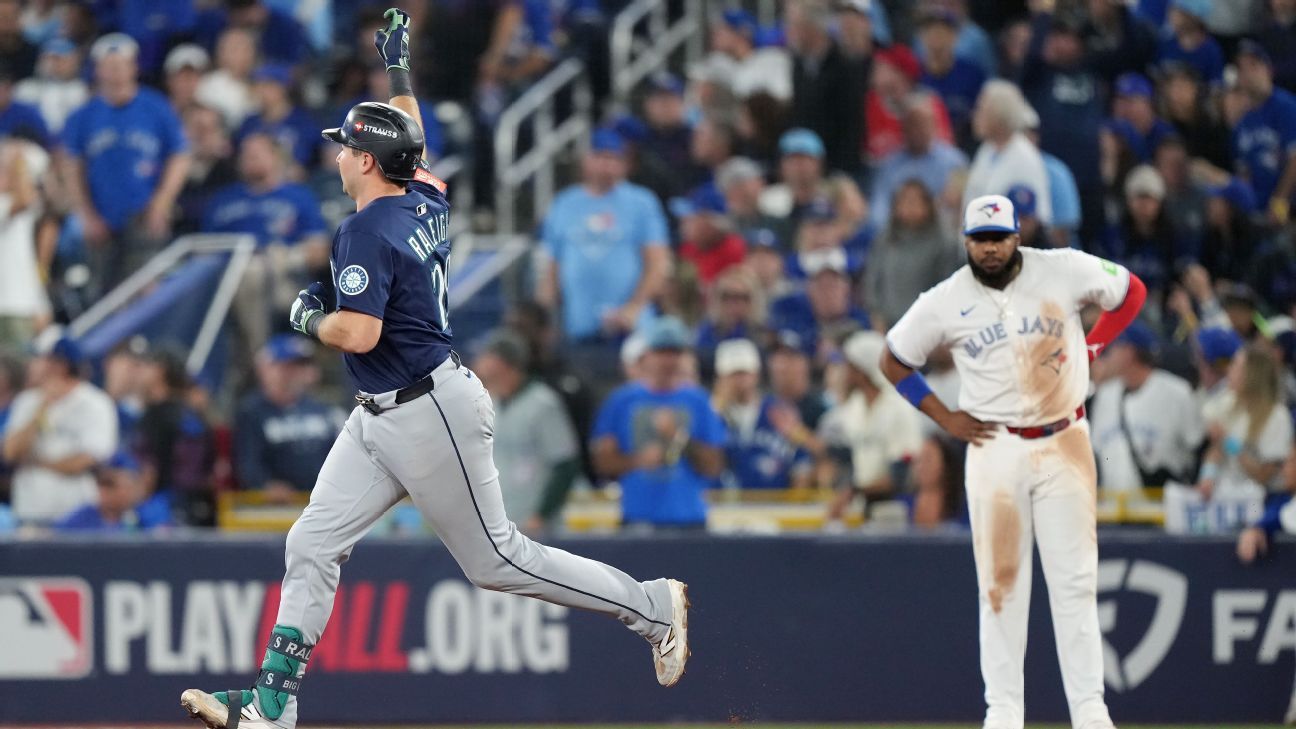
The number: 60
You know this one: Cal Raleigh‘s historic home run total in his near-MVP season. With Raleigh leading the way, the Mariners scored 90 more runs than they did in 2024. How many of those were Raleigh responsible for? Raleigh created about 53 more runs in 2025 than he did in 2024, although he batted 77 more times. We’ll say about 48 of those 90 runs are directly attributable to Raleigh, which means they did have improvement elsewhere: Julio Rodriguez was better, J.P. Crawford bounced back, Josh Naylor was terrific in his two months with the team and Jorge Polanco — now with the Mets — had a big year.
Does this mean the Mariners are due for a big regression in runs? Not necessarily. A full season of Naylor will help, and there are other positions they can get more production from. Still, they have to plan on Raleigh not being quite so dominant. On the other hand: The run prevention could get a lot better. The Mariners allowed 87 more runs than they did in 2024 as the rotation battled some injuries and subpar performance. What Mariners fans can dream on: The offense from 2025 and the pitching from 2024.

The number: 45
Junior Caminero‘s 45-homer season got lost in the barrage of home runs from other elite sluggers — but none of them were 21 years old. Caminero’s 45 home runs were the second most from a player 21 or younger, behind only Hall of Famer Eddie Mathews’ 47 for the Milwaukee Braves in 1953. Other recent big seasons from young hitters: Ronald Acuna Jr. hit 41 in 2019 and Cody Bellinger 39 in 2017 in their age-21 seasons while Juan Soto slugged 34 at age 20 in 2019. Considering this was his first full season in the majors, Caminero has room to improve — notably to improve his chase rate (22nd percentile) and hit the ball in the air more often (he led the majors with 31 doubles play grounded into).
The Rays’ offense has been all over the place in recent seasons: 857 runs in 2021, then 666, then 860 in 2023, then 604 and finally 714 in 2025. The lineup was top-heavy: Caminero, Yandy Diaz, Jonathan Aranda (until his injury) and Brandon Lowe did much of the damage. The outfield was weak, finishing last in the majors with just 29 home runs. But the key to going to the next level in 2026 might be Caminero. Nobody has a faster bat. Despite a long swing, he has an above-average contact rate. If he improves his swing decisions, everything will jump up: His batting average, his OBP, and, yes, his home runs.

The number: 83
A weird thing happened to Globe Life Field in 2025: Nobody could hit there. The Statcast park factor ranked Globe Life tied with Seattle’s T-Mobile as the worst-run scoring park in the majors with a park factor of 83 (meaning about 17% fewer runs were scored there). Its home run factor ranked higher only than St. Louis and Pittsburgh. Globe Life ranked below average in runs in 2024 (but above average in home runs) and as one of the BEST offensive parks in 2023, when it ranked third in runs and first in home runs.
As a result, the Rangers ranked 22nd in the majors in runs scored and first in fewest runs allowed, making it look like they had a bad offense and a great pitching staff. The truth is probably more in the middle (the Rangers were 17th in runs scored on the road and 16th in runs allowed). The way Globe Life played, it makes it tricky to evaluate how individual players performed — and to determine what the Rangers need to address the offseason. They probably need to upgrade both the offense and the pitching staff (and they have a bunch of starts in the rotation to replace anyway) to get back into playoff contention.

The number: 17.8%
The Blue Jays had the lowest strikeout rate in the majors, a key to scoring 127 more runs than they did in 2024, winning the club’s first AL East title since 2015 and, of course, embarking on a memorable postseason run that saw the Blue Jays hit .285 with 28 home runs in 18 playoff games and come so close to winning the World Series. The question, of course: Can the offense do this again? After all, the Blue Jays had the sixth-lowest strikeout rate in the majors in 2024 — and yet scored just six more runs than the Pirates.
Where did the improvement come from? According to the Blue Jays, they “swung harder.” Seriously. That was basically the explanation. The numbers back that up: Their average exit velocity went up from 88.1 mph to 89.3; their hard-hit rate from 37.0% to 41.3%; their BABIP went up from .283 to .298, so the team average increased from .241 to .265. They did all that while striking out less often, which is the hard part. The biggest improvement came from George Springer, who remarkably in his age-35 season went from a .674 OPS in 2024 to .959 in 2025. Daulton Varsho missed time with an injury, but his OPS climbed 133 points. Bo Bichette rebounded after a bad season in 2024. He’s now a free agent. With Bichette perhaps leaving and some likely regression candidates, let’s see if the Jays have the same powerful offense in 2026.
