Who doesn’t love a good preview before the main event? A bit of a primer goes a long way when you’re trying to identify what’s going on during an NBA game. What actions are being run and why? Who is being targeted defensively? Why is this player being guarded by another? In this article (and all previews to follow), I’ll do my best to prepare you for Celtics matchups through film, starting with Tuesday’s game against the Jazz.
Jaylen Brown’s excellence on the perimeter is largely driven by his own skill. He’s an exceptional isolation player who can get to his spots at will. Yet Brown wouldn’t be this great without his teammates and a great game plan. Utilizing a series of guard-guard and guard-wing screening actions, Boston’s offense cycles through different perimeter options by forcing switches until Jaylen, Derrick White, and Payton Pritchard get the matchups they want.
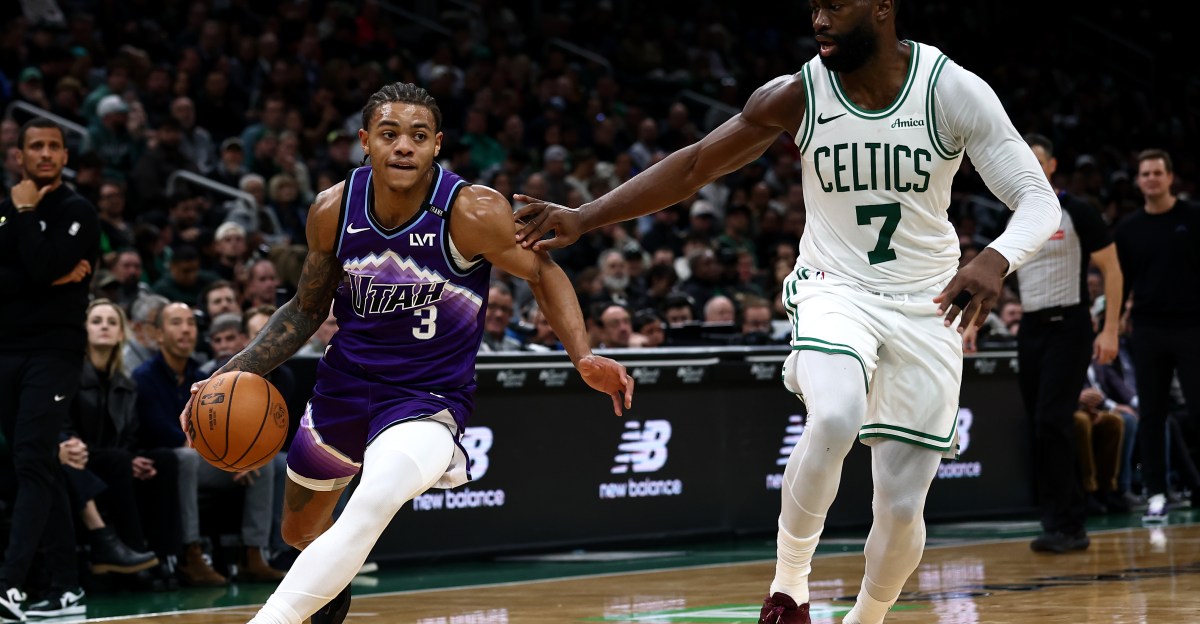
Against the Utah Jazz, the matchup they want is Keyonte George. He’s not physically imposing, often has bad technique, and is late to recognize actions. Boston hit him with a flurry of looks: pindowns, dribble handoffs, simple pick-and-rolls, and stack/Spain PNR looks. They almost always generated a good shot.
Jaylen, Derrick, and Payton will spend a lot of time finding George and putting him into the action. That’s easy stuff for these Celtics. The hard part is keeping him contained on the other side of the floor; in that November 3rd matchup, Key lit them up for 31 points on 9/16 shooting. A lot of that was due to his tough shotmaking ability.
You can switch and contain while fighting through to keep good matchups, but sometimes, a guy just hits his shots. However, there was plenty the Celtics could have done to keep him down. George attempted 13 free throws in that game, and a lot of those freebies were preventable. If Keyonte beats you with tough shots off the dribble, so be it; but you cannot let him get the easy stuff. Boston’s rotations have to be crisp and disciplined when he’s going downhill.
It’s nothing new to see the Celtics struggle with big, skilled players. But the Utah Jazz present a serious issue by having so much functional size. Lauri Markkanen is the star of the show as a matchup-breaking seven-footer with movement shooting skills, but the size advantage doesn’t end there. Jusuf Nurkic and Kevin Love have been dependable vets in the frontcourt, and Kyle Filipowski continues to be a matchup nightmare. There are several ways Jazz head coach Will Hardy uses the size and skill at his disposal against Boston.
The first and most obvious problem is the rebounding. This Jazz quartet of bigs combined for 35 of the team’s 55 rebounds, while the Celtics gathered only 36 boards as a team. Included in those 55 rebounds was the game-winning putback layup by Jusuf Nurkic, a tough early-season blow that sent the Celtics to a 3-5 record at the time. It’s a heavy burden on Neemias Queta to control the glass, and it likely means a few extra minutes for Luka Garza. They can’t leave the glass unguarded for 15+ minutes per game, despite Garza’s many other flaws.
Another problem that has plagued the Celtics this year is floor spacing bigs. Guys who can knock down the open shots are one thing, but it’s the ones knocking down contested shots that really frustrate you. Lauri is one of the elite shooters in the league, while Flip and Love are more than capable of knocking down their looks with a quick trigger release.
The frustrating part is that, aside from Love, running them off the line does little good. Markkanen and Filipowski are capable closeout attackers. For Boston to contain these shooting bigs, they have to be disciplined in their rotations after running them off the line. If that pulls Neemias Queta out to the perimeter, everyone else needs to lock in on the boards.
A possible solution here is Josh Minott. He’s got great size and has the leaping ability to contest taller players. If he can fly around with discipline on defense, he can steal away some rebounds and make impact rotations on driving/rolling bigs. But it’s a tough balance; the ultimate chess move for Hardy is the mismatch post-up, which they went to a few times this past matchup with mixed results. When the smaller wings and guards get switched on Markkanen and Nurkic, watch out for those post-ups.
Utah’s bigs also give them the ability to switch between multiple handoff options. All four of those bigs are capable handoff men to the guards, while Markkanen and Filipowski are dangerous off the catch. The switching and containing has to be on point, because you never know who is going into a two-man action.
The question of Utah’s frontcourt will dictate this entire game. Mazzulla’s rotations may change, tactics may look off, and the rebounding number looms large. No pressure, Neemias Queta.
One last bit. As I mentioned above, the Celtics love to run guard-guard screens. No tandem is more potent than the Jaylen Brown-Derrick White screen action. The threat of both players popping into a catch-and-shoot three or a drive means the switching communication has to be on point. Often with these Utah Jazz, it’s not. That’s why this was the go-to play for the Celtics when they needed a bucket in the clutch; unfortunately, a swallowed whistle cost them dearly.
I’m counting on plenty of Jaylen-Derrick screens in this one, especially when a mismatched defender like Keyonte George or Brice Sensabaugh can be pulled into the action. When those two start screening for one another, keep an eye on the
