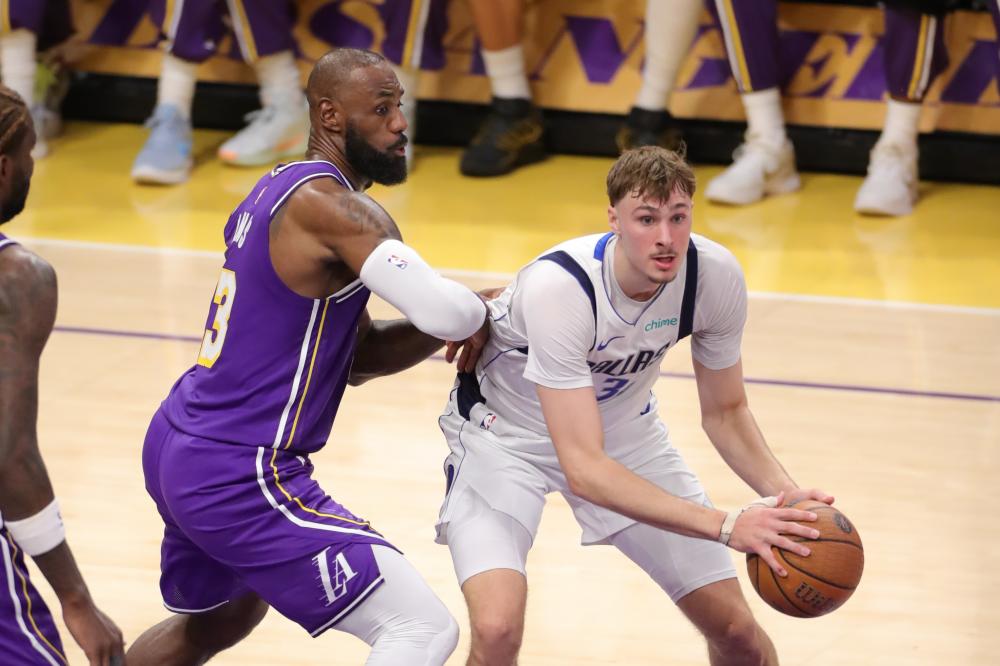
That the NBA is reckoned in seasons is apt. To measure a legacy this way is as much existential as it is symbolic. Martin Heidegger argued that time is not something we pass through, but the condition of our being – less a pathway than a pressure. Heavy stuff, yes, but the NBA has always operated under similar weight.
The millennial superstars who stabilized the league for two decades are now entering their twilight: LeBron James (who turned 41 on Tuesday), Stephen Curry, Kevin Durant, Russell Westbrook, James Harden and Chris Paul. In their wake comes something genuinely new. For the first time, the league’s next dominant generation is unmistakably international. The NBA’s gen Z elite now emerge from Slovenia, Serbia, Greece, Canada and France.
Advertisement
Related: The ascendant San Antonio Spurs are the gift the NBA needed
America’s domestic pipeline still produces talent, but the excesses of AAU culture, one-and-done college basketball and eroding fundamentals have dulled its once overwhelming edge. In a garden crowded by its own overgrowth, the question is which strain ultimately thrives.
Each of the millennial stars now plays under the pressure of finitude. Heidegger described this as living toward an ending – an awareness that sharpens responsibility rather than diminishing it. That sense defines the league’s aging icons. For them, responsibility means one more run. Collectively, this group has won 10 championships and appeared in 23 Finals, but the odds of one last triumph are slim. Curry is straining to extend a dynasty time is quietly dismantling. LeBron is both the Lakers’ largest contract and no longer their centerpiece. Westbrook chases relevance on a lottery-bound roster. Harden remains productive but unsettled. Only Durant, newly aligned with a rising Houston team, appears plausibly positioned for one more push.
The question of succession is unavoidable. Elder statesmen Nikola Jokić (30) and Giannis Antetokounmpo (31) understand the clock well enough to know urgency has arrived. Shai Gilgeous-Alexander (27) looks capable of anchoring something durable in Oklahoma City, with Luka Dončić (26) and Victor Wembanyama (21) pressing close behind. The American presence has not vanished, but it has dimmed since the 1990s. Jalen Brunson, Anthony Edwards, Cade Cunningham and Jayson Tatum keep the idea of domestic succession alive, while 19-year-old Cooper Flagg now complicates the hierarchy entirely.
Advertisement
The NBA has never struggled to define its image. From its rise into national consciousness, the league’s authority flowed through Black American players who made the game modern and irresistible, even while navigating deep economic contradictions. But dominance erodes. The world has caught up.
Generation Z moves differently. Previous generations were asked to embody systems that rarely worked in their favor. These players arrive as brands unto themselves, unburdened by history. American moxie still matters, but it no longer travels alone.
For decades, only Hakeem Olajuwon briefly disrupted American supremacy, and even that required Michael Jordan’s retirement. Now the balance has shifted. The millennial generation reshaped the sport – stretching shooting, flattening positions, weaponizing collectives – but even golden eras end, and their fading has left a vacuum no single nation can easily fill.
There is an uncomfortable symmetry to the timing. As American authority softens on the global stage, so too does its basketball hegemony. Players from countries once peripheral to the sport now produce its gravitational centers.
Advertisement
Can an American reclaim the mantle? Until recently, the answer felt unconvincing. Then Cooper Flagg arrived. As his shooting stabilizes, his path becomes clearer – and it begins where greatness has always been defined: defense.
Across generations, the truly defining stars shared not just brilliance, but responsibility on both ends of the floor. Julius Erving, Michael Jordan, Kobe Bryant and LeBron James could dominate a game while guarding its most dangerous opponent. That same two-way versatility distinguishes Flagg. It is what gives his ceiling historical weight.
Thrown immediately into the burden of replacing Dončić-level expectations, Flagg initially wavered. But after Dallas moved on from general manager Nico Harrison, the collective exhale allowed him to find his footing. The Mavericks sit on the fringes of the play-in picture, but Flagg already checks the league’s most important box: trust.
What makes him viable as the NBA’s next face is the rare blend of responsibility, versatility and control at an age when most players are still learning how to stay on the floor. He plays the basketball the league prefers to elevate – two-way, connective, portable. His defensive impact resembles that of elite bigs, while his offensive reads mirror those of primary creators. He spots mismatches early, toggles between force and patience, and resists rushing possessions into waste.
Advertisement
The NBA crowns players it can trust. As the youngest player in the league, Flagg already plays like an old one.
If the NBA is shaped by contingency rather than ceremony, then the passing of the torch is not an event but an obligation. LeBron’s generation carried the league until their bodies gave way. The world has stepped forward to claim it. But as Heidegger reminds us, what matters is not the future we imagine, but how we handle it once it arrives.
The league is not waiting for Cooper Flagg to become something else. It is already responding to what he is.
