As the final Classic of the season, Il Lombardia has often flown a little south of the radar, despite its Monument status and stunning setting in the foothills of the Italian Alps. This year, that changed – all eyes were on the race as fans contemplated a fifth consecutive victory from Tadej Pogačar. He did not disappoint. As if by action-replay, he tore away on yet another long-distance breakaway and took the win, matching the record of Fausto Coppi, five-time winner of the race between 1946 and 1954.
Not everybody was delighted. Amid the cheering Pogi fans, there were dissenting voices – voices that had begun to gain a critical mass over the previous few weeks. “It’s the same thing again and again,” one fan wrote on CW’s Facebook page. Another said the dominance was lessening their interest in the sport. For some, yet another barely contested Pogačar victory was too much to bear. The great entertainer was starting to become boring.
Tadej Pogačar wins Il Lombardia 2025
(Image credit: Getty Images)
Of course, the 27-year-old is only doing what he is paid to do, or even what he was born to do, if you want to be romantic about it. There is no question that Pogačar tends to win in dramatic, fan-pleasing fashion. But the same story repeated time and again becomes tiresome, and it has started to feel like ‘Pogačar fatigue’ is setting in.
Questions have already been raised over how long the world champion can continue to tick off prestigious race wins with apparent ease. Many have speculated on when he might retire – even his mother said she would understand if he left the sport in the near future, having seen how tired he was after the Tour de France – when he admitted that he couldn’t wait “for it to be over”. He remains under contract with UAE Team Emirates-XRG until 2031.
Entertaining dominance
To assess the scale of Pogačar’s dominance, former pro and TNT cycling commentator Brian Smith suggests stepping back from his latest Il Lombardia victory and taking in the broader landscape. “There are 36 WorldTour events in the year, he’s won eight of them,” Smith tells Cycling Weekly. “I covered a lot of these races, and I can totally understand that nobody likes dominance. Nobody likes what Team Sky did to the Tour de France in the overall – people weren’t entertained. But [with Pogačar] I think they have been entertained.”
For Smith, Il Lombardia was the only race that was too predictable. “You could argue that all the other races have been pretty competitive,” he says, pointing out that the Slovenian races “with flair” and “in an entertaining way”. Pogačar remains a supremely popular rider, of course, and while his team is the strongest in the peloton, it doesn’t seem to snuff out competition in the way that, say, Team Sky or US Postal Service did in their heyday.

Team Sky apply the pressure in the Tour de France, 2012
(Image credit: Getty Images)
Those teams would routinely suffocate their rivals on key Tour de France stages before unleashing their leader to seal the GC. It was brutally effective but drained the drama from what should have been the race’s most thrilling moments, leaving neutral fans disillusioned. Under UAE-Pogačar, the dynamic is different: the dominance is no less real, but it’s far more individual than systematised. Even if you can safely bet that the eventual winner of any given race will be a Slovenian with the initials “TP”, it usually comes after an exciting turn of events – even if it is a carbon-copy audacious long-range attack. Not so long ago, such attacks would have had us rapt.
Still, for fans – and certainly for his rivals – there is an appetite for closer-run battles, says Andy McGrath, author of the new biography Tadej Pogačar: Unstoppable. It’s how the Slovenian reacts to defeat that reveals his true greatness, reckons McGrath. “You need lows to have highs,” he says. “It wouldn’t be very interesting if he just won everything for the last five or six years. Probably, my favourite defeat was the Tour of Flanders in 2022, when he somehow finished fourth, and he was swearing at everyone else. You saw he had that edge – that’s easy to forget… That moment said more than a thousand words could. He’s an inveterate winner, that’s how you win these races, you have to be wired slightly differently.”

‘The Cannibal’ Eddy Merckx having everyone for dinner on the final stage of the 1970 Tour de France
(Image credit: Getty Images / Central Press)
Cast your mind back to the late Sixties and early Seventies, the era of Eddy Merckx – now remembered as a “golden age”. At the time, though, the all-conquering Cannibal wasn’t universally adored; many complained that his dominance was “boring”. Only after his retirement did the perspective on his achievements shift and consensus form that he was the sport’s greatest legend.
As McGrath puts it: “[Pogacar] shouldn’t be taken for granted. Why is excellence boring? When Pogačar goes, probably in five years’ time, we won’t see someone like that for decades, probably ever. It’s tricky.” Yet McGrath also acknowledges the tension at the heart of Pogačar’s dominance. “On one hand, I would say enjoy this, and cherish this, and on the other hand, sport requires unpredictability and rivalry, and we’re not getting much of that when he is attacking from 50km to go in every race and winning quite comfortably.”
The rivals
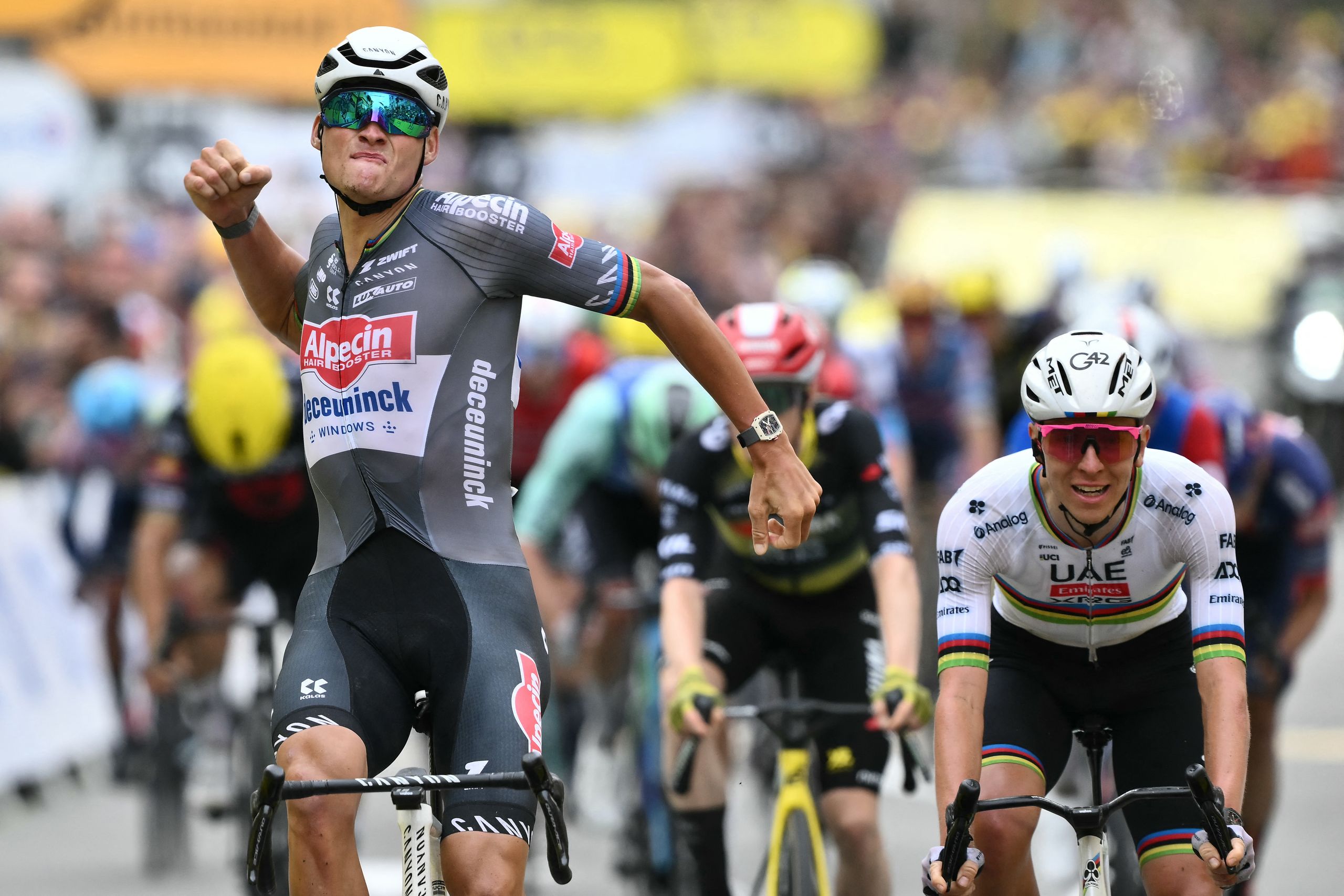
While Pogačar’s dominance looks set to continue for years to come, a few rivals are capable of challenging him – particularly in the one-day races he covets. At Milan-San Remo and Paris-Roubaix, Mathieu van der Poel has already asserted his authority. The Dutchman, winner of both those Monuments in 2025, appears to be the rider who can disrupt Pogačar’s ambitions. On the capi of Italy and the pavé of northern France, recent results have shown Pogačar meeting his match.
Smith notes that Van der Poel dominates cyclo-cross in a manner reminiscent of Pogačar on the road. “It’s a bit like watching Formula One,” he says. “You watch the start and after that there are gaps everywhere – there’s really no excitement.” Yet Van der Poel thrives in the unpredictability of long, one-day Classics, and has demonstrated he can match Pogačar. There’s a strong chance he will keep these races compelling next spring by preventing Pogačar from having it all his own way.
“The fire burning within Pogacar is the fact that he hasn’t won Milan-San Remo yet,” says Smith. “He hasn’t won the Vuelta yet. I say yet, because I believe that he can. [After that] what else has he got to prove? What else is he going to do?”
Joining the ‘Club Cinque’
What about Pogačar’s other targets? Another Tour de France win would see him join the celebrated ‘Club Cinque’ of five-time champions, while Liège-Bastogne-Liège and a third World Championships remain tantalising opportunities. Is there any hope for his rivals?
There is, but it may require ingenuity, says Smith, who believes opposing teams need to be more collaborative and inventive. He points to Lidl–Trek’s Quinn Simmons at Il Lombardia, whose attack from the gun left Pogačar’s UAE team, by their own admission, “a little afraid”.
“They’re not infallible, you know,” Smith adds. “Some of the teams are just riding to help them, and they shouldn’t. I know it’s a difficult thing to organise between the teams, because there has to be a lot of trust and friendship.”

Jonas Vingegaard has beaten Tadej Pogačar before – can he do it again?
(Image credit: Getty Images)
For Smith, teams often appear to be racing for podiums rather than victories when facing Pogačar, settling for the UCI points available for second and third. But there are riders who can beat him – Jonas Vingegaard, for instance, who’s proven it twice at the Tour de France. Smith also highlights Remco Evenepoel. “[Red Bull-Bora-Hansgrohe] have got a really strong team for next year, and the fact that Remco thinks that he can still beat [Pogačar] is a good thing,” he says.
“You have to believe that.” Whether Pogačar’s rivals can ultimately topple him or not, his status is indisputable. “He’s the complete athlete at the moment,” Smith adds, “and what we are seeing, in my eyes, is the best cyclist ever.”
