Should a drafted player be allowed to play NCAA basketball? It’s a lot less absurd than a QB playing six years originally appeared on The Sporting News. Add The Sporting News as a Preferred Source by clicking here.
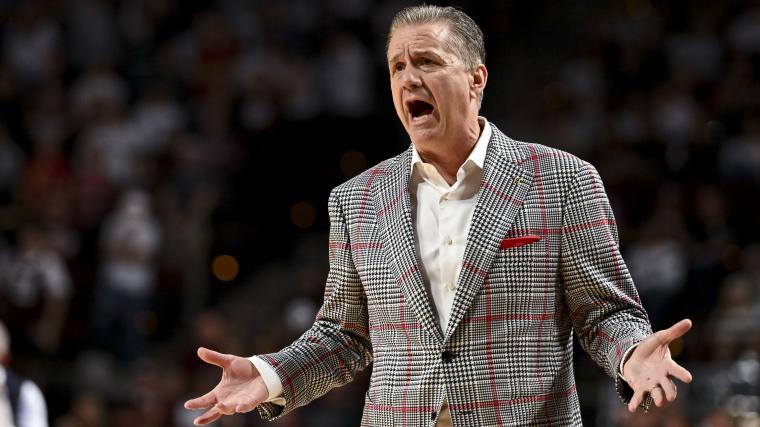
There was a microphone in front of Arkansas coach John Calipari as he spoke Monday night, and technically it was necessary so his words could be spread throughout the internet, but that doesn’t mean he needed it to be heard. He was yelling as if one of his Razorbacks had left open a lethal corner shooter.
Advertisement
“Let me give you this. Real simple. THE RULES BE’S THE RULES. So if you put your name in the draft – I don’t care if you’re from Russia – and you stay in the draft, you can’t play college basketball,” Calipari said. “If your name is in that draft and you got drafted, you can’t play, cause that’s our rule.”
It’s hard to figure why this is the line that has inflamed so many in college sports, following the post-Christmas announcement Baylor was adding 7-0 center James Nnaji. He was chosen in the 2023 NBA Draft second round but returned to Europe without a contract and without ever appearing in the league.
It’s especially odd for to be the line college coaches are drawing, including NCAA championship winners Dan Hurley of Connecticut and Tom Izzo of Michigan State, when we’re nearing the end of a college football season in which the Heisman Trophy runner-up was appearing in his sixth full year of competition.
Advertisement
MORE: Duke lands third five-star recruit for 2026
Diego Pavia played in 21 games in two seasons at New Mexico Military Institute, then played 27 games over two seasons at New Mexico State and then played 13 games in one season at Vanderbilt. That’s already 11 more games than Andy Dalton, who started four years at TCU and made three bowl appearances.
Then Pavia sued to gain another year of eligibility to compete at Vanderbilt in 2025, beyond the bonus season granted to him and everyone else who played during the pandemic-impacted 2020 schedule. He claimed junior college competition shouldn’t count against his NCAA eligibility (though he most likely didn’t reject the transfer of his academic credits from NMMI).
The courts issued a preliminary injunction on the case, and the NCAA granted a one-year waiver for all former JUCO athletes for the 2025-26 school year whose eligibility would have expired. No final court ruling in the case has been issued, though a federal judge said last December that Pavia has a likelihood of winning the case due to the rule being a restraint of trade.
Advertisement
Pavia’s breadth of experience had an obvious impact on his ability to perform, and Vanderbilt achieved its first-ever 10-win record in his sixth year of competition.
MORE: Diego Pavia wins SN’s Player of the Year award
So why would anyone expect the NCAA to return to court in an attempt to keep Nnaji out of college hoops, only to lose again?
James Nnaji isn’t a better player simply because he was chosen in the 2023 NBA Draft. In fact, it says a lot that he was selected and didn’t sign a contract. In the 2023-24 season with Barcelona of Spain’s ACB, he averaged 8 minutes and 2.3 points in 23 games. Last season, it was 5.3 points and 16 minutes with Girona of the ACB, before moving to the Turkiye Super League and averaging 7.5 points in eight games with Merkezefendi.
James Nnagi
His background in the European club system to NCAA basketball is similar or identical to those of myriad rostered players in the Big Ten, ACC and Big 12.
Advertisement
It’s not like being banned from NCAA basketball for staying in the draft is some forever concept, sketched as an addendum onto James Naismith’s original 13 rules of the sport. Players returning after being drafted happened before, and at least one other player went through the draft and returned after being unselected.
The NCAA adopted a rule in 1994 that allowed drafted players to return to their school if they announced their decision within 30 days of the NBA Draft. Voshon Lenard of Minnesota (the 46th pick that year) and Charles Claxton (50th) both chose to take advantage of this.
MORE: Marcus Freeman chooses to stay at ND, and that’s a win for college football
Claxton averaged 12.1 points and 7.9 rebounds the following season for an 18-10 Dawgs team that missed the NCAA Tournament and appeared in the NIT. Lenard contributed 17.3 points and for the Gophers as they went 19-12 and lost in the first round of the NCAAs. As the NBA assured that draft rights to players were not relinquished until a year after their college eligibility expired, however, not even returning to the college game and becoming a superstar could appreciably improve their entry to the league. The NCAA rule eventually was rescinded, but only after a piece of scholarship from the Marquette Sports Law Review argued the rule wasn’t generous enough to college players.
Advertisement
In 2005, Kentucky center Randolph Morris declared for the draft, went unselected, but returned to play for the Wildcats after the school argued the player had sent a fax to coach Tubby Smith regarding his intent to withdraw from the NBA Draft.
The sport somehow has endured another 20 years.
The idea of Nnaji joining Baylor at the semester break is another issue for many coaches.
“This is an easy road. We can do this NCAA!” Calipari exclaimed Monday. “Don’t tell me about lawsuits. If you join a program at midseason, you cannot play that season.”
This concept of the midseason addition is decades old, however. For years, college basketball athletes would transfer at the semester break, spend the spring and fall terms at their new school to establish eligibility and then join teams at this same point in the season. This was a practice embraced and encouraged by many college coaches, even though it meant the athlete in question – if he or she competed in the fall term at the first school before deciding to leave, which was most common – essentially lost a year of eligibility. Those players wound up playing 90 or 95 career games, whereas the standard was 120-130.
Advertisement
For all the time the year-in-residence rule was in place, I never heard a college coach call for this practice to be eliminated, despite the obvious cost to the athletes.
Asked about all this after his team’s most recent game, Purdue’s Matt Painter made a typically cogent plea: “Give us the rules, and we’ll abide by them.” Totally logical. When a football quarterback can play six full college seasons, though, what place does logic have in any of this?
